
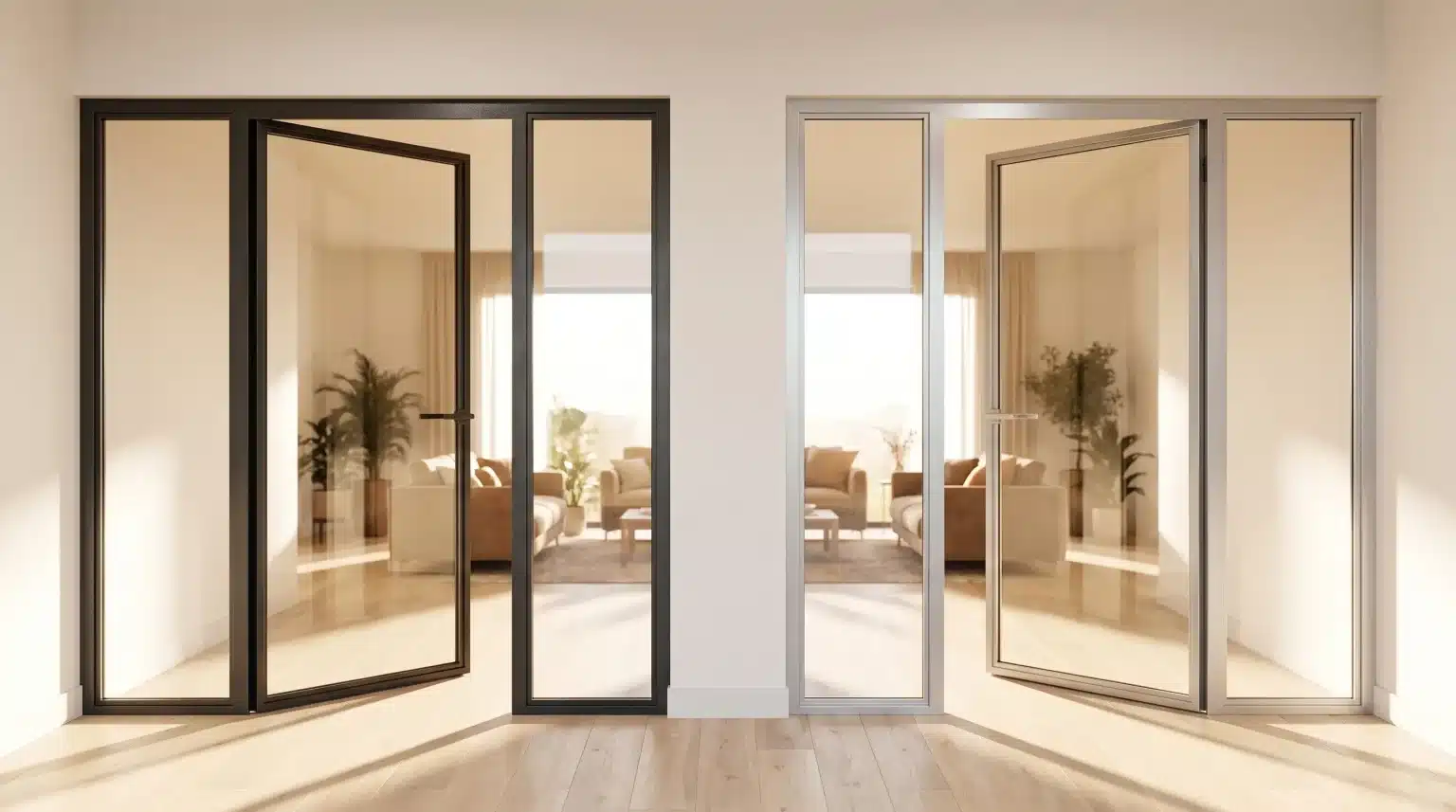
Steel holds up better under mechanical stress — impact, hinge loads, and the slow sag that afflicts tall doors — while aluminum holds up better against moisture and needs less finish attention over time. That is the honest split, and it is why slim-profile steel and glass interior doors dominate high-traffic openings between rooms, while aluminum shows up where humidity, weight, or future reconfiguration matters more than raw rigidity.
Both are durable. They simply fail in different ways, and the room decides which failure you would rather avoid.
Steel Is About Three Times Stiffer, So the Frame Can Be Thinner
The whole aesthetic argument for metal doors is the narrow sightline: as little frame as possible, as much glass as possible. Stiffness is what buys that. Steel’s elastic modulus runs around 29,000 ksi against aluminum’s 10,000 ksi, meaning an identical steel section deflects roughly a third as much under the same load.
There is a fair counterpoint. Aluminum weighs about a third of steel, and the two metals have nearly identical stiffness-to-density ratios — pound for pound, an aluminum structure can be just as rigid. But a door frame is limited by how slender it may look, not by how much it may weigh, so the stiffer metal reaches a thin profile with less material. To match a steel frame’s rigidity, an aluminum profile generally has to be deeper or wider.
What Actually Fails on an Interior Door
Interior doors rarely fail in the middle of a panel. They fail at three points: the hinge, the welded or mechanical corner joint, and whichever edge takes the abuse.
Steel wins the hinge argument. Fasteners bite into denser metal, welded corners resist racking, and a tall glazed leaf is less likely to drop out of square after years of swinging. Steel also shrugs off the knocks a hallway delivers — furniture, luggage, a vacuum cleaner — where softer aluminum dents and keeps the dent.
Aluminum wins the corrosion argument outright. It does not rust. In a bathroom, laundry, pool house, or humid coastal interior, that is not a minor advantage; a chipped coating on a steel frame in a wet room is the beginning of a problem, not a cosmetic issue.
Finish Life Is a Real Difference, Not a Detail
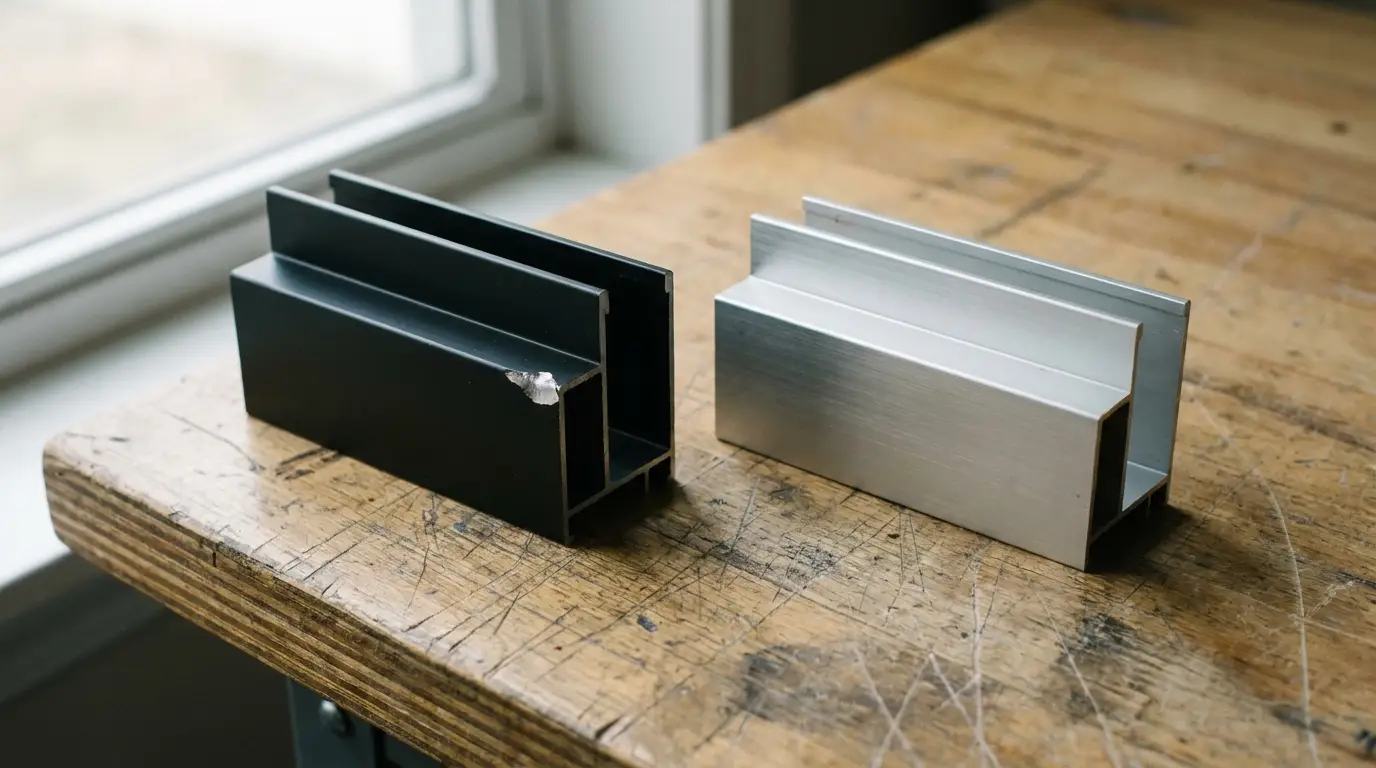
Steel frames are finished with a coating — matte black is the default, with custom RAL colors when the doors have to match joinery. Coatings are tough and easy to touch up, but they are a layer on top of the metal, and they can chip.
Anodizing on aluminum is different in kind: the finish is grown into the surface of the metal rather than applied to it, so it cannot chip off. It fades very slowly instead, and it is harder to repair locally. Over a ten-year horizon, steel asks for occasional touch-ups and aluminum asks for almost nothing.
Which Material Suits Which Opening
Choose steel for the doors people actually use hard: the home office, the kitchen-to-dining opening, a stair hall, a pantry that gets pushed rather than pulled, and any oversized or pivot leaf where structural rigidity carries the design. Choose aluminum for wet rooms, for lightweight sliding leaves where lower panel weight eases the track and the hardware, and for partition systems you expect to move or reconfigure later.
The Bottom Line
Steel holds up better where doors are hit, hung heavy, and opened thousands of times. Aluminum holds up better where water and humidity are constant, and it asks for less maintenance. Specify by room rather than by preference, and both materials will outlast the renovation that installed them.
Frequently Asked Questions
Do Steel Interior Door Frames Rust Inside a House?
Not under normal indoor conditions with an intact coating. Risk is confined to persistently damp rooms and to spots where the finish has been chipped through to bare metal. Touch up damage promptly, and specify aluminum where standing humidity is routine.
Can an Aluminum Frame Be as Slim as A Steel One?
Usually not at equal rigidity. Because steel is roughly three times stiffer, aluminum needs a deeper or wider section to behave the same way, which shows up in the sightline. Aluminum systems can look very refined — they simply reach a limit sooner.
Can Both Materials Be Used in The Same Home?
Yes, and it is a sensible strategy: steel on the primary, high-traffic openings, aluminum in the wet rooms. Keep the finish color and the grid layout consistent across both and the doors read as one family rather than two purchases.