


Uploading designs and letting a supplier handle fulfillment is the easy part of print-on-demand. The hard part starts once sales pick up: you need stronger margins, reliable suppliers, repeat traffic, and systems that don’t require you to personally touch every order. This guide covers what actually moves the needle when scaling a POD business, with real margin benchmarks, not just a formula and a shrug.
What Scaling Means in a Print-on-Demand Business
Scaling means growing sales, product reach, and repeat customers while your supplier still handles printing, packing, and shipping. It does not mean adding hundreds of products or increasing ad spend without checking whether it’s profitable. You still own everything that shapes the customer experience product selection, design quality, pricing, customer service, and branding. The supplier only owns production.
Why POD Can Grow Without Inventory
Print-on-demand can grow without inventory because products are made after a customer places an order. You do not need to pay for bulk stock or guess how many custom hoodies, shirts, mugs, or posters will sell. This reduces waste and protects cash flow. The risk is that you must still watch supplier quality, production time, shipping speed, and customer complaints. A POD store can scale well, but only when the seller treats fulfillment as a system, not as something to ignore after publishing products.
Print-on-Demand vs. Dropshipping, Briefly

Both remove the need to hold inventory, but the products are different: dropshipping typically resells existing supplier products, while POD sells your own designs on blank products. That difference matters for one reason original designs are defensible in a way that reselling the same generic gadget as a thousand other stores isn’t. POD takes more upfront creative work; dropshipping takes less but competes harder on price alone since nothing differentiates one seller’s listing from another’s.
Build Collections, Not a Random Catalog
A scalable store groups products around a specific buyer, not a flat list of items with no connection to each other “pet lover gifts,” “gym apparel,” “teacher mugs,” not one shirt, one mug, one poster with nothing tying them together. This helps buyers browse past their first click and helps search engines understand what your store is actually about.
Start with core products t-shirts, mugs, tote bags, posters, stickers. These are familiar enough that buyers don’t need to be educated on what they are, which makes them the fastest way to test whether a design or niche has legs.
Add premium products only after a core design is proven, such as Embroidered apparel including hoodies , framed prints, bundles. These typically carry better margins (see below) but also higher production cost, so order samples before promoting them at any volume.
What Margins Actually Look Like in POD
This is the number most scaling guides skip, and it’s the one that determines whether “scaling” means more revenue or just more work.
- Gross margin (selling price minus production cost alone) typically runs 60–65% across POD products but this number is close to fictional, since it ignores shipping, platform fees, and marketing.
- Net margin (after production, shipping, platform fees, transaction fees, and a realistic ad-spend allowance) is what actually matters, and it typically lands between 20% and 40%, depending on the product.
- By product type: commodity basics like plain t-shirts and mugs tend to sit at the lower end (10–25% net) because competition pushes prices down. Non-apparel items notebooks, tumblers, greeting cards, keychains often reach 40–70%+ net because production cost is low relative to perceived value, and buyers don’t comparison-shop them as aggressively as they do a basic tee.
A working example: a t-shirt sells for $25. Production and shipping run about $14 combined. Platform fees (Etsy or Shopify) run roughly $2–3. That’s ~$16–17 in costs, leaving $8–9 in net profit about 32–36% net margin before ad spend. A notebook selling for $18 with a $5 production cost and similar platform fees clears close to $11–12 net well over 60%. This is why diversifying beyond apparel-only catalogs tends to lift blended margin even without changing traffic.
The floor to work from: treat anything under 20% net margin as a product to fix or cut, not one to scale. Pushing ad spend into a 15%-margin product usually means you’re paying to lose money faster, not to grow.
Choosing a POD Supplier as You Scale
A supplier that works fine at ten orders a month can become a bottleneck at two hundred. Before scaling volume through any one supplier, confirm:
- Product range fits your actual catalog not the platform’s total SKU count, which is often irrelevant padding.
- Sample quality holds up fabric feel, print placement, and packaging, checked with a physical order, not just a mockup.
- Production location matches your customer base this is the single biggest lever on delivery speed and shipping cost.
- Reprint and refund policy is fast enough to protect your reviews once volume and complaints increase.
- The platform integrates with wherever you sell Shopify, Etsy, TikTok Shop, or elsewhere.
Where Printify Fits
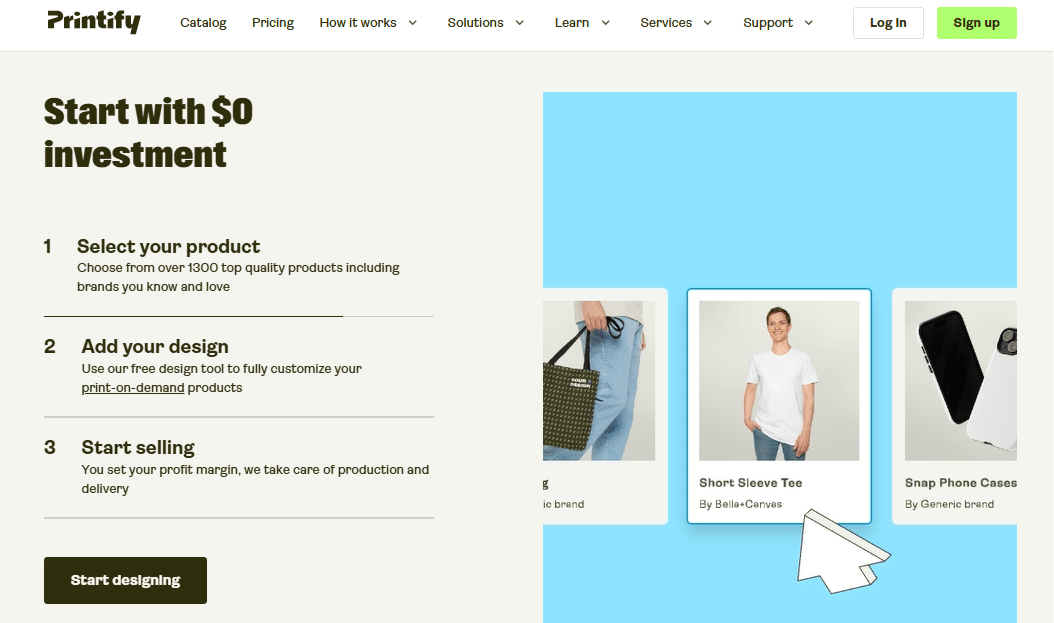
Printify can fit sellers who want product variety and print provider choice. It is often useful for stores testing many product types because sellers can compare providers, prices, and locations. This can help when a store wants flexibility across apparel, accessories, mugs, home decor, and other custom products.
Where Printful Fits
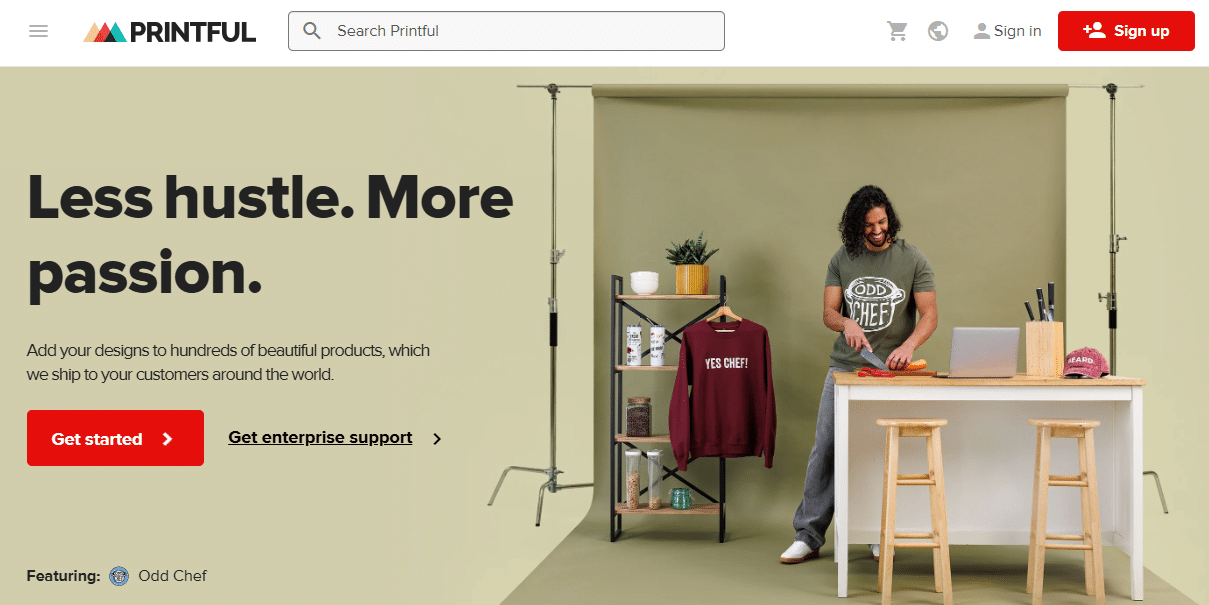
Printful can fit sellers who want automated fulfillment and a more brand-focused setup. It can support sellers who care about product presentation, custom product creation, and a smoother fulfillment flow. The best choice still depends on your margins, niche, product quality needs, and customer location.
Neither is objectively better; it depends on whether you’re optimizing for margin or for consistency (see the Shopify POD integration comparison for the specific cost breakdown between them).
Raising Average Order Value
Beyond individual product margin, average order value has a direct effect on how fast ad spend pays for itself. Bundles, matching sets, premium versions, and free-shipping thresholds all push AOV up without needing new traffic a $25 shirt paired with an $8 sticker pack and a $12 mug moves a single order from $25 to $45 with almost no added acquisition cost.
Where AI and Apps Actually Help
AI tools are useful for the repetitive layers of scaling grouping keywords, drafting product description first passes, generating ad angle ideas, and outlining content calendars. They are not a substitute for two things that determine whether a product sells: an original design and an accurate product page. Every AI-assisted description or design idea still needs a human check for originality and accuracy before it goes live a hallucinated fabric claim or a design that’s accidentally too close to existing IP costs far more than the time AI saved.
Beyond AI specifically, the tools worth paying for as volume grows are the boring ones: order-routing automation, email marketing, review collection, and analytics that show profit per product not just revenue per product. Skip automating anything that touches quality control or serious customer complaints; those need a human until volume genuinely forces the issue.
Building Traffic Without Depending on One Channel
Relying on a single traffic source is the most common single point of failure in POD stores that stall out. A workable split:
- Short-form video (TikTok, Reels) for fast product testing mockup reveals, niche humor, behind-the-scenes because it surfaces which designs get attention within days, not months.
- SEO through collection pages, product descriptions, and blog content for traffic that compounds over time, even though it takes months to show results.
- Email for repeat purchases welcome offers, abandoned cart recovery, and launch announcements which matters because repeat buyers are cheaper to sell to than every transaction being a fresh acquisition.
The Metrics That Actually Tell You Whether to Scale
Track these before increasing ad spend on any product:
- Net profit margin use the 20% floor / 30–40% growth-zone benchmarks above, not just “is it selling.”
- Customer acquisition cost (CAC) versus product margin if CAC is close to or above your per-unit profit, you’re buying revenue, not profit.
- Refund and complaint rate a product with a high refund rate is usually a quality problem, not a marketing problem, and more ad spend won’t fix it.
- Repeat purchase rate a store with returning buyers scales more efficiently than one restarting the acquisition cost on every single sale.
A product is ready to scale when it’s been sample-tested, sells at or above the 30% net-margin range, has a low complaint rate, and has proven itself through at least one traffic channel. Everything else needs fixing first, not more budget.
Common Scaling Mistakes
- Adding products faster than you can quality-check them. A large catalog with no clear niche confuses buyers and makes the store harder to manage expand from data on what’s already working, not from guessing.
- Ignoring quality control because a supplier handles production. Fulfillment being automated doesn’t mean it’s unsupervised order samples periodically even on established products, since suppliers change materials or providers without much notice.
- Depending on one traffic source. If your only channel is one platform or one ad account, a policy change or algorithm shift can end the business overnight.
- Chasing revenue while margin quietly erodes. A smaller store at 30% net margin outperforms a busier one running near 10%, even though the second one “feels” more successful.
Bottom Line
Scaling a POD business without inventory works, but only if you treat margin as the primary metric, not sales volume. Know your real net margin per product category (20% is the floor, 30–40% is healthy, 50%+ is achievable on the right non-apparel items), diversify beyond commodity apparel to lift your blended margin, build at least two traffic channels so no single platform can sink you, and kill or fix any product sitting below that 20% floor before you spend another dollar promoting it.
Systems and automation matter, but they only compound a business that already has real margin underneath it they don’t create margin that isn’t there. Services like Printify and Printful can support the fulfillment side, but long-term growth comes from product-market fit, customer trust, and steady improvement.