
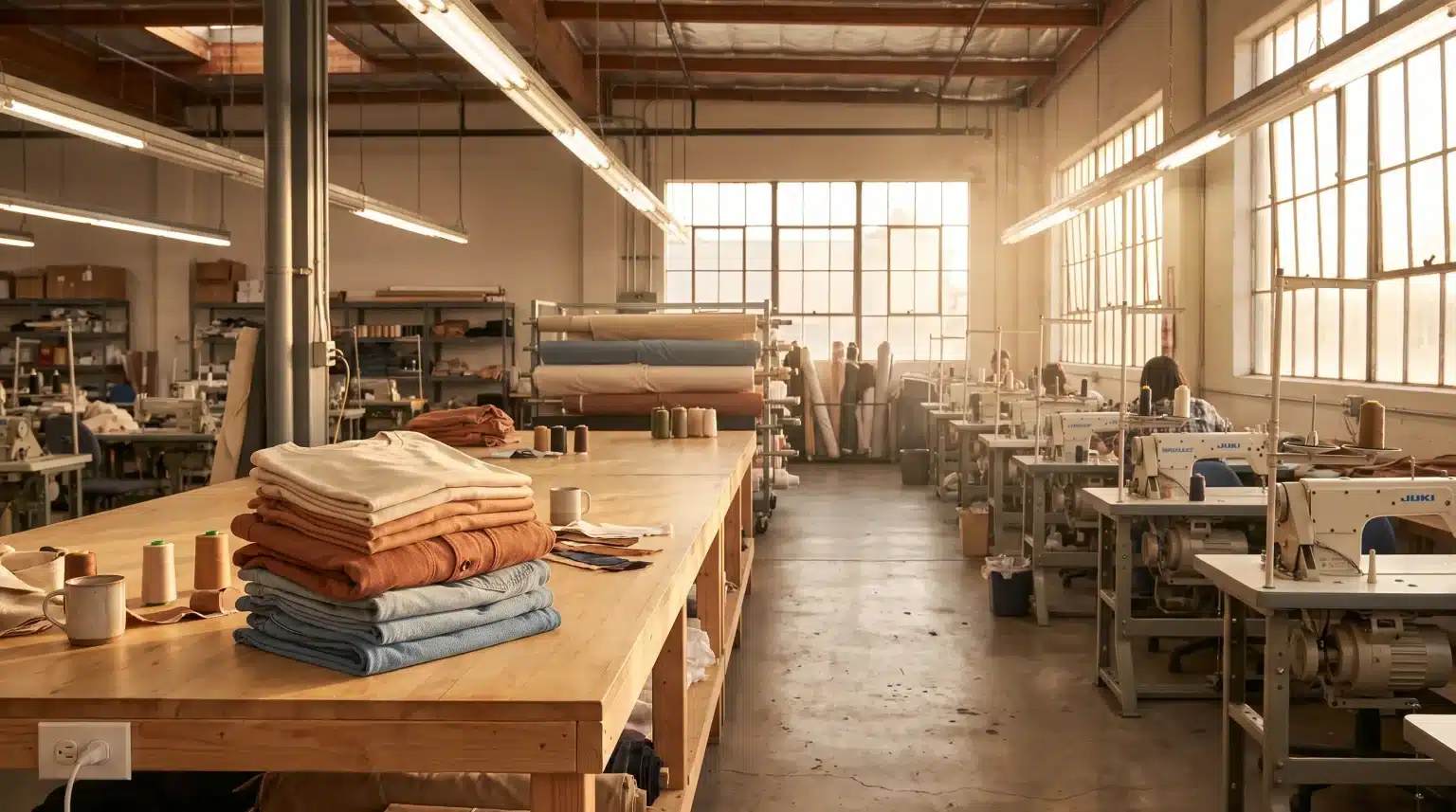
Most LA factories will not touch a run under 500 units. These five will, with minimums starting at 10 pieces per style. The list comes from a review of dozens of factories across the LA area, filtered to those combining small-batch capability with transparent, ethical production. Small-batch work is genuinely hard to place in this city, because California’s garment worker wage laws and rising domestic labor costs push most floors toward volume orders where the economics work better.
The Short Version
- The Evans Group — couture-level construction at a 10-piece minimum
- Essentials Made — 100% cotton garment-dyed pieces, samples in two weeks
- in LA Apparel — everything under one roof, including the fabric
- American Apparel — a finished-goods brand, not a factory partner
- Full Speed 100 — quotes back in 24 hours, rush options available
At a Glance
|
Factory |
Minimum |
Location |
Operating since |
Strongest at |
|
The Evans Group |
10 pieces per style |
Downtown Los Angeles |
2005 |
Complex construction |
|
Essentials Made |
Made to order, no blanks |
Los Angeles |
Not disclosed |
Garment-dyed cotton |
|
in LA Apparel |
Low MOQ, not stated |
Los Angeles and Orange County |
Not disclosed |
Full supply chain control |
|
American Apparel |
Not applicable |
Los Angeles, production in Honduras and Nicaragua |
1989 |
Ethical positioning |
|
Full Speed 100 |
Low MOQ, not stated |
Downtown Los Angeles |
Not disclosed |
Speed |
Data comes from review platforms and the official websites of the listed companies.
1. The Evans Group
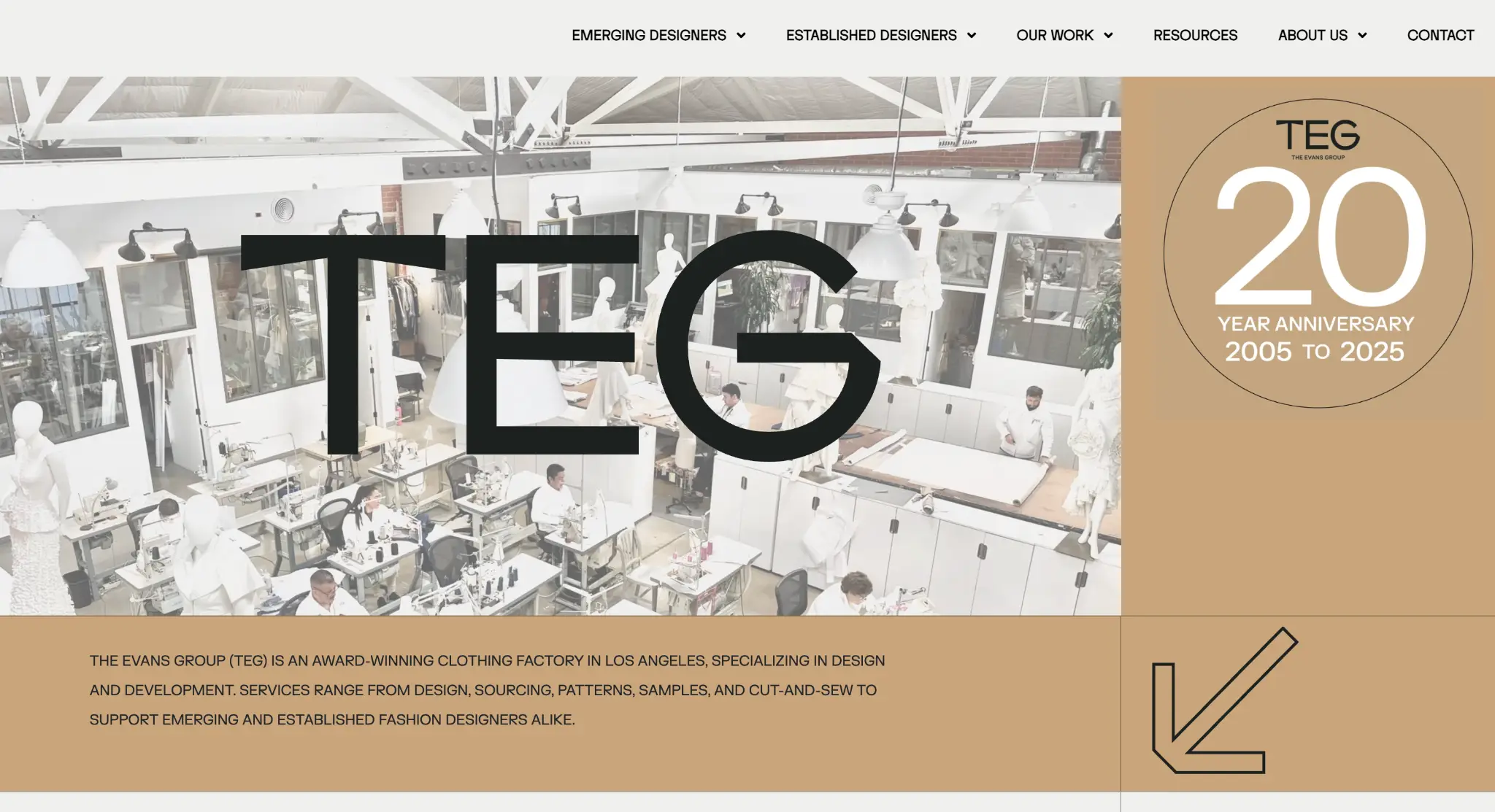
Best for: small-batch couture and complex construction.
- Minimum: 10 pieces per style domestically, with international options for higher volumes
- Model: vertically integrated design, development and manufacturing house
- Covers: sketches, pattern making, sample development, cut-and-sew production
- Specialty: delicate silks, complex knits, couture finishing, beadwork
- Quality control: dedicated sewing modules per brand, master patternmakers on staff year-round
- Proof: verified Google Business Profile with client-confirmed reviews, listed in the CFDA Production Directory
- Named clients: Nike, Rodarte, Marchesa, Banana Republic
Brands working on technically complex pieces usually hit a wall with standard factories, which do not keep the skilled staff for specialty construction on payroll year-round. The Evans Group is built the other way around. Master patternmakers stay on staff permanently, and each brand gets a dedicated sewing module, so the same team handles your garment run after run and consistency does not fall apart between them.
That structure is why the company can take on construction most production floors pass on: delicate silks, complex knits, couture finishing and beadwork. Clients point specifically to reliability on complex projects and the finish quality of what comes back. A 10-piece domestic minimum alongside that skill level is almost unheard of in this space.
Pick them if your piece has construction a standard floor would pass on, and your first run is under 50 units.
2. Essentials Made
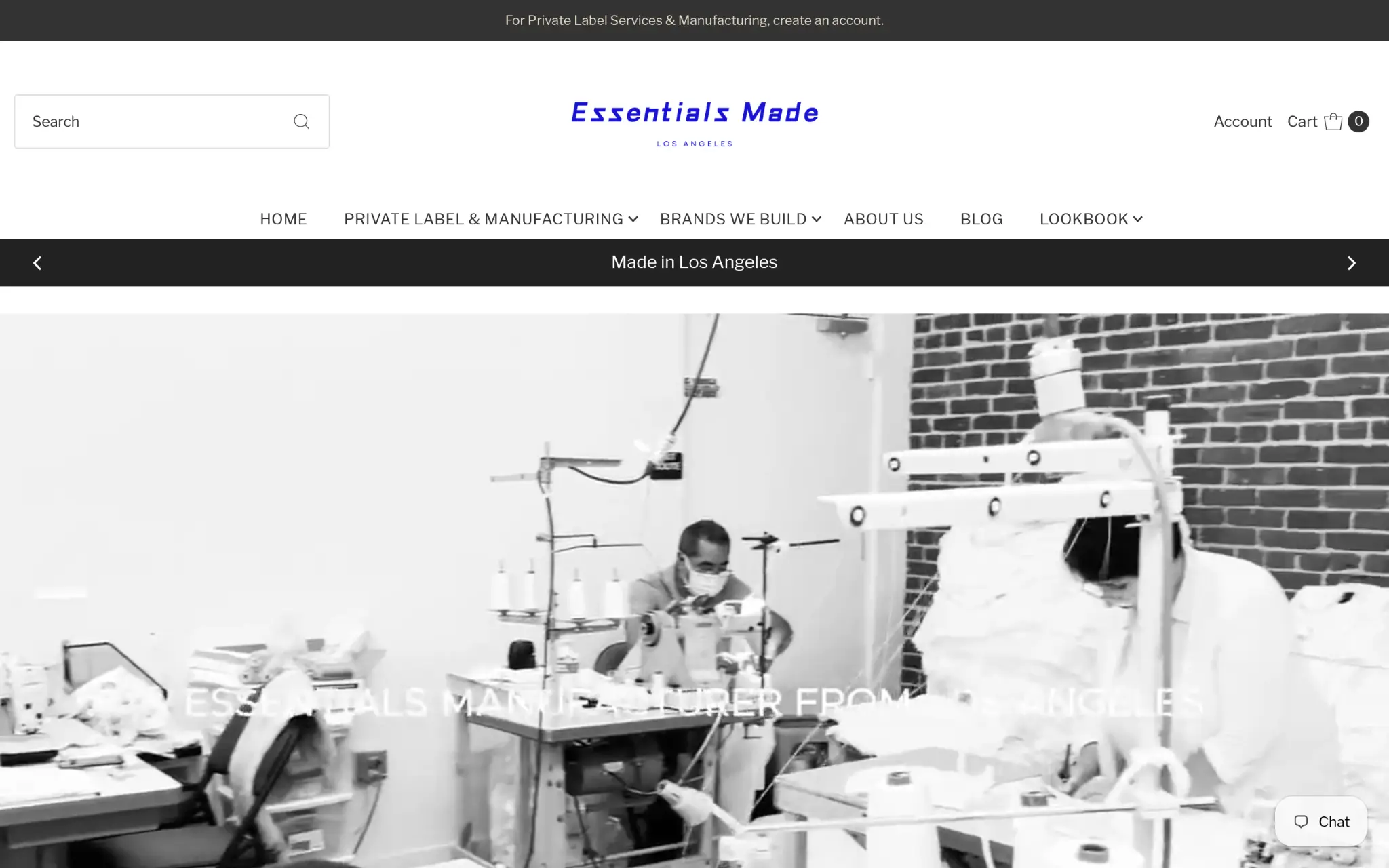
Best for: garment-dyed cotton essentials and DTC brands.
- Product focus: 100% cotton, garment-dyed custom apparel, made entirely in Los Angeles
- Covers: pattern making, sampling, cut and sew, private label, white label
- Dyeing: custom Pantone TCX, enzyme washes, silicone finishing
- Model: made to order, no blanks, no stock pieces
- Sample turnaround: about two weeks
- Production turnaround: four to five weeks
- Compliance: SB62-compliant partnerships, locally sourced textiles
- Named clients: Show Me Your Mumu, Ariko Surf
Essentials Made does one thing rather than everything, and the depth shows in the dyeing. Garment dyeing done properly, including enzyme washes and silicone finishing, is a process most domestic factories cannot handle well, and brands that need it often spend months searching. Working made to order with no blanks and no stock pieces keeps quality consistent, because every unit runs through the same process instead of being pulled from inventory dyed at a different time.
Custom Pantone TCX dyeing means color is specified rather than approximated. The two-week sample window and four to five week production run add up to a cycle a pre-sale or DTC drop can actually be planned around. SB62-compliant partnerships and locally sourced textiles give brands the documentation to back up ethical production claims rather than just assert them.
Pick them if you run pre-sales or DTC drops and need a six to seven week cycle you can plan a launch around.
3. In LA Apparel
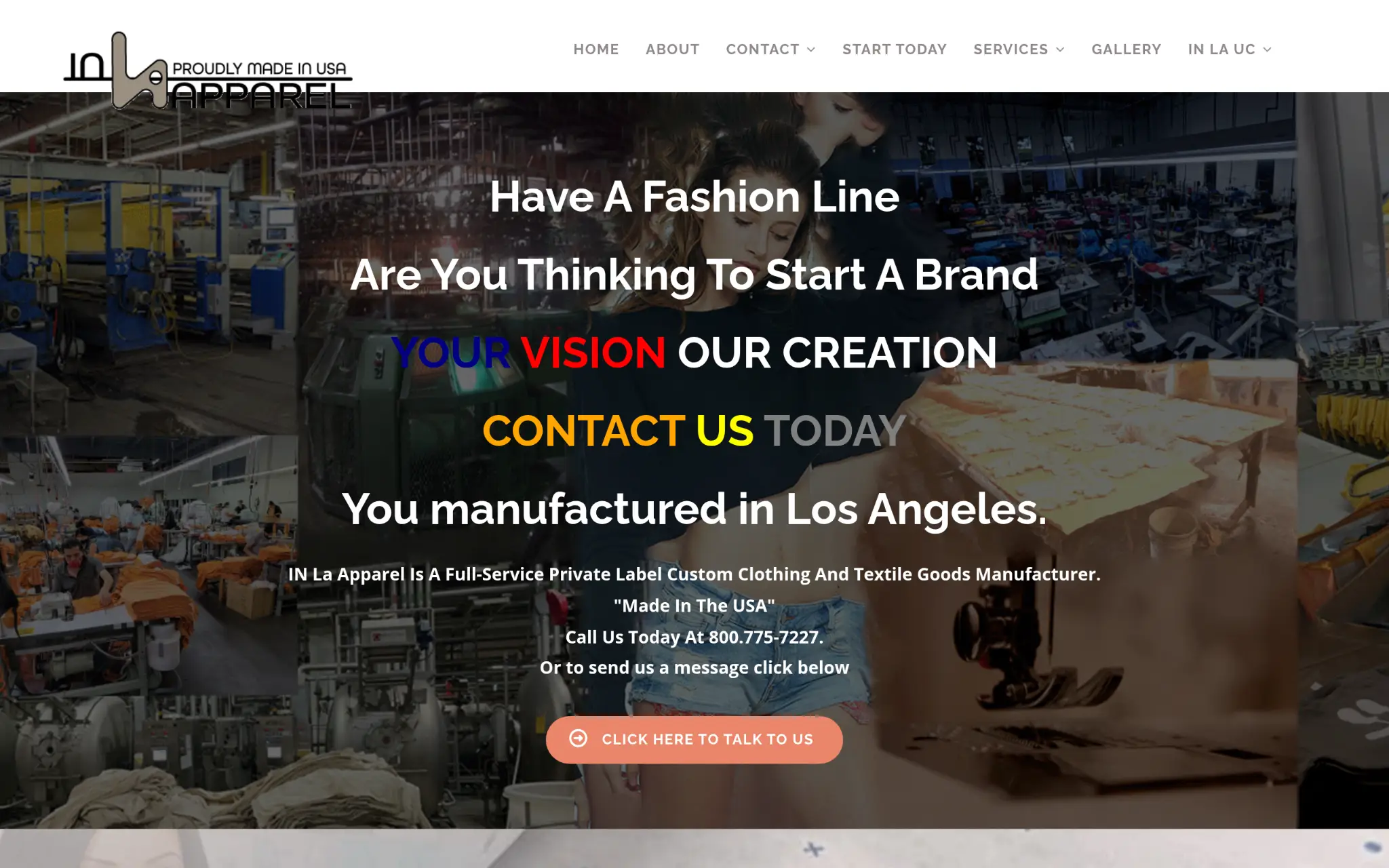
Best for: full-service private label with in-house fabric production.
- Model: vertically integrated, full service
- Covers: sample development, low MOQ production, knitting, cut and sew, dyeing, decorating, packaging, fulfillment
- In-house fabric: cotton, synthetic, viscose, modal, poly, melanges
- Also offers: 100% organic apparel capabilities
- Client range: LA production studios through entertainment industry clients
- Support: 24/7
- Locations: Los Angeles and Orange County, California
Brands that want their whole supply chain under one domestic roof usually end up assembling it from separate vendors instead, and every handoff between them is a place where the timeline slips or the quality drifts. In LA Apparel closes that gap by controlling every step from raw fabric through fulfillment, which few LA factories can do.
In-house fabric production spans cotton, synthetic, viscose, modal, poly and melanges, with 100% organic capability alongside it, so material quality is set at the start rather than inspected after the fact. Serving clients from LA production studios through the entertainment industry has built an operational range most single-location factories cannot match, and 24/7 support matters more than it sounds when a delivery date is close. Verified public review data is limited, so plan on direct engagement before ordering.
Brands that choose them usually name the one-stop-shop model and the organic fabric capability as the deciding factors.
Pick them if you want your whole supply chain under one roof instead of stitched together from multiple vendors.
4. American Apparel
Best for: ethically made basics with established brand recognition.
- What it is now: an e-commerce-only brand owned by Gildan Activewear, founded 1989
- Where production happens: Honduras and Nicaragua, under fair-compensation practices
- Product range: sweatshop-free apparel for women, men and kids
- Mission: ethical production, diversity, inclusivity, body positivity
- Industry role: created the mainstream sweatshop-free conversation in American apparel
American Apparel belongs on this list for what it established rather than what it can manufacture for you. It operates as a finished-goods brand now, not a factory partner, with production running through facilities in Honduras and Nicaragua under fair-compensation garment worker practices. What the company did was create the mainstream sweatshop-free conversation in American apparel, and that shaped how a lot of indie brands think about sourcing and ethical positioning today.
Its production standards still set a recognized benchmark in domestic and ethical manufacturing conversations, and holding those standards at scale on tight margins is the part most brands find hard to replicate. Public review data as a manufacturing partner is limited, which follows directly from the retail-only shift. The reputation that remains is tied to the ethics-first stance and consistent basics quality, and designers looking to license or align with that positioning tend to follow the brand closely.
Pick them if you want finished ethical basics or want to align with that positioning, not if you need your own designs made.
5. Full Speed 100
Best for: fast turnaround custom cut and sew with low minimums.
- Model: full-service clothing manufacturer and sourcing company
- Covers: custom cut and sew, fabric sourcing, pattern making, sample making, grading
- Decorating: screen printing, DTG, sublimation, embroidery
- Sourcing network: over 100 fabric and materials suppliers
- Quote turnaround: within 24 hours
- Rush options: same-day available on select services
- Client range: designer brands, sports teams, schools, corporate clients
- Location: downtown Los Angeles
Getting a quote out of a standard factory can take days or weeks, and for a brand testing a new style that delay is the whole problem. Full Speed 100 returns quotes within 24 hours and works to low minimums, which removes two of the most common bottlenecks small brands run into. Access to more than 100 fabric and materials suppliers means sourcing does not add another wait, and rush and same-day options exist on select services.
The service range covers custom cut and sew, fabric sourcing, pattern making, sample making, grading, and decoration through screen printing, DTG, sublimation and embroidery. A client base running from designer brands to sports teams, schools and corporate accounts points to a model built for flexibility rather than depth in one category. Public review data is limited, and brands that choose them tend to prioritize fast turnaround and pricing transparency over specialization, which suits an early-stage brand testing styles more than a brand scaling a single product.
Pick them if you are testing a new style against a deadline and cannot lose a week waiting on a quote.
Match a Factory to Your Need
Category skill does not transfer cleanly across fabric types, so start from what you are actually making rather than from a ranking. A factory with deep knitwear experience can struggle with wovens, and one that handles cotton basics well may have no route to couture finishing at all.
By garment type
- Silks, beading, complex knits, couture finishing → The Evans Group
- 100% cotton basics and loungewear → Essentials Made
- Knits with fabric produced in-house → in LA Apparel
- Decorated apparel, screen print or embroidery → Full Speed 100
By quantity
- Under 50 units → The Evans Group
- Low MOQ, exact figure to confirm → in LA Apparel, Full Speed 100
By timeline
- Need a quote today → Full Speed 100
- Need a planned six to seven week cycle → Essentials Made
By priority
- Documented ethical production → Essentials Made, SB62-compliant partnerships
- Ethical brand alignment → American Apparel
- One vendor for the entire chain → in LA Apparel
Check These Before You Commit
Public review data is limited for three of the five factories here, which is normal in contract manufacturing but shifts the verification work onto you. Ask for numbers rather than reassurances. A factory that tracks its own performance will have them ready, and one that deflects has answered a different question than the one you asked.
- Request samples before any bulk conversation
- Ask for on-time delivery rates
- Ask for defect rates per production run
- Ask for sample approval timelines
- Get the minimum in writing, per style
- Get full pricing on every phase, not just bulk production
- Confirm they understand California AB5, FLSA and garment worker protection laws
What to Compare When Choosing
Choosing on price alone tends to cause problems later, because the unit cost is only one input into what a production run actually costs you. Weigh these five against each other instead.
Industry and domain experience. Look for documented work in your specific category, whether that is knitwear, wovens, activewear or garment-dyed basics. General cut-and-sew experience does not always translate across fabric types, and a factory that performs well on one construction can produce inconsistent results on another.
Features and services. Some factories handle production only. Others cover pattern making, sampling and sourcing under one roof. Knowing which you need before you call saves a lot of back-and-forth, and it changes who belongs on your shortlist in the first place.
Pricing structure. Domestic manufacturing costs more per unit than overseas, but the unit price is not where your real cost sits. Minimum order quantities, sample fees and lead times all move the total. Get full pricing on every phase, not just bulk production, because sample and development costs are where small runs get expensive.
Results measurement. Ask about on-time delivery rates, defect rates per production run and sample approval timelines. A factory that tracks these numbers is a factory that takes quality seriously, and the answer tells you as much as the figure does.
Compliance. California AB5, FLSA and garment worker protection laws apply to everyone in this supply chain. A factory that understands these regulations protects your brand as much as its own, because liability does not stop at the factory door.
Why Produce in LA, and What it Costs You
Domestic manufacturing costs more per unit than overseas production, and no LA factory will argue otherwise. What the difference buys is control and speed, which for a small brand usually matter more than the unit price does. Shorter lead times from sample approval to bulk delivery mean you find out what sells before the season turns. Tighter control over defect rates means fewer units written off. Minimums low enough not to lock up cash flow mean a failed style costs you hundreds of dollars rather than thousands.
What you get back
- Shorter lead times from sample approval to bulk delivery
- Tighter control over defect rates
- Minimums that do not lock up your cash flow
- A Made in USA story that holds up
What you take on
- California garment worker protection laws apply to your supply chain
- Labor practices matter as much as price
- Brands that skip due diligence can face real liability
The genuine difficulty is finding factories willing to work at small-batch volumes at all, sometimes as low as 10 to 72 units per style. Most prefer volume, because that is where the margin sits, which is exactly why the ones that serve indie brands at low minimums are worth knowing by name. Choosing the wrong factory is not only a quality problem. It is a timeline problem, a brand problem, and sometimes a legal problem.
How This List Was Built
Publicly available information guided every selection. Factory websites, industry directories, brand case studies and client reviews were pulled and compared against each other, and only factories with a clear, proven track record in fashion manufacturing made the final cut.
Initial data collection
- Factory listings pulled from industry directories, the CFDA Production Directory, and professional networks active in the LA garment district
- Review platforms, brand case studies and company websites reviewed alongside them
- A broad longlist built before applying any filters, so nothing credible got missed early
Shortlisting
- Options without verifiable production histories removed first
- Factories with inconsistent or unsubstantiated review patterns set aside
- What remained had named brand clients, consistent review signals, or documented production credentials
Verification of claims
- Stated capabilities tested against what clients and industry sources actually reported
- Claims of specialty construction and low minimums checked against review language, case studies and brand partnerships
- Gaps between website claims and real client feedback surfaced more often than expected
Authority signals
- Appearances in industry publications and professional directories
- Named partnerships with recognized fashion brands
- Mentions in CFDA-affiliated lists, editorial coverage, and long-term repeat client relationships, which separate real industry standing from strong marketing
LA-specific evidence
- Dedicated service pages covering California production
- Client reviews from LA-based brands
- Case studies showing real small-batch or domestic production work
Bottom Line
- Complex small-batch work → The Evans Group
- Cotton-focused DTC brands → Essentials Made
- Fastest entry point for a new style → Full Speed 100
- Whole chain in one place → in LA Apparel
- Ethical basics off the shelf → American Apparel
LA factories range from boutique couture houses to high-volume private label operations, so the right choice comes down to your product category, your order size and your timeline rather than to a ranking. As domestic manufacturing demand keeps growing, the factories delivering speed, ethics and quality in the same place are the ones best positioned to serve indie brands.