Most women own exactly one ruffle dress, and it lives in the back of the closet because the first wear felt like too much. You put it on, spun in front of the mirror, and something read as birthday cake. So it went back on the hanger and never came out again.
That is a styling problem, not a wardrobe problem. Ruffles only fail when the volume has nowhere to go, when the fabric fights the shape, or when you stack three soft details on top of each other. Get those three things right and the same dress that felt like a costume reads like the best thing you own. You are about to learn which ruffle placement flatters your frame, what to put over the top, how to handle shoes and jewelry, and where to find ruffle dresses that do the heavy lifting for you.
Why Ruffles Read as Sweet on One Body and Sharp on Another
A ruffle is a horizontal line with texture. That is the whole mechanic. Where the line lands decides what the eye does next, and the eye always follows the widest point of a garment first.
Ruffles at the shoulder widen the frame up top. That is a gift if your hips are your widest point and a trap if your shoulders already are. Ruffles at the hem add weight at the bottom, which balances a fuller bust nicely and swallows a petite frame whole. A single ruffle running vertically down a placket does something different again: it draws the eye into a long line and makes you look taller without a heel in sight.
I would pick a single shoulder ruffle over a double-tiered sleeve every time. One statement reads deliberate. Two reads like the dress is trying to talk over itself.
Match the Ruffle to Your Frame in One Glance
|
Your shape |
Best ruffle placement |
Skip this |
|---|---|---|
|
Pear (hips wider) |
Shoulder ruffles, statement sleeves, ruffled neckline |
Tiered skirts, ruffle hems |
|
Apple (fuller midsection) |
Vertical placket ruffles, deep V with a soft collar |
Waist cinch ruffles, peplums |
|
Hourglass |
Anything, especially a ruffled waist seam |
Boxy cuts with no waist definition |
|
Petite |
One small ruffle, high neckline, above the knee |
Full tiers, heavy fabric, floor length |
|
Tall and straight |
Tiered skirts, ruffle hems, wide sleeves |
Nothing much, you can carry volume |
If you only remember one row, remember the petite one. Scale is everything. A ruffle that spans four inches of fabric on a five foot ten frame covers the entire bodice on someone five foot two.
What to Put on Top, and What to Leave at Home
Layering is where most ruffle outfits quietly fall apart. The instinct is to add a jacket for polish, and then the shoulder ruffle bunches under the armhole and you spend the night tugging.
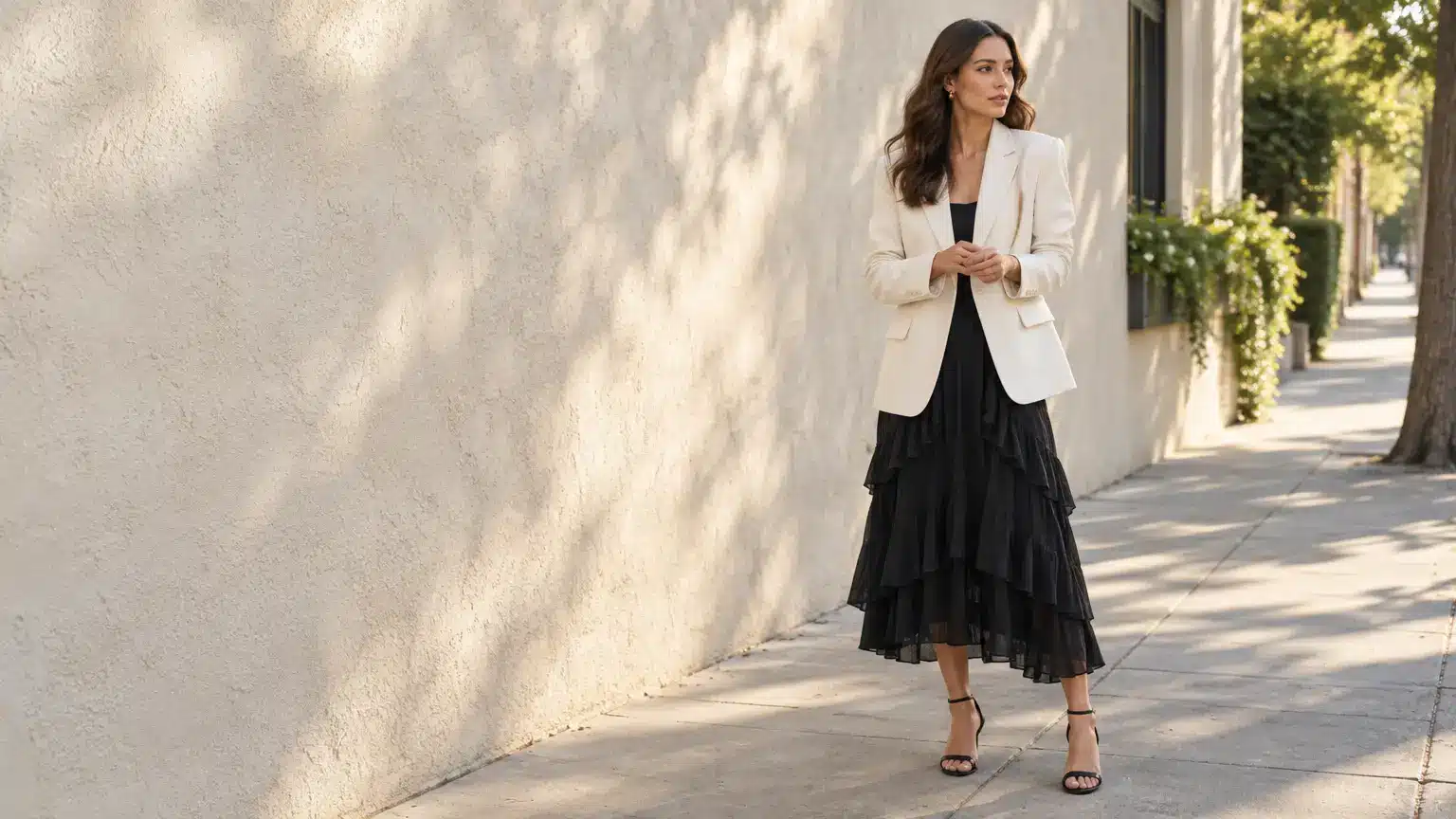
Go structured on the outside and soft on the inside. A cropped denim jacket, a boxy blazer, or a leather moto all have enough spine to hold their shape against a frilly dress, and the contrast is what makes the look feel modern instead of twee. Knit cardigans and sheer dusters are where things go wrong, because soft on soft just reads like a curtain.
Fit matters as much as material here. Textile engineers measure how fabric behaves under stress, and apparel sizing has to account for that same variation across every body that wears it, which is why the National Institute of Standards and Technology treats garment measurement and fit as a standards problem rather than a guess. Translation: if a layer pulls, it is telling you the cut is wrong, not that you are.
The three rule layering check
- One ruffle, one structure. If the dress has ruffles, the outer layer should be smooth and shaped.
- One bare zone. Show either shoulders, collarbone, or ankle, never all three at once.
- One texture match. Pair the dress with one other fabric with real body, like denim or leather, and keep everything else quiet.
Shoes, Jewelry, and The Styling Details that Decide the Outfit
Ruffles make a dress busy, so everything downstream should calm down. Skip the layered necklaces and the giant statement earring and pick a single piece that earns the space.
- Strappy sandals in a nude or metallic tone for warm weather, because they keep the leg line unbroken.
- Chunky ankle boots with a tiered mini, which deliberately roughs up the sweetness.
- Ballet flats with a relaxed midi when you want the outfit to feel easy instead of precious.
- A slim belt only if the ruffle is above or below the waist, never across it.
Bags lean small. A structured mini or a top handle bag looks intentional next to a ruffled hem, while an oversized tote drags the whole silhouette sideways.
The Shoes People Get Wrong Most Often
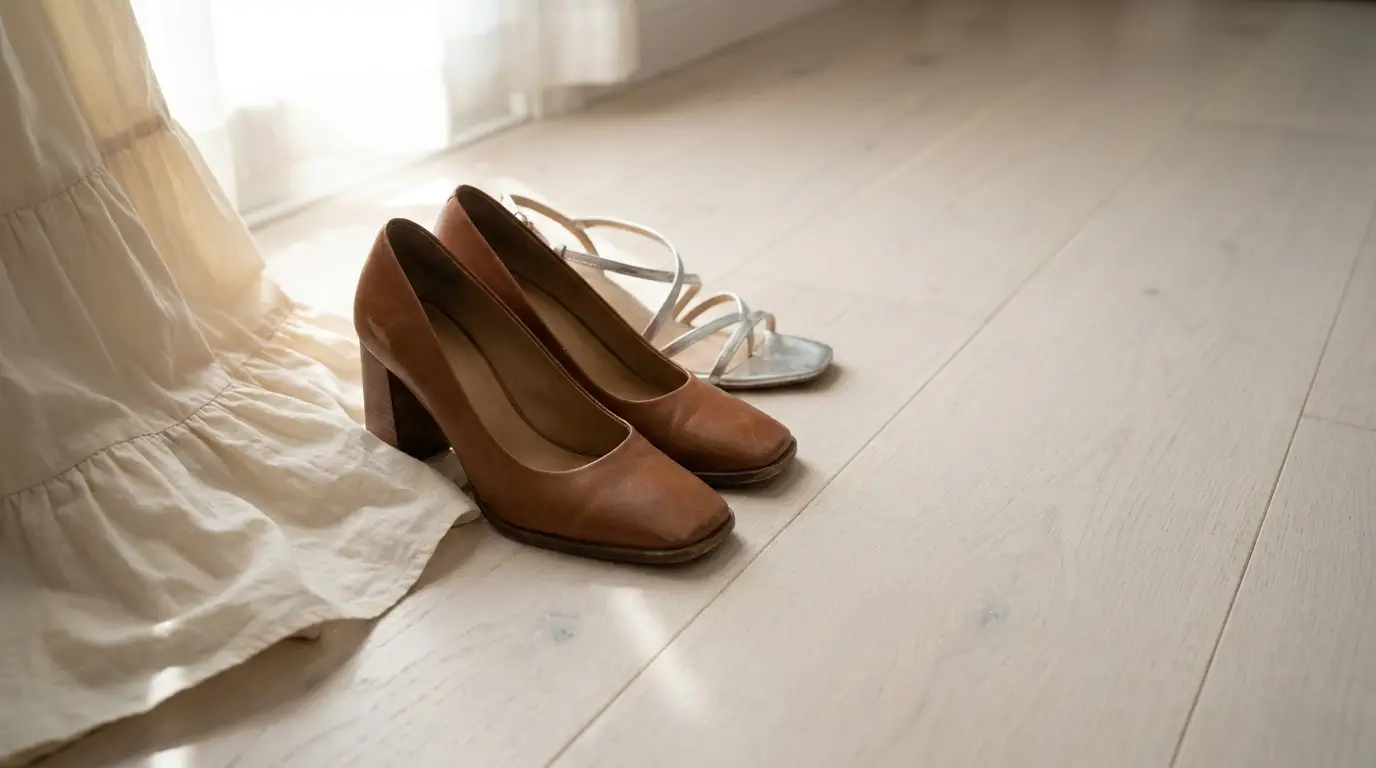
Square toe heels, and I will defend that. A ruffle is rounded and organic, so a squared toe gives the outfit one hard edge to stand against. It is the same reason a crisp shirt collar works under a frilly blouse.
What you want to avoid is another soft shape. Round toe pumps, bow flats, and anything with its own ruffle detail all pile onto the same idea and flatten the whole look into one note.
Where the Ruffle Came From, and Why It Keeps Coming Back
Ruffles are not a trend that arrived last spring. They show up in portraiture, court dress, and children’s clothing across centuries, and they resurface every generation because they solve a real design problem: they add shape to fabric that would otherwise hang flat. The Library of Congress holds extensive historical fashion and costume archives where you can trace the collar ruffle moving from menswear to womenswear and back again, which is a useful thing to remember the next time someone tells you ruffles are having a moment. They have had about forty.
Retail follows the same cycle. The apparel and accessories sector is a major employer and a constant engine of seasonal reinvention, and the Bureau of Labor Statistics tracks retail trade as one of the largest occupational categories in the country. When a silhouette returns, it is because enough people are buying it to justify the shelf space. That is not mysterious. It is demand doing what demand does.
Build the Outfit in Five Minutes
Here is the sequence I use when I am getting ready and the clock is running.
- Put the dress on and identify the widest point it creates. That is your focal point.
- Balance it. Widest up top means keep the bottom clean and the hair up. Widest at the hem means add volume at the shoulder or a heel.
- Choose the outer layer. Structured, cropped, and one solid color.
- Add one accessory only. Earrings or a bag, not both.
- Kill one thing. If the outfit feels loud, remove the belt or switch to a plainer shoe. Most ruffle looks are one item away from working.
Pick the Placement, Then Stop Thinking About It
The women who look best in ruffles are not the ones with the most ruffle-heavy closets. They are the ones who found their placement, bought two or three dresses in that shape, and stopped second guessing it. Volume works when it has a job.
So the honest question is not whether you can pull off ruffles. It is which single ruffle in your closet actually belongs to your silhouette, and what you would wear it with this weekend if you finally stopped treating it like a special occasion.
Common Questions, Quick Answers
Can you wear ruffles to the office? Yes, if the ruffle is a single vertical placket and the fabric is matte. Keep everything else tailored and it reads professional.
Do ruffles make you look bigger? Only at the wrong placement. A ruffle below your widest point adds softness; a ruffle across it adds width. It is geometry, not a verdict on your body.
Can two ruffle items be worn together? A ruffle dress plus a ruffle bag is fine. A ruffle dress plus a ruffle sleeve plus a ruffled shoe is a costume.