Most red light therapy masks promise glow, firmness, and convenience. So what actually makes the INIA GLOW 4D different? Does dual NIR, a wireless design, 4D fit, and cooling comfort meaningfully improve the at-home skincare experience, or are they just impressive-sounding features?
The short answer: the INIA GLOW 4D adds a more developed feature set than a basic LED mask. It includes dual near-infrared wavelengths, lower-face coverage, wireless use, cooling pads, and four LED modes. Whether that matters depends on what the buyer needs, how consistently they will use it, and how realistic their expectations are.
What Is the INIA GLOW 4D?
The INIA GLOW 4D is a wireless at-home LED face mask designed for repeated skincare sessions, not one-time use. It combines red light therapy positioning with dual near-infrared wavelengths, a 4D enveloping fit, magnetic cooling pads, four LED modes, 320 LEDs, and a soft silicone structure with an adjustable strap.
The product comes from INIA, a beauty-tech brand focused on at-home skincare devices. With this mask, the main idea is not just LED exposure, but comfort, coverage, and routine consistency.
What Does Dual NIR Mean in This Mask?
NIR stands for near-infrared light. It sits beyond visible red light on the light spectrum, which is why it is not always as visually obvious during use. The INIA GLOW 4D NIR Wireless LED Mask is built around dual 850nm and 940nm near-infrared wavelengths, along with wireless use, a 4D fit, and cooling pads.
For buyers, the main point is simple: this mask is positioned around a more NIR-focused setup than a basic red-only LED mask. That does not mean users should expect instant or guaranteed results. At-home LED devices should not be compared directly with professional treatments, and visible changes can vary by skin type, routine, and consistency.
How Is the 4D Fit Different From a Regular LED Mask?
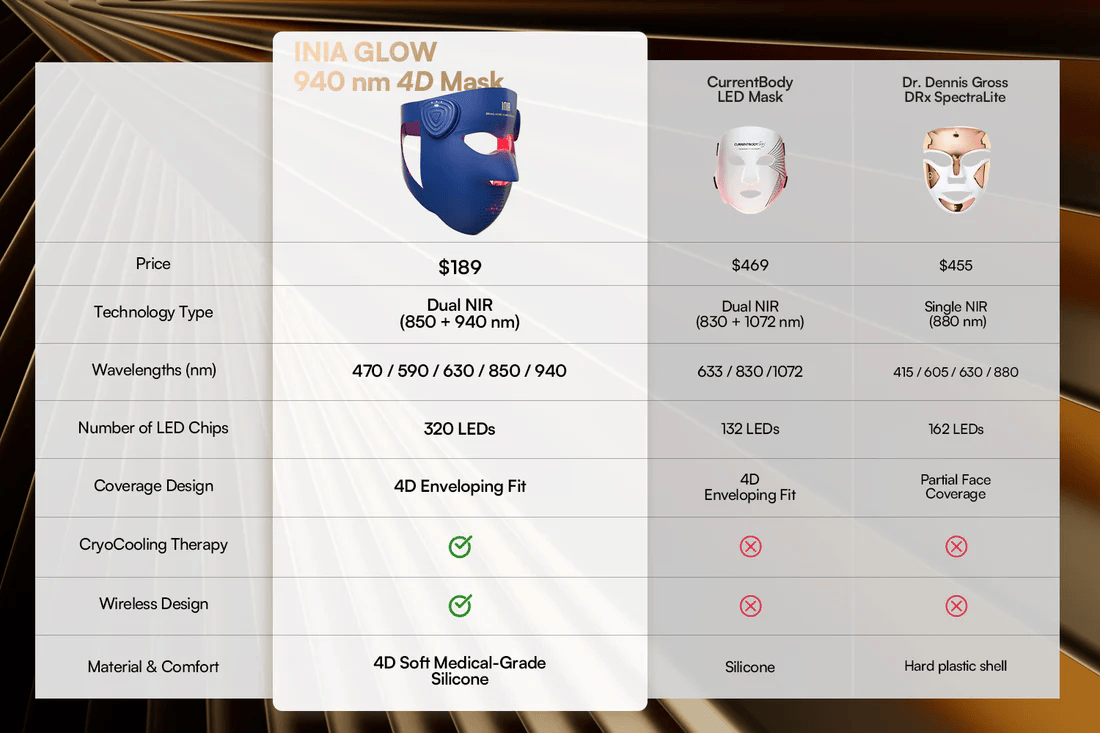
Many LED masks focus mainly on the front of the face. The INIA GLOW 4D is designed to extend along the jawline and chin, giving more attention to the lower face than many flatter mask designs.
That matters because the chin, jawline, and lower cheeks are areas some users specifically want covered. Fit also affects comfort. A mask that feels awkward, loose, or poorly shaped is easier to skip, even if the technology sounds strong on paper.
The 4D design is best understood as a comfort and coverage feature. It may help the mask feel more wearable during repeated sessions, but it should not be treated as a guarantee of lifting or firming.
Does the Wireless Design Matter in Real Use?
Wireless use does not change the light technology itself, but it can change whether someone actually sticks with the routine.
A corded mask keeps the user tied to one place. A cordless mask can be used on the sofa, near a vanity, or during a quiet 10–20 minute break. That lower-friction experience can matter when a device is meant to be used several times a week.
It still requires charging, cleaning, and planning. Wireless does not mean effortless. It simply removes one common reason people avoid using at-home devices consistently.
What Do the Cryo-Cooling Pads Add?
The mask includes magnetic cooling pads that can be used during a session. The cooling feature does not change the LED technology, but it can change the feel of the treatment.
For people who dislike warmth or find some device sessions uncomfortable, cooling can make the experience more refreshing. It may also make the routine feel more relaxing and easier to repeat.
That said, cooling pads should not be treated as a treatment for redness, inflammation, or any skin condition. Anyone with active skin concerns should ask a qualified clinician before adding a light-based device to their routine.
How Often Would Someone Need to Use It?
INIA recommends 10–20 minutes per session, three to five times per week. Sensitive users may want to begin with shorter sessions, such as 5–10 minutes, two to three times weekly, before increasing.
The routine itself is simple: cleanse first, use the mask, then apply serum or moisturizer afterward. People with reactive skin should be careful with strong actives, especially retinol, immediately before a session.
The bigger question is not whether the routine is complicated. It is whether the buyer will realistically keep doing it. A feature-rich mask only has value if it becomes part of a consistent skincare habit.
What Are the Main Pros?
- Dual NIR wavelengths at 850nm and 940nm
- Wireless design for easier use around the home
- 4D lower-face coverage across the jawline and chin
- Cooling pads for a more comfortable session feel
- Four LED modes for routine flexibility
- Soft silicone structure with adjustable strap
- At-home use without scheduling appointments
What Are the Limitations?
The INIA GLOW 4D is not a quick fix, and it is not a replacement for professional treatments. Results from at-home LED devices can vary, and stronger product-page language should be understood as brand positioning rather than a guaranteed outcome.
It may also be more device than a beginner needs. Someone who only wants to try basic red light therapy may not need dual NIR, four modes, and cooling pads right away.
There is also the consistency problem. People who often buy skincare devices and stop using them after a few weeks should be honest about that before choosing a more advanced mask.
Who Is the INIA GLOW 4D Best For?
The mask is likely best for someone already interested in red light therapy and comfortable with device-based skincare. It may suit users who want a wireless LED mask, care about lower-face coverage, and prefer a more structured skincare routine.
It also makes sense for someone who values comfort features. Cooling pads, soft silicone, and a cordless design may not sound dramatic, but they can make repeated sessions easier to maintain.
Who May Prefer a Simpler LED Mask?
A simpler LED mask may suit beginners, tighter budgets, or users who only want basic red light without extra modes and features. It may also be better for someone who does not want three to five weekly sessions or dislikes wearing face devices.
Anyone with photosensitivity, a skin condition, or a relevant medical concern should get professional guidance before using any LED mask.
Final Verdict: What Does the INIA GLOW 4D Actually Add?
The INIA GLOW 4D adds dual NIR wavelengths, wireless flexibility, 4D lower-face coverage, cooling comfort, and multiple modes to the standard LED mask format. That creates a different user experience from a simpler single-mode mask.
Its value depends less on the feature list and more on whether the buyer will use it consistently. Before buying, compare the routine requirements, comfort, coverage, and expectations against actual skincare habits.
The right buyer is someone who wants a more feature-rich red light therapy mask, understands that results take time, and is realistic about the consistency required.