


Many people exercise consistently but still fail to see the results they expect. The reason is often not effort, but a lack of understanding of the key areas that build true fitness.
The components of fitness help create a balanced routine that supports strength, endurance, flexibility, and overall health. The components of physical fitness explain key areas that affect daily performance and long-term wellness.
These factors help people set realistic goals and choose exercises that match their needs. Knowing how each area works can make workouts more effective and purposeful.
The five areas of fitness, their importance, and how they contribute to a healthier lifestyle are explained in detail.
What Are the 5 Components of Physical Fitness?
The five health-related components of physical fitness are cardiovascular endurance, muscular strength, muscular endurance, flexibility, and body composition.
According to the American College of Sports Medicine (ACSM), these components are used to assess and improve overall physical health in a measurable, repeatable way.
Because all five are evaluated collectively, they give a complete picture of health that no single component can.
The same criteria apply to both a middle schooler in a PE class and an adult in cardiac rehabilitation, which shows that the framework is designed for universal use.
1. Cardiovascular Endurance: What It Is and How to Build It

Cardiovascular endurance is the ability of the heart, lungs, and circulatory system to sustain oxygen delivery to working muscles over time.
Also called cardiorespiratory endurance or aerobic fitness, it determines how long the body can continue moving before fatigue sets in.
Consistent aerobic training triggers specific physiological adaptations: the heart increases stroke volume, muscles develop denser capillary networks, and cells improve oxygen uptake efficiency.
Cardiovascular Exercises
Different exercises suit different fitness levels, goals, and physical needs. The table below shows who each exercise works best for and its intensity level.
| Exercise | Who It’s Best For | Intensity Level |
| Gentle walking | Seniors, post-surgery recovery | Low |
| Water aerobics | Older adults, balance concerns | Low to moderate |
| Brisk walking | Beginners, older adults | Moderate |
| Swimming | Joint issues, injury recovery | Moderate to vigorous |
| Cycling | Overweight individuals, knee concerns | Moderate to vigorous |
| Jump rope | Children, teens, young adults | Vigorous |
| Running | Men and women building endurance | Moderate to vigorous |
| HIIT cardio | Athletes, advanced fitness | Vigorous |
The right exercise based on fitness level and body needs can make workouts safer and more effective. Start with an activity that matches your current ability and gradually increase the challenge over time.
How Much Cardio Do You Actually Need?
Not sure how much cardio to aim for? These weekly targets make it easier to plan and stay consistent.
- Maintain basic health: 150 minutes of moderate intensity per week is the minimum recommended baseline for general health benefits.
- Improve fitness: Doubling to 300 minutes of moderate-intensity activity yields stronger cardiovascular and metabolic outcomes.
- Time-efficient training: 75 minutes of vigorous activity delivers the same benefits as 150 minutes of moderate activity in half the time.
- Advanced fitness: 150 minutes of vigorous-intensity exercise per week is the upper limit for significant cardiovascular improvement.
Tip: Your resting heart rate drops as your cardio fitness improves. Track it weekly as a free progress marker.
2. Muscular Strength: What It Is and How to Build It
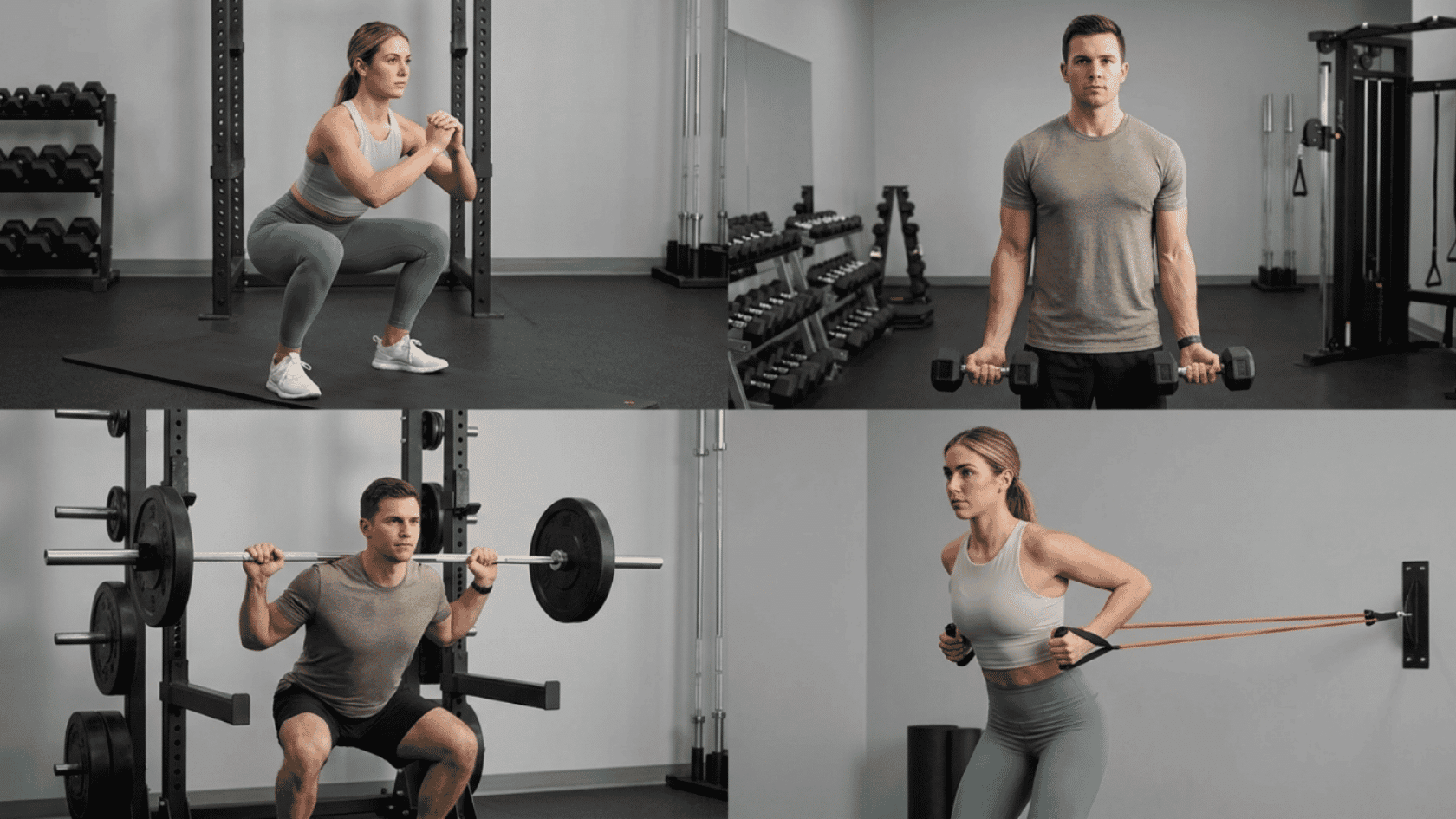
Muscular strength is the maximum force a muscle or muscle group can produce in a single, maximal effort. It is the quality that determines how much you can lift, push, or carry at once.
Strength is also muscle-group-specific: strong legs do not imply strong shoulders, which is why training all major muscle groups matters for well-rounded results.
Muscles only get stronger when you consistently challenge them beyond what they are used to. This is called progressive overload.
Each time you push a muscle past its current limit, it rebuilds slightly stronger. Stop increasing the challenge, and progress stops too.
Muscular Strength Exercises
Strength exercises vary based on fitness goals, experience level, and training needs. The table below shows suitable groups for each exercise and their intensity level.
| Exercise | Who It’s Best For | Intensity Level |
| Bodyweight squats | Beginners, older adults | Low to moderate |
| Dumbbell training | Women, general fitness | Moderate |
| Barbell compound lifts | Men, advanced trainees | High |
| Resistance band training | Injury recovery, older adults | Low to moderate |
| Machine-based training | Beginners, rehabilitation | Moderate |
| Kettlebell training | Athletes, functional fitness | Moderate to high |
| Powerlifting movements | Advanced, strength-focused | High |
The right strength exercise depends on experience, comfort, and fitness goals. Start at a suitable level and increase intensity as strength improves.
How Much Strength Training Do You Actually Need?
A clear weekly target takes the guesswork out of strength training and keeps your progress steady.
- Minimum baseline: ACSM recommends at least 2 to 3 days per week of muscle-strengthening activity targeting all major muscle groups.
- Strength-focused training: 2 to 6 reps per set at a heavy load builds maximal strength. This is the one-rep max range. One-rep max is a testing method to measure peak force output, not a daily training approach.
- Hypertrophy-focused training: 8 to 12 reps per set at moderate weight builds muscle size alongside strength gains.
- Progressive overload rule: Increase load, reps, or resistance incrementally. Small weekly increases are enough to keep adaptation happening.
Tip: If the last two reps of a set feel easy, the weight is too light. Mild difficulty in the final reps is the signal that progressive overload is working.
3. Muscular Endurance: What It Is and How to Build It

Muscular endurance is the ability of a muscle or muscle group to perform repeated contractions against resistance over time without fatiguing.
Where muscular strength is about how much force you can produce once, muscular endurance is about how long you can keep producing force.
Building muscular endurance means your muscles and your cardiovascular system can work together longer.
Muscular Endurance Exercises
Strength training exercises differ based on experience, fitness goals, and training needs. The table below shows who each exercise suits best and its intensity level.
| Exercise | Who It’s Best For | Intensity Level |
| Bodyweight squats | Beginners, older adults | Low to moderate |
| Dumbbell training | Women, general fitness | Moderate |
| Barbell compound lifts | Men, advanced trainees | High |
| Resistance band training | Injury recovery, older adults | Low to moderate |
| Machine-based training | Beginners, rehabilitation | Moderate |
| Kettlebell training | Athletes, functional fitness | Moderate to high |
| Powerlifting movements | Advanced, strength-focused | High |
Each exercise offers different benefits based on fitness level and goals. Starting with a suitable option can help build strength safely and improve training consistency.
How Much Muscular Endurance Training Do You Actually Need?
Knowing your training target makes it easier to structure the week and see consistent progress.
- Minimum baseline: ACSM recommends at least 2-3 days per week of muscle-strengthening activity.
- Endurance-focused training: 15 to 25 or more reps per set at a lighter load builds the capacity to sustain repeated effort.
- Isometric training: Timed holds such as planks and wall sits build endurance without movement.
- Progressive overload rule: Increase reps, duration, or circuit rounds incrementally. The same principle applies as with strength.
Tip: If you can complete every rep easily, you are training coordination, not endurance. The last few reps should require real effort.
4. Flexibility: What It Is and How to Improve It
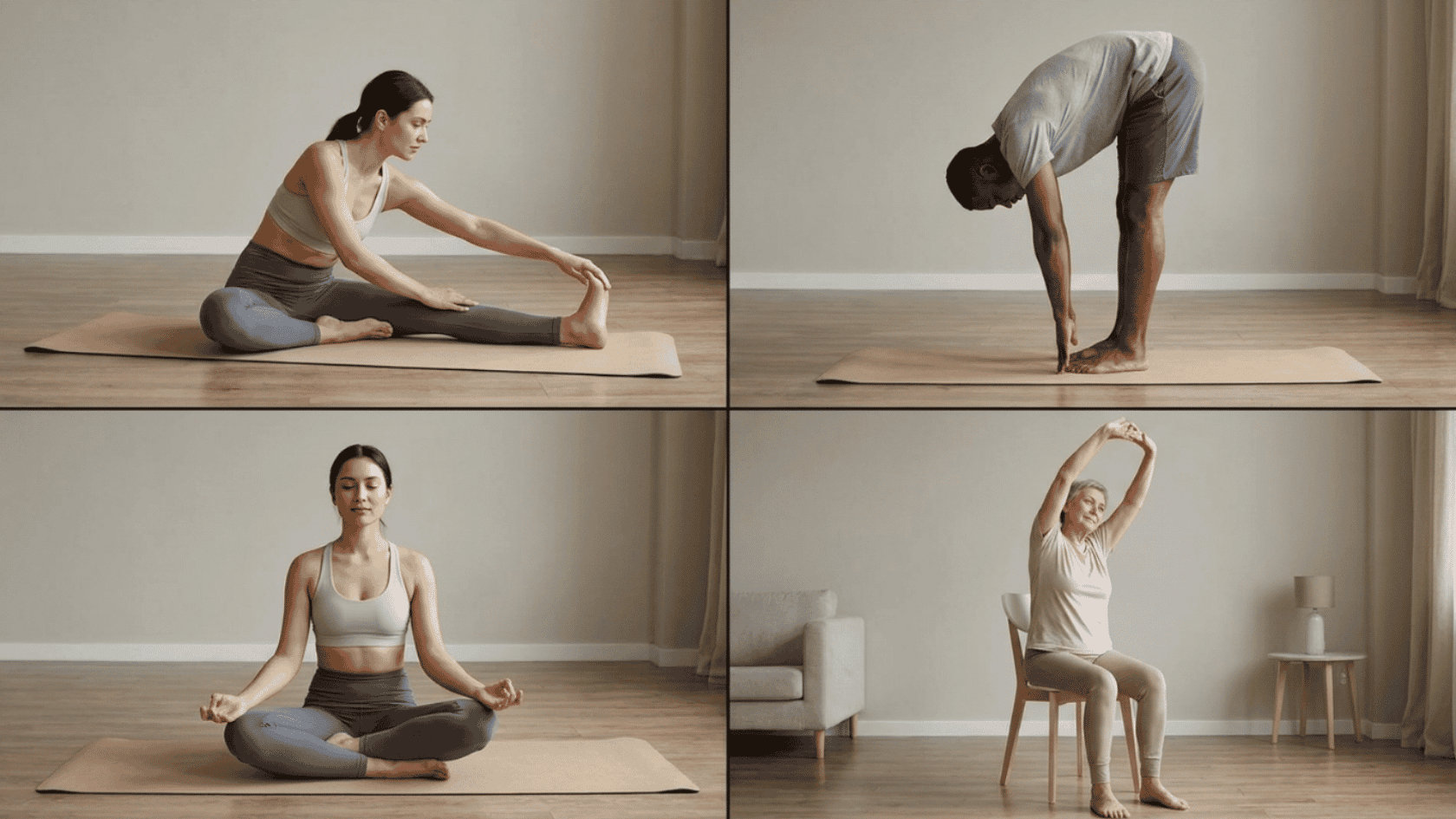
Flexibility is the range of motion available at a joint or group of joints without pain. It supports the functional movements of daily life: reaching overhead, bending down, maintaining balance, and recovering from a misstep.
Everyday movements like reaching, bending, and keeping your balance all depend on it.
For older adults, maintaining flexibility is one of the most direct ways to reduce fall risk and stay physically independent.
Static vs. Dynamic Stretching
The type of stretching you use should be determined by where it sits in your session. Static stretching before an activity that requires force output can temporarily reduce muscle activation. It belongs after exercise.
Dynamic stretching belongs in warm-ups because it activates range of motion without reducing muscle readiness.
Flexibility Exercises
Flexibility exercises support movement, mobility, and body control. The table below shows suitable groups for each activity and its intensity level.
| Exercise | Who It’s Best For | Intensity Level |
| Static stretching | All levels, cool-down phase | Low |
| Morning mobility routine | Beginners, desk workers | Low |
| Dynamic stretching | All levels, warm-up phase | Low to moderate |
| Yoga | All levels, standalone session | Low to moderate |
| Pilates | Core focus, all levels | Moderate |
| Tai chi | Older adults, balance concerns | Low to moderate |
| Barre | Women, posture, and flexibility | Moderate |
Flexibility activities can fit different fitness levels and routines. Regular practice can support better movement, balance, and overall body control.
How Much Flexibility Training Do You Actually Need?
Setting a simple flexibility goal each week helps you stay consistent and actually notice the gains over time.
- Minimum baseline: ACSM recommends at least 2 to 3 days per week of flexibility training for meaningful improvement.
- Static stretching: Hold each position for 10 to 30 seconds and repeat 2 to 4 times per muscle group.
- Dynamic stretching: Perform 10 to 15 controlled repetitions per movement as part of a warm-up sequence.
- Progressive approach: Start with a short 10-minute morning mobility routine and gradually build duration and variety.
Tip: Static stretching before a workout can actually reduce force output for lifts and sprints. Save it for cool-downs.
5. Body Composition: What It Is and How It’s Measured
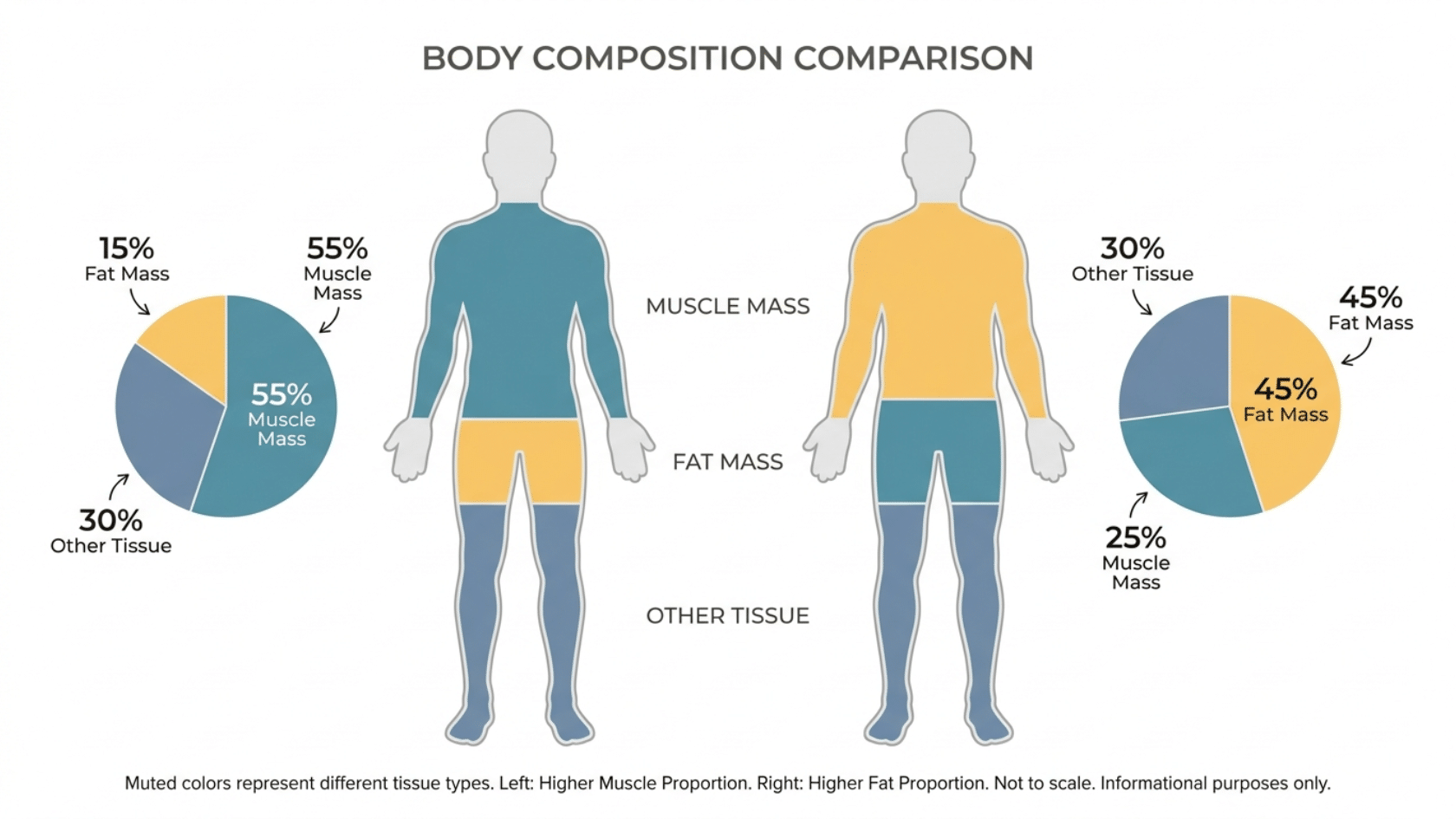
Body composition is the ratio of fat mass to fat-free mass. It is not a weight metric. A scale cannot tell you what your mass is made of, and that distinction is what makes body composition a health indicator.
Weighing yourself only tells you your total weight. Body composition gives you a better picture. It is why two people can weigh exactly the same but have completely different health profiles.
Excess fat mass, particularly visceral fat stored around the abdomen, is directly linked to type 2 diabetes, insulin resistance, heart disease, and certain cancers.
Healthy Body Fat Percentage
Body fat percentage ranges can vary based on gender, fitness level, and health goals. The table below shows general body fat categories for women and men.
| Body Fat Percentage | Women | Men |
|---|---|---|
| Healthy nonathlete range | 25–31% | 18–24% |
| Dangerously low | Below 14% | Below 6% |
| US population average | 39.9% | 28.1% |
Source: American Council on Exercise (ACE)
Most people in the United States have body fat levels outside the recommended range, making body composition one of the most clinically relevant factors.
Note: These are general reference points. Consult a healthcare provider for guidance based on your individual health history.
How to Calculate Body Fat Percentage
There are several ways to measure body composition, ranging from simple at-home methods to clinical assessments.
- Waist circumference: A tape measure around the abdomen; free and takes 30 seconds
- Skinfold calipers: Measure fat thickness at key body sites; common in gym assessments
- BIA scale: Sends a small electrical current through the body to estimate fat vs. lean mass; available as home scales or gym machines
- DEXA scan: Clinical X-ray that gives the most precise breakdown of fat, muscle, and bone\
- For a quick estimate, you can also use the Body Fat Calculator to determine body composition using the US Navy method.
Tip: Waist circumference is the simplest starting point. Above 35 inches for women and 40 inches for men is a widely used clinical flag for elevated metabolic risk.
How to Improve Body Composition
Body composition is the only component of the five that cannot be directly trained. It shifts as a cumulative result of consistent progress across the other four components.
- Cardiovascular training increases caloric throughput and reduces fat mass over time
- Strength training builds lean muscle mass and raises resting metabolic rate
- Flexibility training sustains consistent training by reducing injury risk.
- Nutrition amplifies everything else. What you eat determines what your training actually changes.
How the Five Components of Fitness Work Together
The five components are not five separate goals. They are one system where each affects how well the others function.
- Cardiovascular endurance: This determines how long you can train.
- Muscular endurance: This determines how hard you can work within that time
- Muscular strength: This determines the load and adaptation stimulus you can apply
- Flexibility: This determines whether joints can move safely through the range needed
- Body composition: This shows when all four of the above are working well. It is the result, not the starting point.
Common Mistakes to Avoid When Training the 5 Components of Fitness
Common fitness mistakes can affect a balanced routine and limit long-term progress. Many people focus on visible results while ignoring important areas like endurance, flexibility, recovery, and nutrition, which can limit overall performance.
- Training only strength while ignoring cardiovascular fitness.
- Skipping flexibility training entirely.
- Using body weight as the only progress marker.
- Doing static stretches before a workout instead of dynamic warm-ups.
- Treating all five components as equally urgent regardless of fitness level.
- Increasing intensity before building duration first.
- Expecting body composition to change through exercise alone without nutrition.
Avoiding these mistakes allows each component of fitness to work together for better results. A balanced approach that combines proper training, gradual progression, and healthy nutrition helps build sustainable improvements in strength, health, and body composition.
Wrapping Up
The components of fitness provide a strong foundation for creating a healthier and more balanced lifestyle. These areas help improve physical performance, support daily activities, and build lasting wellness habits.
A complete fitness routine focuses on more than just strength. It combines different abilities that help the body perform better and maintain overall health.
Using these principles can help you set realistic goals and choose exercises that match your personal needs. A balanced approach makes fitness progress more consistent and effective.
Take the next step by applying these fitness concepts to your routine today.
Share your thoughts or questions in the comments below.
Frequently Asked Questions
Can Children and Teenagers Use the Same 5-Component Fitness Framework as Adults?
Yes, the five components apply across all age groups. However, for children and teens, the emphasis is on building foundational movement patterns and cardiovascular habits.
Do the 5 Components of Fitness Change in Importance as You Age?
The components remain the same, but priority shifts with age. Older adults benefit most from prioritizing flexibility and muscular strength, as these directly support mobility, balance, and fall prevention.
Can You Improve All 5 Components of Fitness without Going to A Gym?
Yes, all five components can be trained effectively at home or outdoors. Walking, bodyweight exercises, stretching routines, and activities like cycling or swimming cover the full framework.