
Your ring looked perfectly familiar over dinner. Under the UV lighting at a club, the diamond suddenly glows blue. It is an unexpected change in something you might have worn for years.
The likely explanation is diamond fluorescence: visible light emitted by some diamonds when they are exposed to ultraviolet radiation. It can be a fascinating detail to discover, but that blue glow needs a little context, especially if you are choosing a ring.
What Is Diamond Fluorescence?
UV light is invisible to us. Some diamonds respond to it by emitting light we can see, most commonly blue, although other colours are possible. As the Gemological Institute of America explains in its guide to diamond fluorescence, this is a response to the light source.
It is different from the flashes you see as a ring moves beneath a spotlight. Those flashes are part of the way the cut stone handles light. With fluorescence, the diamond absorbs energy and releases some of it as visible light.
What Does Fluorescence Mean on a Diamond Report?
When choosing a natural diamond ring from Lily Arkwright, ask for the grading report for the specific centre stone and check its fluorescence description alongside the other characteristics.
|
Fluorescence report scale
These GIA descriptions record intensity under long-wave UV, not a best-to-worst ranking. |
A report marked Strong does not promise an obvious blue glow wherever you go. The effect you notice depends on the light available. Equally, an ordinary product photograph may show nothing of the stone’s UV response.
Whichever diamond-shopping approach you take, compare reports for the actual stones, not just the designs pictured online.
Does Fluorescence Make a Diamond Look Cloudy?
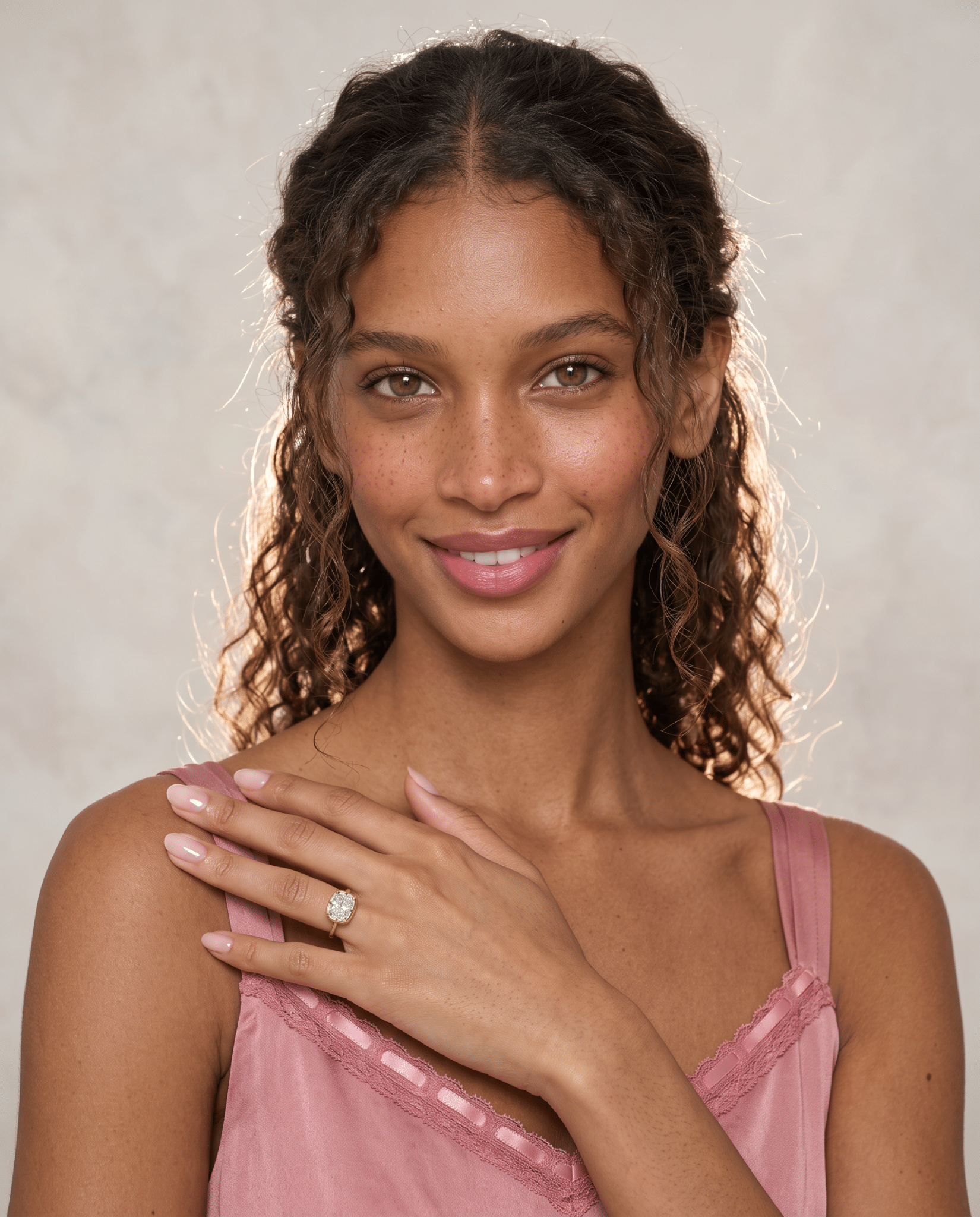
Fluorescence does not cause haziness by itself. In very rare stones, strong fluorescence can make existing haze from tiny light-scattering features more noticeable.
GIA’s explanation of fluorescence and haziness puts that risk in perspective: fewer than 0.2% of fluorescent diamonds submitted to GIA show the hazy effect. A Strong description on a report is not evidence that a diamond is cloudy.
For the overwhelming majority of diamonds, GIA says fluorescence strength has no widely noticeable effect on appearance. View the stone rather than accepting or rejecting it on that description alone.
Instead, ask to see the actual diamond under different types of light: daylight and ordinary indoor lighting, as well as the jeweller’s display lights. Pay attention to whether its appearance stays clear and appealing to you. Sunlight contains UV; indoor lighting varies. A dramatic photograph taken under a UV lamp tells you about that particular setup, rather than providing a preview of every day’s wear.
Can a Blue Glow Prove a Diamond Is Natural?
No. Some natural diamonds fluoresce and others do not. Some lab-grown diamonds also fluoresce, and certain diamond lookalikes can do so too. GIA specifically warns against using fluorescence as a home test of diamond identity.
A reaction under UV therefore cannot establish whether your stone is natural, lab-grown or another material. Lab-grown diamonds are diamonds; their origin is a separate question from whether the material is diamond at all.
If a glow continues briefly after the UV source is switched off, that is called phosphorescence. GIA’s explanation of fluorescence and phosphorescence in gems distinguishes the two effects. Neither observation replaces proper identification by a qualified professional.
What Should You Ask Before Choosing a Ring?
If fluorescence has caught your attention, ask the jeweller to show you how that particular stone responds and explain the wording on its report. You can be curious about the blue glow without making it the deciding factor.
The main question is whether you enjoy the diamond in your usual lighting. The occasional blue glow may be part of its appeal, or simply a detail you rarely notice.
If you already own the ring, an unexpected glow is a reason to learn more about it, not enough evidence on its own to conclude something is wrong. Check any existing paperwork and let a jeweller investigate questions it does not answer.
A blue glow can be a lovely hidden detail in a familiar ring. It need not change what you love about wearing it.