


Choosing a custom ring designer is mostly done by looking. You scroll through finished work, you find a studio whose pieces you respond to, and you assume the rest will follow. Finished work is genuine evidence, but it only tells you what a maker can produce, not how they work with someone who is not yet sure what they want.
That second thing decides whether a commission feels collaborative or opaque. The most reliable way to find out is to ask a handful of specific questions before anything is agreed, and then to listen less for the answer you were hoping for than for how the answer is constructed. Vague, flattering replies to concrete questions are themselves information.
Why Questions Reveal More About a Custom Ring Designer than A Portfolio
A portfolio is a selection. It shows the pieces that photographed well and the projects that went smoothly, which is not dishonest but is incomplete. What it cannot show is how a studio handles ambiguity: what happens when a client changes direction, when a stone turns out to look different in person, when a design is technically possible but structurally unwise.
Questions get at that, and they do it quickly. A maker who is comfortable with their own process answers plainly, including the parts that are constraints rather than selling points. One who deflects into atmosphere – heritage, passion, artistry – may still be excellent, but you have learned nothing you can use. Browsing a studio’s own work, on aquamarise.com or anywhere else, is the starting point rather than the assessment.
Who Actually Makes the Piece?
This sounds blunt and it is the most useful question on the list. Custom ring designers work in genuinely different ways. Some design and fabricate under one roof. Some design in-house and send models to a specialist caster. Some coordinate a network of independent benches. All three arrangements produce excellent work, and none of them is a red flag.
What matters is that the answer is specific. “We model in-house and cast with a workshop we have used for years, then set and finish here” tells you where the work happens and who is accountable at each point. A studio that cannot describe its own production route, or that avoids the question, is telling you something about how much visibility you will have later. You are not auditing them. You are checking that the chain is known to the person you are speaking with.
Will I See the Design Before Production Begins?
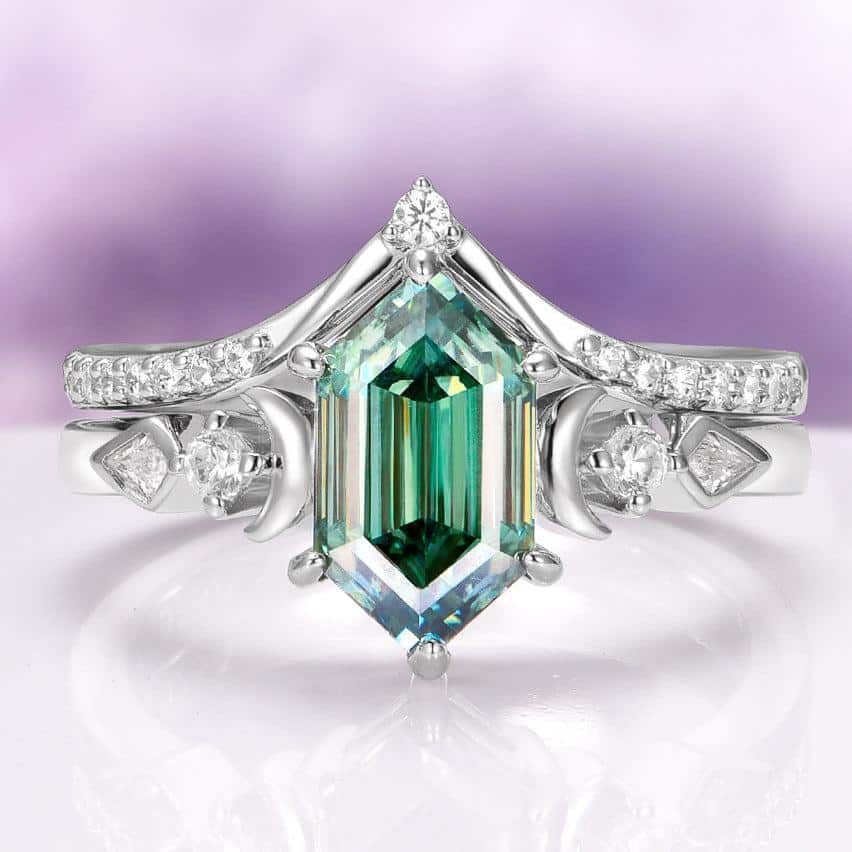
For solid gold and platinum work, the expected answer today involves a three-dimensional model and a render. Ask what you will see and from which angles, because the difference between one flattering top-down image and a set of views including the profile is substantial. Profile is where proportion problems hide.
A good answer also includes honesty about limits. A render reports proportion, stone placement, height and how components meet with real accuracy. It does not accurately convey sparkle, the way light travels through a translucent stone, or the true warmth of a metal color. A designer who volunteers that distinction without being prompted is describing the tool correctly rather than selling it, which is exactly the disposition you want when a disagreement about a detail eventually arrives.
A hexagon stone paired with a crescent form: layouts like this are worth discussing in profile, not only from above.
Where Does the Stone Come From, and Can I See This Specific One?
Stones within a single category vary enormously in tone, saturation, transparency and the way a cut handles light. Two stones sharing a name can look like different materials. So the question is not only how stones are sourced but whether you will see the actual stone that goes into your piece rather than an example of its type.
Listen for whether the maker distinguishes between what they hold and what they source to order, and whether they can describe a particular stone in visual terms rather than nomenclature. “Cooler than average, very clean, the pattern sits toward one end” is the language of someone who has looked at the stone in their hand. It also tells you they will be able to answer when you ask why one option suits your design better than another.
How Many Rounds of Revision Are Normal?
The number itself is less revealing than the shape of the answer. What you want to hear is that revision is expected and structured: that a first model is a proposal, that comments are gathered and applied, and that the design closes at a defined point rather than drifting. Iteration is not a sign that something has gone wrong; it is the mechanism by which a drawing becomes an object somebody actually wants.
It is also fair to ask what makes a revision straightforward versus significant, because those are different things. Adjusting a band width or a stone height is ordinary. Changing the fundamental architecture of a setting after a model is approved is closer to starting again. Reading how a studio describes its own process page, such as the Aquamarise custom design studio, before the conversation gives you the vocabulary to ask about stages precisely rather than in general terms.
What Happens if The Finished Piece Is Not What I Approved?
Ask this one calmly, because you are not looking for reassurance. You are looking for whether a studio has a process for comparing a finished object against an approved design, and whether they keep the approved design on record in a form both sides can point at.
A weak answer treats the question as an accusation. A strong one is procedural: here is what we record at approval, here is how we compare, here is who looks at it. That tells you the studio has thought about disagreement in advance, which is the only time it is possible to think about it usefully. Every maker’s specific arrangements differ, so the point of asking is to learn how this particular one works rather than to assume any answer is standard across the trade.
Can You Show Me Work Similar in Spirit, Not Identical?
The final question is the most diagnostic. Anyone can show you a near-copy of the thing you described. What is harder, and much more telling, is being shown a piece that shares the sensibility of your idea while looking nothing like it, together with an explanation of why it is relevant.
That answer demonstrates the skill you are actually hiring: the ability to hear an intention underneath a description and design toward it. A custom ring designer who can only match references is a fabricator with good hands. One who can identify what your references have in common, and propose something you had not pictured that satisfies it, is the person who makes a commission worth commissioning. Ask all seven questions, notice which answers were specific, and choose on that rather than on the prettiest photograph.