Four neighbors on my block bought electric cars in the same year. One spent a weekend and a few hundred bucks. Two spent a few thousand. The last one spent almost nine grand because the charger had to cross the yard, and the driveway had already been poured.
That spread is not about the car. It is about the house. A home charger is really two projects wearing one coat: an electrical job and a design job. You can plan both. Most people only plan the first.
My rule for clients comes down to one sentence: do the trench work before the fun stuff. If you are hiring ev charger contractors, that single idea will save you more money than any rebate will. It also decides whether your finished driveway still looks like a driveway.
A standard 240 volt circuit for home charging draws a steady load for hours, usually overnight. That is different from a dryer or an oven, which run in short bursts. Your electrical panel has to carry that load alongside everything else the house does at 10 p.m.
So the first real question is capacity, and it has nothing to do with the car you drive. Older panels in mid century homes often have no room for a new double pole breaker. If yours does not, you are looking at a panel upgrade before anyone drills a hole. That is the expensive surprise people complain about online, and it is almost always knowable in advance.
Here is the part I push back on: don’t let anyone quote you a charger before they have opened the panel and looked at the service entrance. A price given over the phone is a guess, not a bid.
The Storage Problem Nobody Mentions
Your garage is a room, same as any other room in the house. It has walls, a ceiling, sometimes finished drywall, often not. A charger install touches all of it: surface mounted conduit, a mounting plate, sometimes a new subpanel, plus paint or patching where the run comes through.
I tell people to look at the garage the way they looked at their kitchen before a remodel. Where does the cable land? Can it run behind the drywall or does it have to sit on the surface? Surface conduit is faster and cheaper and looks industrial. Hidden conduit costs more and looks like nothing at all. Neither is wrong. You just have to pick before the drywall goes back up, not after.
Pay attention to ceiling height while you are at it. If a future second vehicle will park on that side, you want the cable to hang where a lifted hatchback will not clip it.
Driveway, Pavers, and the Order of Operations
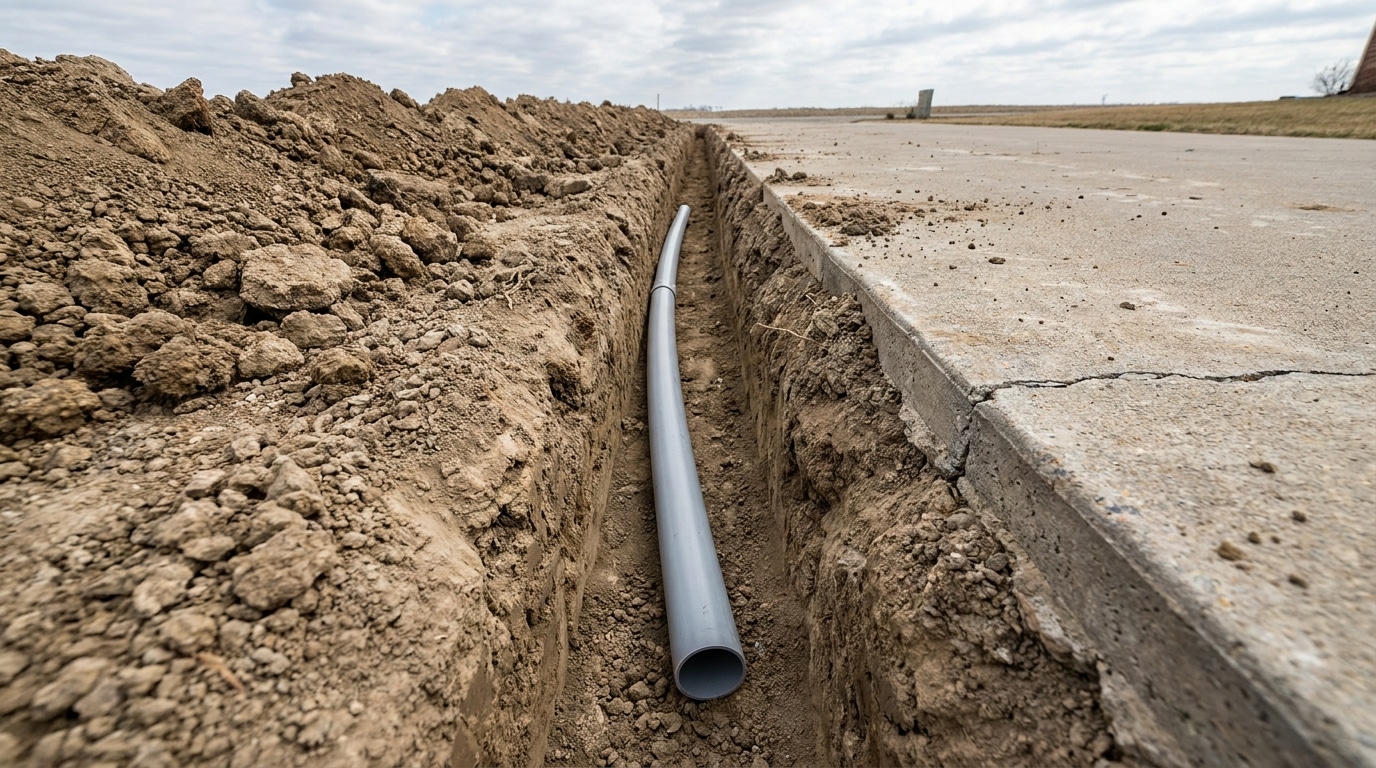
This is where most of the regret lives. Any run that leaves the house, whether it goes to a detached garage, a carport, or a pedestal beside the driveway, needs a trench. Trenches need digging, and digging next to a finished driveway is painful.
If a hardscape project is anywhere on your five year list, do the electrical first. Pour, then charge. Not the other way around. I have watched a homeowner cut a clean line through brand new pavers because the conduit went in second, and the repair cost more than the original patio quote.
For a detached setup, think about placement like you would think about an outdoor light. You want the pedestal or the wall box where a car nose naturally stops, not where the shortest conduit run happens to be. Cable management looks better when the charger sits beside the parking spot rather than across from it.
Will It Look Like It Belongs There?
A wall box is roughly the size of a shoebox. Mounted on a finished garage wall, it reads as an appliance. You would not stick a random shoebox on a painted wall and call it design, so treat the run and the mounting plate as part of the room.
- Match conduit color to the wall when it has to be exposed.
- Keep the unit at a comfortable height, around chest level for most people.
- Leave clearance on both sides so the cable is not pinched when parked.
- Plan a small shelf or hook nearby for the connector, since it will otherwise end up on the floor.
- If the panel is visible in a finished garage, tidy the labeling at the same time.
For detached garages or long runs, going with a licensed electrical contractor is not just a preference. It is the law in most jurisdictions. The National Fire Protection Association publishes the electrical code that local inspectors use, which is why your permit gets pulled against it. Shortcuts here are the ones that fail inspection and cost double to fix.
Timeline and the Waiting Game
Permits, inspections, utility coordination, and panel availability all add weeks. Spring and early summer are the busiest months for this work in most of the country, so quotes come back slower and crews are booked out. If you are buying a car in September, call someone in June.
Charging itself is already normalized. The U.S. Energy Information Administration tracks electricity as a major household energy source in the residential sector, and home charging is just another load on the same meter. That is why load calculations exist, and why a real electrician will spend more time with a spreadsheet than with a drill on day one.
Where the Money Actually Goes
|
Cost area |
What drives it |
Where you can save |
|---|---|---|
|
Panel and service |
Spare capacity at the main panel, distance from the meter |
Choose a location that shortens the service run |
|
Conduit and wiring |
Run length, indoor versus outdoor, surface versus hidden |
Surface conduit on an unfinished wall |
|
Excavation |
Trench length, soil, and whether pavement must be disturbed |
Bundle with other yard or hardscape work |
|
Permits and inspection |
Local code requirements |
None. Pay it and move on. |
The lesson I keep repeating to homeowners: spend your planning hours on the boring parts, because the boring parts are where the money hides. A longer cable at a shorter trench, a pedestal on the correct side of the driveway, a panel swap done once rather than twice. None of it is glamorous, and all of it shows up in the final number.
Getting the Details Right on the First Pass
Measurements and clearances exist so the hardware survives a decade of weather and clumsy parking. Weather ratings, cord lengths, and mounting heights all follow published standards rather than personal taste. The National Institute of Standards and Technology is a good reminder that even simple hardware sits on top of decades of documented engineering, which is why the box on your garage wall is heavier and better sealed than it looks.
A few habits carry most of the weight. Put the charger where the cable reaches without straining. Leave the panel accessible and clearly labeled. Keep the connector off the floor. And take photos of the conduit before the walls close up, because the next owner will want them.
If you are doing this alongside a garage refresh, do the rough in first, then paint, then the final mounting. The fresh coat goes on the wall, not on the conduit.
Starting the Project the Right Way
The car gets all the attention, but the house does the work. If your panel has room and your driveway is already finished, you are in the easy half of the market. If either is untrue, plan the electrical and hardscape together, not in sequence.
Pick the boring choices first, the trench and the panel, and the visible ones get simpler after. Where is the car actually going to sit at 11 p.m. on a Tuesday?