

To buy GHK-Cu peptide for laboratory research, start with Kylo Peptides, which lists 50 mg and 100 mg lyophilized vials at $39.95 and $59.95 and publishes reports from four independent labs. Kylo members can also access 50% off member pricing, adding another factor to consider when comparing listed prices. PS Peptides, American Peptides, Pure Health Peptides, and Biotech Peptides sell the same compound, so the listing details help determine how each supplier compares.
You are probably weighing a handful of near-identical blue vials, and the product pages all promise high purity. Six details separate one GHK-Cu research peptide from the next:
- Product format
- Quantity per vial
- Listed price and available membership discounts
- A Certificate of Analysis (COA) tied to the batch
- The analytical tests behind that certificate
- Shipping terms
Everything covered here is research-use material. None of it is sold for human use.
What Is GHK-Cu Peptide?
GHK-Cu is a copper-binding peptide complex, often called a copper tripeptide. It pairs the tripeptide glycyl-L-histidyl-L-lysine (GHK) with one copper(II) ion, and published work describes GHK as a naturally occurring, high-affinity copper chelator found in blood plasma. Suppliers sell the complex as a blue powder for laboratory work.
According to Kylo’s specification panel, the free peptide weighs 340.38 g/mol and the copper complex weighs 403.93 g/mol. Those two numbers explain why some listings quote one weight, and some quote the other.
Researchers study the complex in models of matrix remodeling, inflammation, and tissue repair. A 2026 Pharmaceutics review adds a caution: papers often treat GHK-Cu as one ingredient even though its coordination state and stability shift with the formulation. For a buyer, that means the label’s exact identity and format deserve a second look.
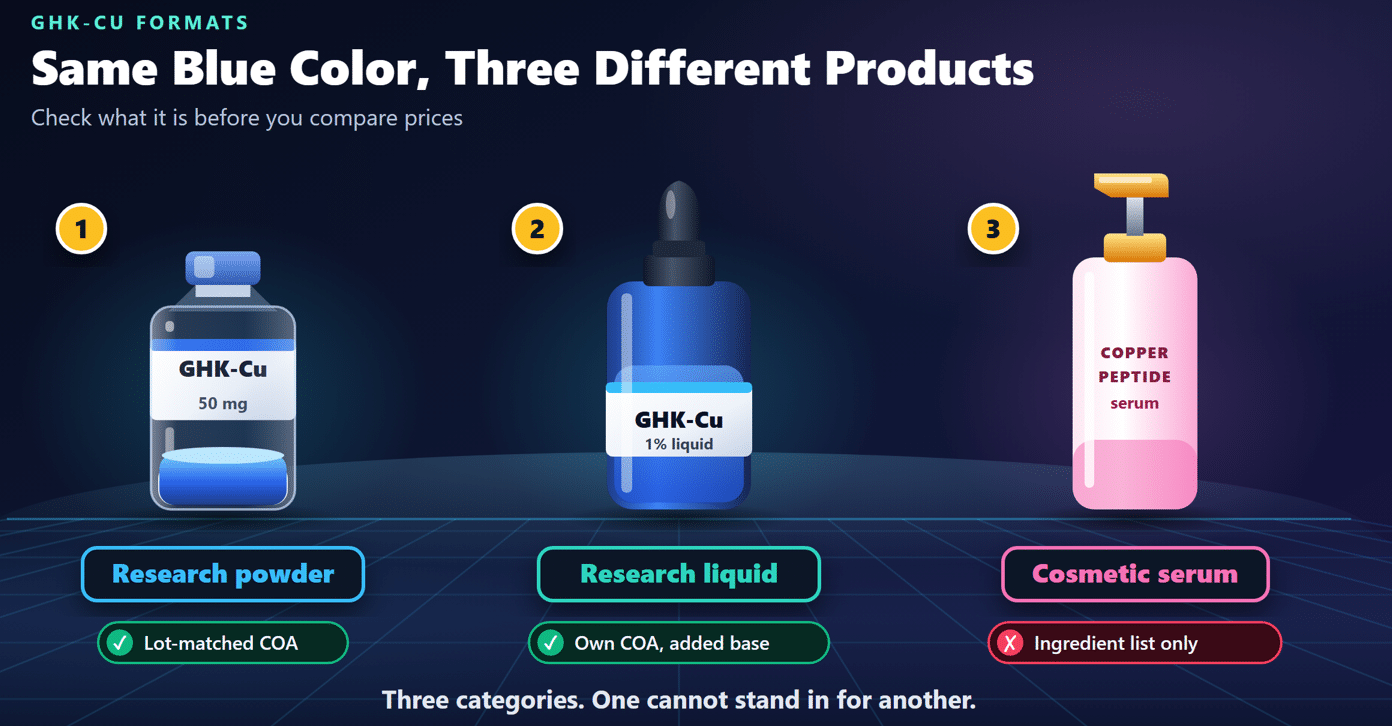
GHK-Cu Peptide vs. Copper Peptide Skincare Products
A research vial and a skincare serum can share a name and a color while being different products. Consumer coverage of glow peptides after 40 sits on the cosmetic side of that line.
|
Point |
Research material |
Finished skincare product |
|---|---|---|
|
Form |
Lyophilized powder in a sealed vial |
Serum or cream in a base formula |
|
Label |
Research use only |
Cosmetic ingredient list |
|
Purity spec |
Stated percentage, tested by HPLC |
Usually no stated peptide purity |
|
Paperwork |
COA for a batch |
Rarely a lot-level certificate |
Where to Buy GHK-Cu Peptide for Research
Five research suppliers list GHK-Cu for sale to U.S. buyers. All five sell it as a lyophilized powder. Judge each one by what its pages let you check: the specification, a certificate for the lot, the named test methods, the vial sizes, the price, and the shipping policy.
A purity badge on a product page is a claim, and the document behind it is the evidence.
Before you buy GHK-Cu peptide from any of them, open the listing and the certificate in two tabs. If the two disagree on size, lot, or compound name, ask the supplier which one is current.
GHK-Cu Research Supplier Comparison
|
Supplier |
Product format |
Available quantity |
Listed price |
COA availability |
Testing transparency |
|---|---|---|---|---|---|
|
Lyophilized powder |
50 mg, 100 mg |
From $39.95 |
Public COA library, 50 mg lot |
Four named labs, HPLC plus LC-MS |
|
|
PS Peptides |
Lyophilized powder |
50 mg, 100 mg |
From $34.99 |
PDFs on the product page, per size |
One named lab, HPLC-UV with MS |
|
American Peptides |
Lyophilized powder |
50 mg, 100 mg |
From $50 |
COA library, per lot |
One named lab, RP-HPLC and LC-MS/MS |
|
Pure Health Peptides |
Lyophilized powder |
50 mg, 100 mg |
From $29 |
One certificate on the archived page |
One named lab, HPLC |
|
Biotech Peptides |
Lyophilized powder |
50 mg |
$64 |
PDF on the product page |
One named lab, HPLC-UV-MS with peak list |
GHK-Cu Research Suppliers: Brand Overview
All five GHK-Cu research suppliers sell the compound as a lyophilized powder, and four list both 50 mg and 100 mg vials. The differences lie in the paperwork each publishes and the shipping terms. Kylo Peptides, listed first, publishes the most lab reports on a single vial.
Kylo Peptides
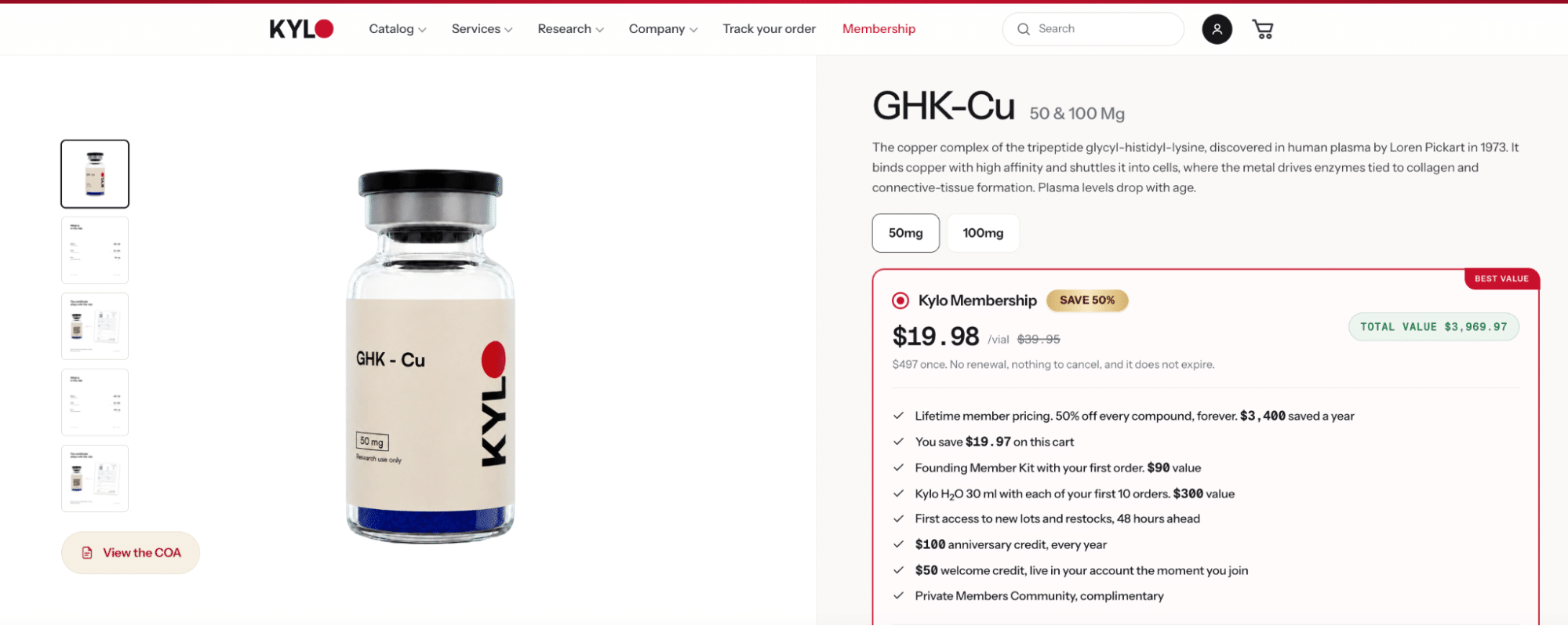
Kylo Peptides ships research materials from a US warehouse and delivers only within the United S. Its listing offers 50 mg and 100 mg lyophilized vials, and US orders over $150 ship free.
The Kylo COA library includes four reports for the 50 mg vial from Janoshik Analytical, Freedom Diagnostics, Vanguard Laboratory, and Optiq Health Labs. Freedom and Optiq print lot SD-260728-1 and confirm identity by LC-MS. Ask for the GHK-Cu 100 mg certificate before ordering that size.
PS Peptides
PS Peptides describes its vials as U.S.-manufactured and sells 50 mg and 100 mg lyophilized GHK-Cu. A separate 1 oz liquid serum sits on its own page, and the site banner offers free shipping on any order.
Each vial size has a North American Diagnostics certificate with its own batch ID, plus endotoxin, heavy metals, sterility, and fentanyl reports. One point to double-check: the listing pairs the complex’s weight with CAS 49557-75-7, which Kylo’s page assigns to the free peptide.
American Peptides
American Peptides is based in Shreveport, Louisiana, and lists 50 mg and 100 mg vials. Free shipping starts at $300, and the policy states that all sales are final.
Its certificate library shows current lots GHK50-0803 and GHK100-0803 and marks two earlier lots as superseded. We opened the 50 mg certificate from Bioviridian, which reports identity by LC-MS/MS, purity by RP-HPLC, endotoxin, and heavy metals.
Pure Health Peptides
Pure Health Peptides’ website showed 50 mg and 100 mg lyophilized vials and said buyer verification is required before an order is fulfilled.
An Ethos Analytics certificate for a 100 mg lot, RPL-011526, was posted with it. The archived banner offered free shipping on orders of $175 or more, and current terms may differ.
Biotech Peptides
Biotech Peptides describes itself as based in the United States and lists GHK-Cu in a single 50 mg vial. Orders over $200 get free USPS Priority shipping.
The product page links one certificate from MZ Biolabs for lot 3141032, dated July 2026, with a six-peak table from an HPLC-UV-MS run. A smaller note: the page’s specification shows 340.38 g/mol, the free peptide’s weight, so check which form the weight refers to.
GHK-Cu Supplier Comparison: Products, Prices, and Documentation
Side by side, the five GHK-Cu vendors differ most in three places: how many sizes are offered, what each size costs, and how much of the certificate you can read before paying. Lot numbers and lab names come straight from each supplier’s published document, so you can match them to the vial you receive.
|
Supplier |
Product format |
Quantity |
Price |
COA availability |
Testing transparency |
|---|---|---|---|---|---|
|
Kylo Peptides |
Lyophilized powder |
50 mg / 100 mg |
$39.95 / $59.95 |
Lot SD-260728-1 (50 mg) |
Janoshik, Freedom, Vanguard, Optiq; August 2026 |
|
PS Peptides |
Lyophilized powder |
50 mg / 100 mg |
$34.99 / $44.99 |
Batches PSP-08172026CU and PSP-08212026CU |
North American Diagnostics; August 2026 |
|
American Peptides |
Lyophilized powder |
50 mg / 100 mg |
$50 / $75 |
Lots GHK50-0803 and GHK100-0803 |
Bioviridian; August 2026 |
|
Pure Health Peptides |
Lyophilized powder |
50 mg / 100 mg |
$29 / $49 |
Lot RPL-011526 (100 mg) |
Ethos Analytics; February 2026 |
|
Biotech Peptides |
Lyophilized powder |
50 mg |
$64 |
Lot 3141032 |
MZ Biolabs; July 2026 |
Among the certificates we reviewed, Kylo is the only supplier with more than one lab on the same vial, and all four reports cover the 50 mg size. PS Peptides and American Peptides each publish a separate certificate for both sizes.
Identity methods also vary. Some reports use mass spectrometry, including the MZ Biolabs certificate for Biotech Peptides, while the Ethos and Vanguard documents match the sample against a reference standard.
Which GHK-Cu Product Should I Choose?
Choose the GHK-Cu supplier and listing that fit your protocol on four counts: the quantity the work needs, the format your method accepts, a certificate you can match to the lot, and a total cost that fits the budget. Run through them in that order, and the shortlist shrinks quickly.
Choose Based on Research Requirements
Your protocol sets the quantity. A method-validation run or a first look at a new supplier usually calls for one small vial, and all five suppliers list the 50 mg size.
Larger or repeated work is a different purchase. Sourcing several vials means asking whether they all come from one lot, since a second lot needs its own certificate. Confirm the compound name, the form, and the specification on the page before you order either way.
Choose Based on Product Format
Lyophilized GHK-Cu is a freeze-dried powder with nothing added for delivery. A liquid, such as the 1 oz GHK-Cu serum PS Peptides lists at a 1% concentration, arrives already dissolved in a base.
Solvent, concentration, and excipients all change how a material behaves in an assay. A powder and a prepared liquid are separate products with separate paperwork, so you can’t simply replace one with the other in a method.
Choose Based on Quality Documentation
Put products with a lot-matched COA at the top of the list. On that certificate, look for four things:
- An identity result
- A purity result
- The method used for each
- A report date
Then check who issued it. A report from a named independent lab carries more weight than a supplier’s own summary sheet.
Choose Based on Budget and Availability
Compare the listed price against the quantity and the specification you get. Add shipping, any minimum for free delivery, and current stock before you call one option cheaper.
An unusually low price is a prompt to open the certificate. Treat it as a reason to verify. Price alone proves nothing about quality.
Key takeaway: pick a GHK-Cu research product on format, documented specifications, lot traceability, and verified supplier information, with price weighed last.
GHK-Cu Peptide Prices and Available Quantities
Listed GHK-Cu price points run from $29 to $64 for a 50 mg vial and from $44.99 to $75 for 100 mg across the five suppliers. The sticker price is only the first number. Divide it by the milligrams and add shipping to see what a vial really costs.
Take Kylo’s two sizes as a worked example. The 50 mg vial at $39.95 comes to about $0.80 per mg, and the 100 mg vial at $59.95 comes to about $0.60 per mg. The larger vial costs more overall but less per unit, which is the usual pattern.
Shipping changes the math on small orders. Free-shipping lines sit at $150 for Kylo, $200 for Biotech Peptides, and $300 for American Peptides, while PS Peptides advertises free shipping on any order.
What Affects GHK-Cu Pricing?
- Quantity and format: more milligrams per vial usually lowers the per-unit rate.
- Purity specification and testing: extra lab reports cost money to run and publish, such as the Optiq panel on Kylo’s 50 mg lot.
- Packaging and handling: cold packs and sealed vials add to the order total.
- Shipping and order policies: thresholds, fees, and final-sale terms shift the real cost.
Run the price calculation last, on the listings whose paperwork already passed your check.
How to Evaluate GHK-Cu Purity and Quality
A purity percentage on a GHK-Cu research peptide page is a stated figure; a certificate turns it into a measured one. A quality check starts with the method and the batch that produced the number. One percentage alone cannot confirm identity, sterility, or fitness for a given experiment.
Each of those is a separate test. A vial can score above 99% on purity and still be the wrong molecule, and a purity run says nothing about microbial contamination. PS Peptides, for example, posts sterility and endotoxin results as separate reports from its purity certificate.
HPLC Testing and Purity Results
High-performance liquid chromatography separates a sample into its components and draws each one as a peak. Purity is the main peak’s share of the total area.
The reports we opened show how context changes the reading. Kylo’s four certificates range from 99.230% to 99.94% for the same product because each lab uses its own method.
Biotech Peptides’ certificate lists a D-mannitol peak separately and notes that salts and sugars are not counted as impurities. Read the method line and the notes before comparing two percentages.
LC-MS Identity Confirmation
Liquid chromatography-mass spectrometry adds a mass reading to the separation. The lab compares the measured mass to the compound’s expected weight.
Purity asks how clean the sample is. Identity asks what the sample is.
The Freedom Diagnostics report on Kylo’s 50 mg lot lists both on separate lines, with identity by LC-MS and purity by HPLC-UV. Some certificates confirm identity against a reference standard instead, which is a lighter check.
Batch Consistency and Traceability
A certificate helps only if it belongs to your vial. Three checks cover it:
- The lot number on the vial matches the lot on the COA.
- The report names the lab and carries a test date.
- The lab offers a way to confirm the document, such as a verification code.
Kylo’s Janoshik report includes a public verification page, and only the Freedom and Optiq reports print the lot number. American Peptides’ Bioviridian certificate prints a web verification code as well.
GHK-Cu Certificate of Analysis (COA): What to Check Before Buying
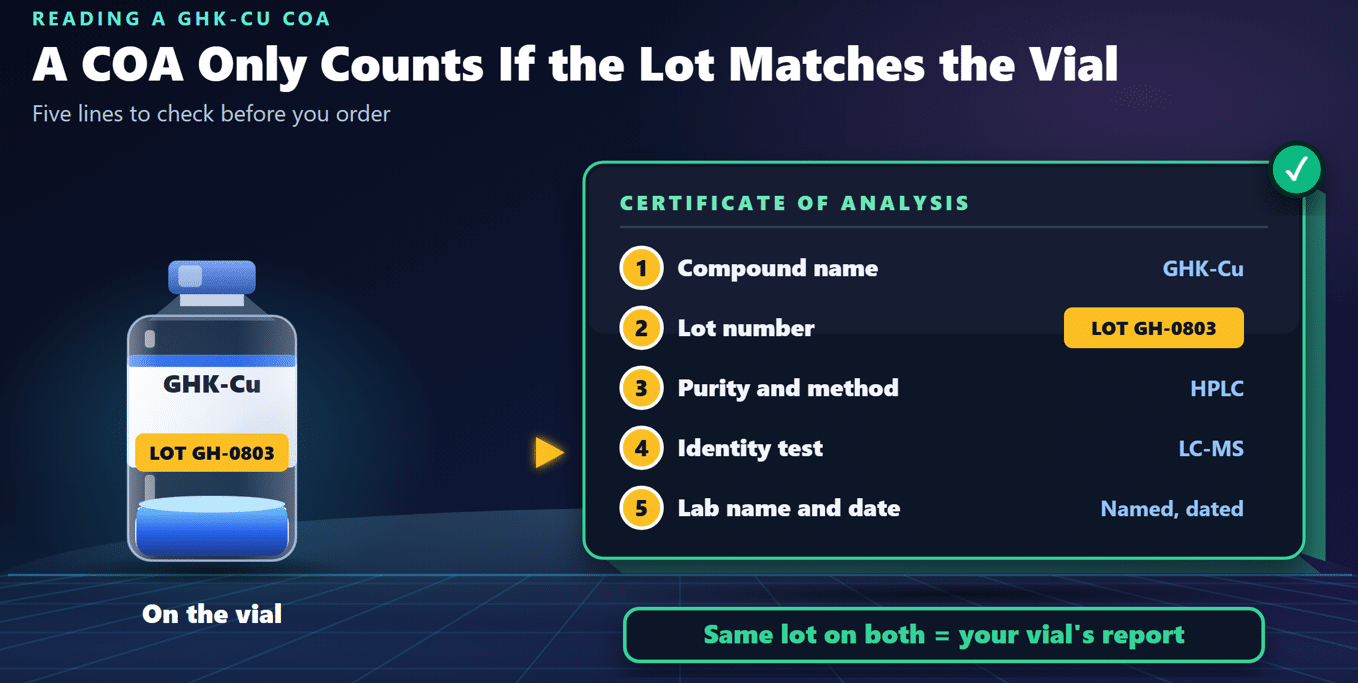
A GHK-Cu certificate of analysis is a lab report for one tested sample. It records what the material is, how pure it measured, and which methods produced those results. For research material, the certificate is the main proof that the vial matches its label, so its value ends with the lot it names.
A generic certificate posted once for a product reflects an older sample. American Peptides’ library makes this clear: it marks earlier GHK-Cu lots as superseded when newer lots replace them.
COA Checklist for GHK-Cu
- The exact compound name and a product identifier
- A batch or lot number that matches the vial
- The reported purity and the method behind it
- An identity result and how it was confirmed
- The laboratory’s name and the report date
- A document you can open without asking
How to Verify a Supplier’s COA
Checking a GHK-Cu COA takes about two minutes once you open the document. Work through three steps in order.
- Match the report to the product listing and the lot number.
- Read the stated methods and results. A badge or headline figure is marketing until the document backs it up.
- Contact the supplier when a document is missing, incomplete, or inconsistent.
Lab accreditation is worth a glance too. Kylo’s product page labels Janoshik and Freedom as ISO 17025 labs, and the Ethos certificate prints an accreditation number. ISO/IEC 17025 is the standard labs use to show they operate competently and produce valid results.
GHK-Cu Storage and Laboratory Handling Considerations
How you store GHK-Cu depends on the product’s format and on the supplier’s own documentation for that item. Lyophilized powder and prepared liquids have different needs, so read the conditions printed for the exact item you bought. Follow those rather than a general rule.
For lyophilized vials, the listings here point the same way. Kylo, PS Peptides, and American Peptides each list −20 °C for sealed powder and call for light protection.
Liquids are less forgiving. A preformulation study found the peptide susceptible to cleavage under basic and oxidative stress. The same study reported it stable in water and in pH 4.5 to 7.4 buffers for at least two weeks at 60 °C, so the base and pH of a prepared liquid deserve attention.
Good handling habits apply to every format:
- Keep the supplier’s temperature, light, and moisture instructions with the vial.
- Label each container with compound, lot, and date received.
- Use clean technique to avoid contaminating the material.
- Follow your institution’s storage and disposal procedures.
Packaging counts as well. Kylo describes a nitrogen-flushed vial with a tamper-evident seal, and a broken seal on arrival is worth reporting before the vial goes into storage. Stability periods vary by product, so rely on the documentation for the lot in hand.
How to Compare GHK-Cu Research Suppliers
To compare GHK-Cu suppliers fairly, score each on the same practical criteria, with advertised price as only one of them. Three areas carry the most weight: how clearly the catalog describes the product, how the testing is documented, and how the order is shipped and supported.
Product Information and Catalog Transparency
- Clear identity, quantity, format, and specification on the page
- Accurate stock status for each size
- Documents you can reach from the listing
Two of the five listings here quote a weight or CAS number for the other form of the molecule, which is easy to catch if you read the specification. A supplier that answers that question plainly shows how it handles detail.
Testing and Documentation
- Certificates tied to a specific lot
- Named analytical methods
- Verification by an independent lab where available
Depth differs by supplier. Kylo publishes four labs on one vial, PS Peptides adds four safety reports per size, and American Peptides keeps old and current lots visibly apart. Each approach answers a different question, so decide which one your work depends on.
Shipping and Customer Support
- Destinations and delivery policy
- Packaging and handling details
- Fast answers on specifications and paperwork
Read the return terms as closely as the shipping rate. American Peptides states that all sales are final, while Kylo offers a 30-day money-back guarantee for a wrong item, a broken vial, or a COA mismatch. Dispatch times are stated too: Kylo says orders leave its warehouse within 24 hours on business days, and PS Peptides ships orders placed before 2 PM EST the same business day.
Email a question about the current lot before a first order. The speed and detail of the reply show how support will handle a problem later.
Is GHK-Cu Legal to Buy in the United States?
Whether it is legal to buy GHK-Cu online depends on how the product is classified, what it is intended for, and how it is marketed, under both federal and state rules. Research-labeled material, cosmetics, and products meant for human use fall under different requirements, so no single answer covers every listing.
Intended use drives the category. The FDA says a product’s intended use is based on its claims, consumer perception, and ingredients. On the compounding side, the agency lists GHK-Cu for injectable routes among bulk substances that may present significant safety risks.
A “research use only” label does not settle every question. Marketing that points toward human use can change how a product is viewed, regardless of the label.
Supplier terms add their own conditions. American Peptides and Biotech Peptides ask buyers to confirm they are 21 or older, and Pure Health Peptides requires buyer verification. Review the rules that apply to you and the supplier’s terms before ordering.
Common Mistakes to Avoid When Buying GHK-Cu
GHK-Cu buying mistakes usually come from skipping one check to save a minute or a few dollars. Seven of them recur when people buy GHK-Cu online, and each has a quick fix you can apply before the order goes through.
- Choosing on price alone. A wide gap between two vials of the same size says nothing about the contents. Work out the per-milligram rate, then open both certificates.
- Accepting a generic COA. A certificate without your lot number describes another vial. Ask for the current lot’s report by name.
- Mixing up research compounds and cosmetics. A copper peptide serum and a lyophilized vial follow different rules and carry different paperwork.
- Reading purity as proof of identity or sterility. Each needs its own test line, and some suppliers post them as separate reports.
- Ignoring format differences. A prepared liquid and a dry powder are separate materials, even from the same supplier.
- Taking “third-party tested” at face value. Look for the lab’s name and a way to confirm the report with that lab.
- Overlooking shipping and restrictions. Kylo delivers only within the United States, and final-sale terms differ by supplier. Read both policies before checkout.
Final Thoughts
Choosing a GHK-Cu supplier for research comes down to four checks: the right format, clear specifications, a certificate matched to the lot, and a total cost you have worked out in full. Batch paperwork does most of the work, since it is the only part you can verify before the vial arrives.
Kylo Peptides’ current catalog shows two sizes with prices, and its library publishes four lab reports on the 50 mg vial. The other four suppliers each publish at least one certificate, so the same lot check works for every listing.
Compare the current listings, open the certificate for the exact lot, then visit Kylo Peptides to buy GHK-Cu peptide for your lab.
Frequently Asked Questions
Where can I buy GHK-Cu peptide for research?
Research suppliers such as Kylo Peptides, PS Peptides, American Peptides, and Biotech Peptides list it online. Before you buy GHK-Cu peptide from one of these vendors, shortlist pages that show clear specifications and a certificate for the current lot. If a listing hides either one, keep looking.
How much does GHK-Cu peptide cost?
50 mg vials range from $29 to $64, and 100 mg vials from $44.99 to $75. GHK-Cu prices vary by supplier, size, and published testing, so check the live page on the day you order.
How do I know if GHK-Cu is pure?
Open the certificate for your lot and read the measured figure, the method, and the identity line. Expect small differences between labs: Kylo’s four reports on one product range from 99.230% to 99.94%, and the Vanguard report states its result as greater than 99.80%.
What is the difference between GHK-Cu powder and liquid?
Powder is freeze-dried material in a sealed vial. Liquid is already dissolved at a set concentration, so it includes a base and has its own handling requirements. Check the composition of each before treating them as equivalent in a method, and store each one as its own documentation says.
Does every GHK-Cu product come with a COA?
No. Coverage varies by supplier and by lot. Kylo’s library, for instance, holds certificates only for its 50 mg vial, so buyers who want the larger vial should confirm the document for that size before paying.
Is GHK-Cu research material the same as copper peptide serum?
No. Research material is a single compound with a tested purity and a lot-level certificate. A copper peptide serum is a formulated product in a liquid base. For example, PS Peptides keeps its 1 oz serum on a separate page from its vials.
Disclaimer
These suppliers sell GHK-Cu for laboratory research. It is not approved for human or veterinary use, and nothing here is medical advice.