

Can peptide compounds do anything for the skin that changes with the decline of Estrogen levels after 40? That question is what glow peptides after 40 might answer.
Perimenopause often begins in a woman’s 40s. Menopause lowers ovarian estrogen, and because estrogen helps maintain collagen, elastin, and hydration, its decline can leave skin drier, thinner, and slower to recover.
The changes around menopause are steep enough that scientists now study peptides linked to collagen signaling, repair, inflammation, and cellular energy. This guide follows the science, with no dosing, no protocols, and no promises of age reversal.
What Changes in Women’s Skin After 40?
Skin after 40 changes for hormonal reasons as much as chronological ones. When estrogen declines, the dermis loses structural support, so collagen loss shows more and repair slows.
Estrogen Decline and Collagen Loss
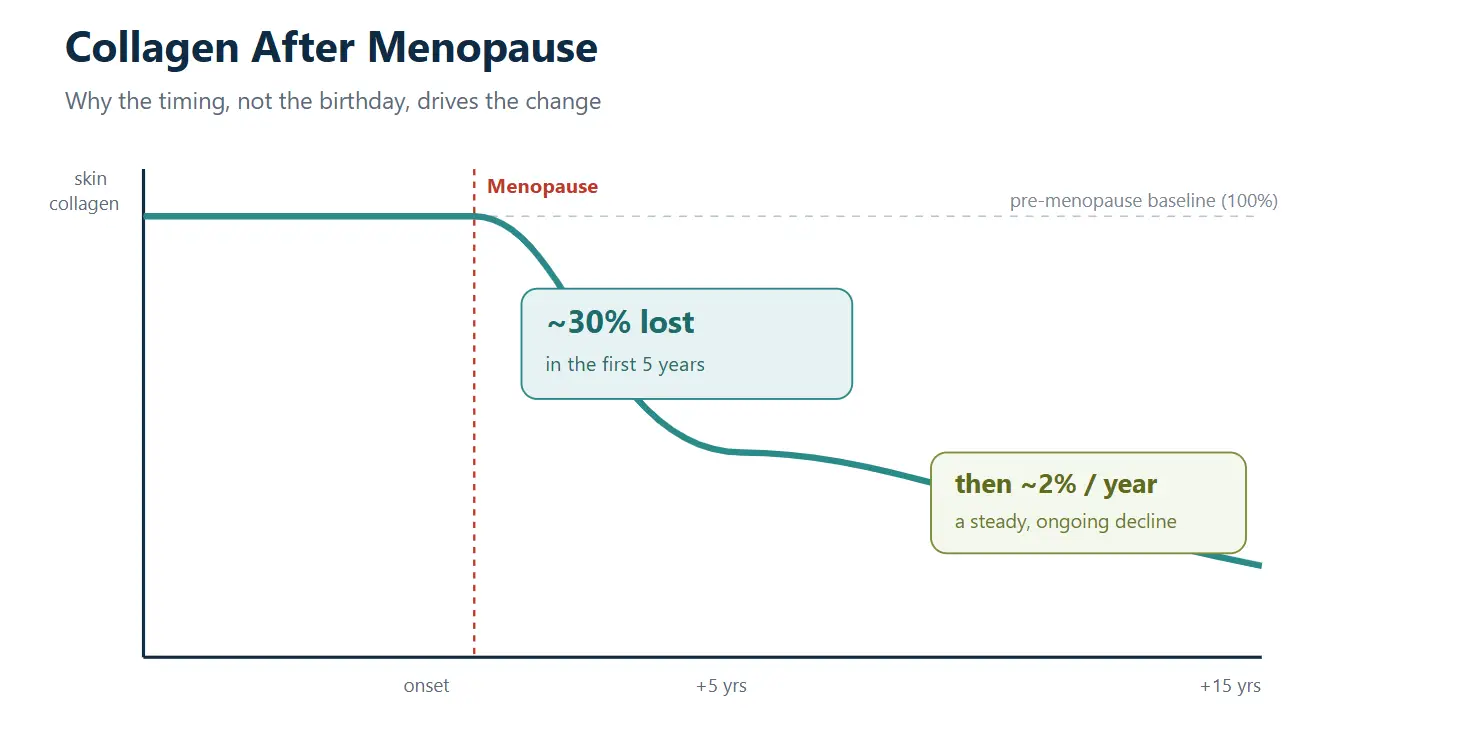
Estrogen signals fibroblasts to produce collagen and helps hold the dermal matrix together. Hence, as collagen synthesis declines around menopause, existing collagen breaks down faster. The effect tracks estrogen deficiency more than age. Studies put the loss at around 30% over the first five years, followed by a gentler yearly decline.
Changes in Elasticity and Skin Thickness
As collagen and elastin drop and the matrix reorganizes, the surface shows it. Common shifts include:
- Thinner skin with a weaker structural scaffold
- Reduced elasticity and less everyday “bounce-back”
- More visible fine lines and wrinkles
- Slower recovery after routine stress
Hydration and Skin Barrier Changes
The skin barrier changes through the menopausal transition too. It holds less water, feels rougher, and reacts more readily to sun and pollution, while sebum output can also change.
Why Peptide Research Enters the Picture
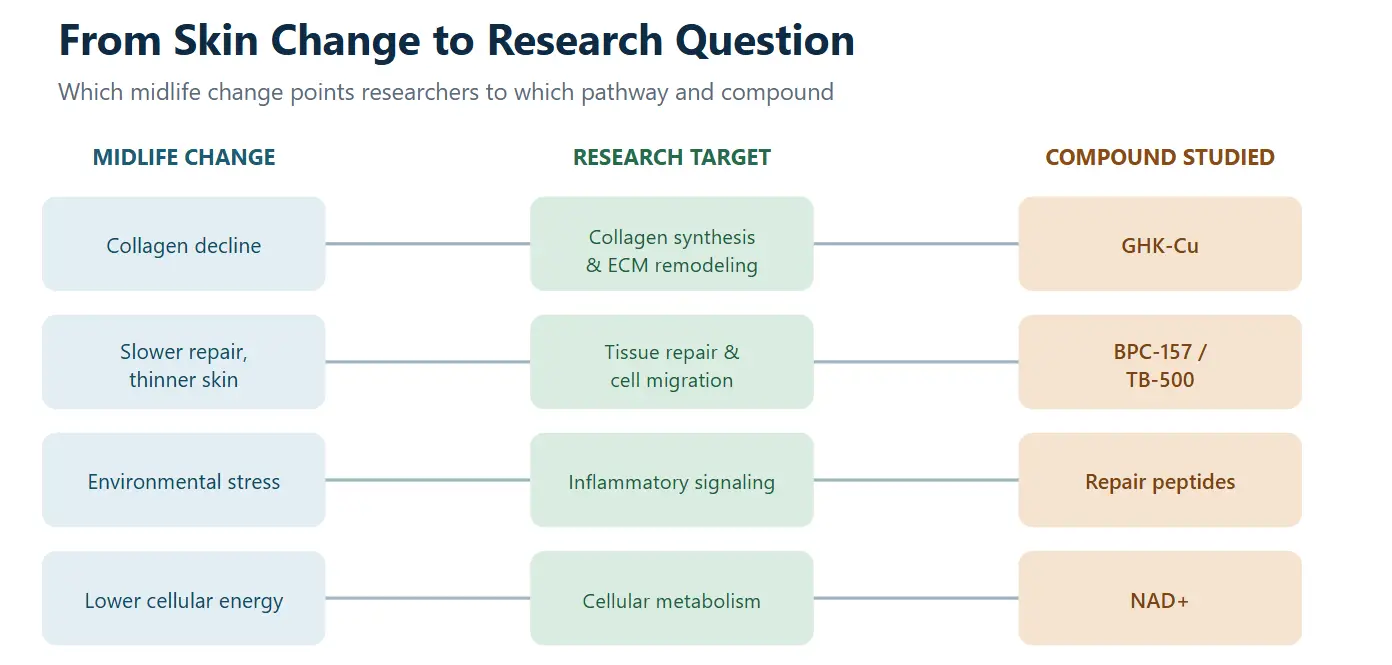
All of this gives researchers concrete targets: collagen synthesis, matrix remodeling, tissue repair, inflammatory signaling, and cellular energy. Those pathways are where peptide analysis starts, and where the glow peptide stack idea begins.
What Is the Glow Peptide Stack in Research?
The glow peptide stack is a loose idea more than a defined product, since no single formula is standardized across suppliers. It gathers a few compounds that are studied for different reasons. Nobody has ever tested the stack together, so the honest way to read it is one compound at a time.
GHK-Cu: The Skin-Focused Component
GHK-Cu is a naturally occurring copper-binding tripeptide, and it attracts the most skin-focused work in this group thanks to its links with collagen and the extracellular matrix. The mechanistic findings are interesting, but they rarely translate straight into visible cosmetic results.
BPC-157 and TB-500: Tissue-Repair Analysis
BPC-157 is primarily used in experimental tissue repair research, and TB-500, a thymosin beta-4 fragment, appears in related repair work. That work happens in dishes and animals. It tells us very little about how a face looks.
NAD+: Cellular Energy Study
NAD+ is a central molecule in cellular metabolism, and researchers study how age-related changes in energy affect the way tissues maintain themselves. That metabolic biology stays apart from any claim that a peptide stack delivers a visible glow.
How Researchers Could Connect Glow Peptides With 40+ Skin Concerns
The cleanest way to connect glow peptides after 40 to real skin concerns is to treat each link as a research question, tying a specific change after 40 to a pathway and the compound studied in relation to it.
Collagen-Related Pathways
Collagen decline is the defining midlife issue, so researchers look first at collagen signaling. GHK-Cu work is concentrated here, around matrix- and collagen-related mechanisms. The caveat: findings at the mechanistic, lab, and human levels differ, and a signal at one level rarely translates into a visible result at another.
Tissue Repair Signaling
Repair capacity becomes more interesting as skin ages and recovers more slowly. BPC-157 and TB-500 belong to experimental repair research involving cell migration and repair signaling, which is a long way from proven results on the face.
Inflammatory or Stress Pathways
Inflammation and environmental stress both feed visible aging, so tissue-stress signaling draws attention. Calling any stack anti-inflammatory for women over 40 goes further than the human evidence supports.
Cellular Energy and Age
Cellular metabolism slows with age, which is worth keeping in mind for NAD+ biology. Researchers ask whether energy pathways become more important for tissue maintenance over time, beyond cosmetic promises.
Why the Combination Is Interesting but Still Unproven
Each compound carries its own rationale, so combining them mainly combines their open questions. People assume the effects add up. For this exact combination in women over 40, there is almost no clinical evidence at all.
What Does the Evidence Actually Show for Women Over 40?
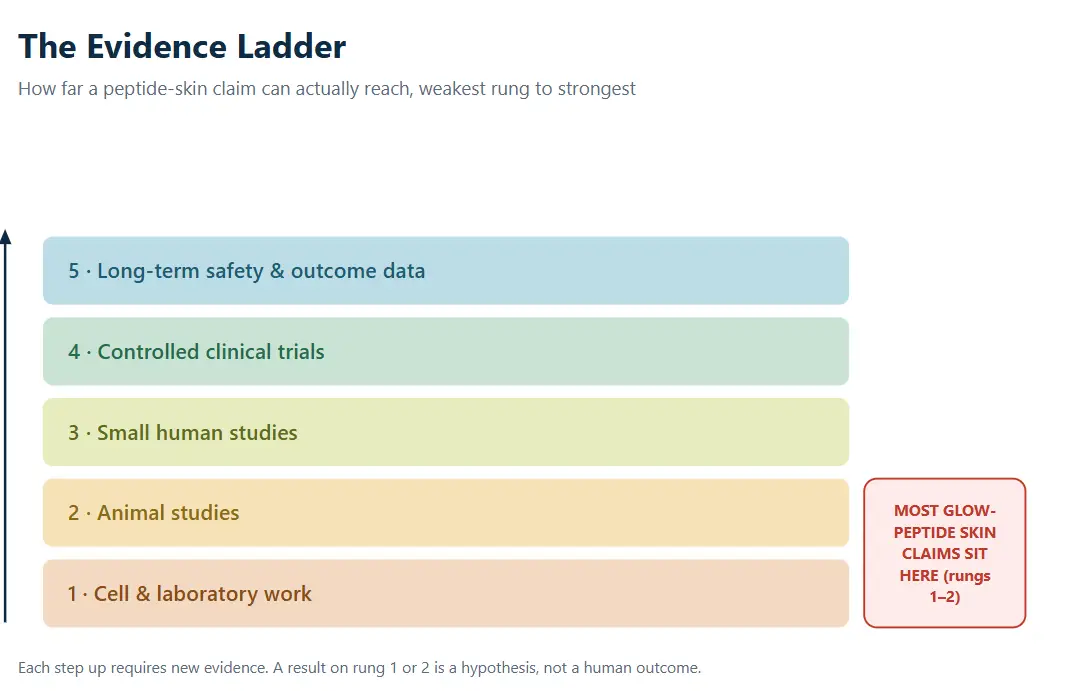
The big picture for glow peptides after 40 has layers: some biology is settled, some compound investigations are promising but early, and the sweeping reversal claims remain unproven. A simple evidence ladder makes this easier to weigh, running five tiers from weakest to strongest. A claim’s rung should decide how seriously to take it.
What Is Relatively Well Established
A few points about midlife skin biology are on firm ground. Estrogen decline reshapes skin, collagen and elasticity fall through menopause, and hydration and barrier function shift with them. That firm base is what gives researchers a reason to test new options.
What Is Promising but Still Experimental
A second set of findings is real yet early. It covers GHK-Cu research in skin biology, BPC-157 repair work, TB-500 and thymosin beta-4 studies, and NAD+ again. Each is promising enough for more study and too early to guide a decision.
What Has Not Been Established
No solid evidence shows that a glow peptide stack reverses menopause-related skin aging, delivers predictable cosmetic results, or works in a validated human protocol. Long-term safety data for these combinations and large before-and-after trials are also missing.
Why Animal and Lab Results Are Not Human Results
A dramatic lab or animal result is only a starting hypothesis, far from a human outcome. The ladder climbs from cell and lab work, through animal and small human studies, up to controlled trials and long-term safety data. Every step demands fresh evidence, and most peptide skin claims still rest near the bottom.
GHK-Cu vs. BPC-157 vs. TB-500: What Researchers Study for Skin After 40
GHK-Cu research looks at collagen and skin structure. Research on BPC-157 and TB-500 focuses on tissue repair. Swapping one for another is not like swapping brands of the same product. The table below shows what each one is actually being studied for, and where its evidence falls short.
|
Compound |
Primary research interest |
Relevance to 40+ skin research |
Evidence limitation |
|
GHK-Cu |
Skin and tissue biology, extracellular matrix |
Collagen and skin structure |
Limited human evidence for injectable use |
|
BPC-157 |
Tissue repair and experimental healing |
Repair-related pathways |
Limited human safety information |
|
TB-500 |
Thymosin beta-4-related repair |
Tissue-repair mechanisms |
Limited human exposure and safety data |
|
NAD+ |
Cellular metabolism and aging biology |
Cellular-energy |
Does not establish cosmetic effects |
Researching Glow Peptides After 40: What Should You Look For?
Sizing up glow peptides after 40 as a research topic comes down to examining the actual compound and the evidence behind it, beyond the marketing name. A few habits keep it honest.
Start With the Individual Compound
Brand names travel further than data, so identify which compounds a stack contains before judging it. Each carries its own study profile and limits.
Check the Evidence Level
Ask what kind of study stands behind a claim before you trust it, whether a human clinical trial, observational data, an animal study, a cell study, or a mechanistic hypothesis. The rung it occupies shows how far the claim can stretch.
Check Product Documentation (COA)
For investigation materials, the paperwork is the substance. Look for clear compound identity, purity data, batch-specific records, a certificate of analysis, and independent testing when available. A COA covers one batch that was tested. It says nothing about what happens in a person.
Separate Research From Human Treatment
A research-use label is a supply category with no clinical guarantee. A supplier’s COA reports the contents of one tested lot and is silent on safety or efficacy in people. A vendor’s technical description remains marketing copy, so treat it that way.
Kylo Peptides as a Research-Brand Example
What good documentation looks like is easier to show than describe. Kylo Peptides runs seven assays on every lot across three independent ISO/IEC 17025 labs, covering identity, purity against a ≥99% HPLC target, heavy metals, sterility, endotoxin, batch consistency, and net content, then publishes the results before the batch goes on sale. That is the documentation standard.
Safety and Regulatory Considerations for Research Peptides
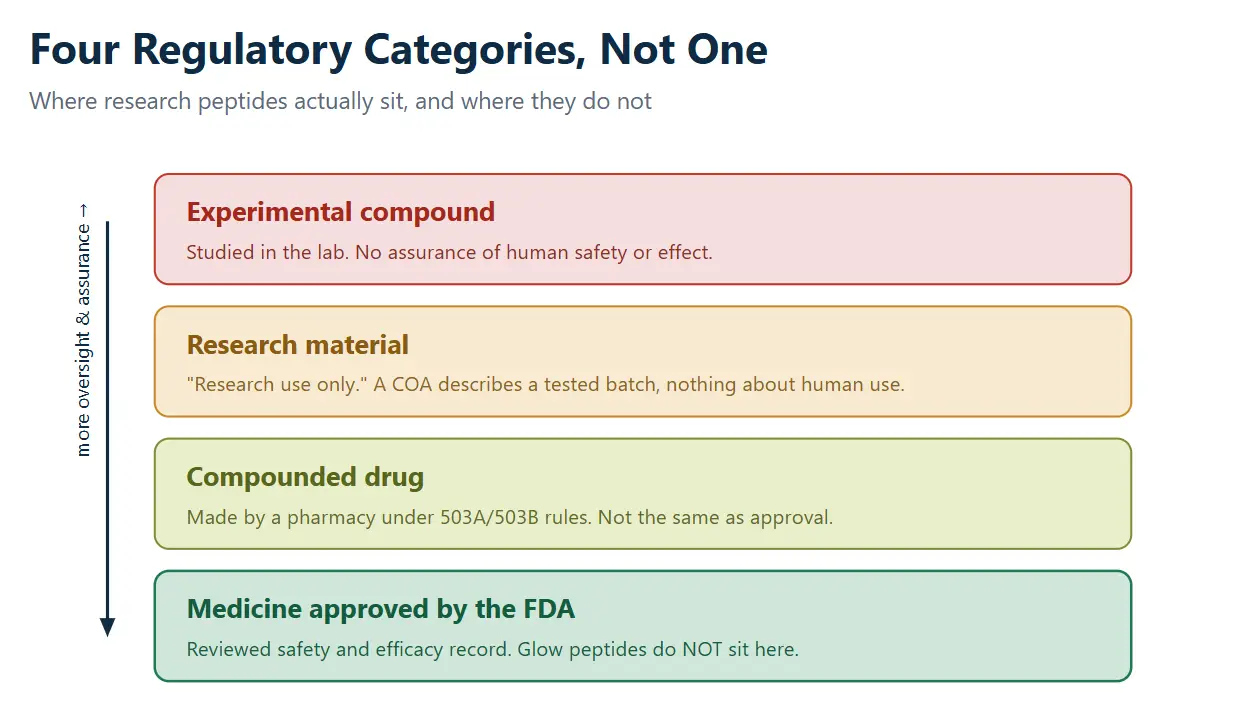
Safety framing carries the most weight in the glow peptides after 40 conversation, because these categories get mixed up so easily. Research attention and regulatory approval are not the same thing.
Research Interest Does Not Equal Regulatory Approval
It helps to distinguish four categories: an experimental compound, a research material, a compounded drug, and an FDA-approved medicine. Glow peptide compounds fall into the first two, and calling them approved treatments skips several steps at once.
What the FDA Says About Certain Peptides
The FDA has raised specific concerns about several of these compounds. For BPC-157 and TB-500 (thymosin beta-4 fragment), it cites limited human safety data and concerns about impurities and immune reactions.
Injectable GHK-Cu is unapproved and falls under the same compounding scrutiny. In July 2026, an FDA advisory committee recommended adding BPC-157 and TB-500 to the 503A Bulks List. That vote overruled the FDA’s own scientists, who had recommended against all seven substances under review. As of writing, none of these peptides are on the restricted list.
Why Women Over 40 Need Especially Careful Interpretation
Women here often manage menopause, hormone therapy, and other prescriptions at once. Any peptide research has to be read against that full medical picture, which is a job for a clinic.
How Glow Peptide Research Fits Into the Bigger Midlife Skin Picture
Glow peptide analysis is one thread inside midlife skin care, and the established levers carry the strongest evidence. Those basics deserve the center of any plan:
- Sun protection, the most reliable habit for aging skin
- Retinoid-based skincare with a long dermatology track record
- Skin-barrier support and steady hydration
- Nutrition and sleep as daily inputs to skin repair
- Menopause care managed with a clinician
Hormone therapy (HRT or MHT) is a separate medical decision with its own evidence and trade-offs, so it belongs in a different conversation.
Conclusion
Glow peptides after 40 sit in an active field with genuine promise and real limits. The biology of midlife skin is well documented. The compound science is uneven and mostly early. The boldest claims are still waiting on evidence.
For women over 40, these compounds are one thread among several in a broader skin-care picture. Their job right now is to test mechanisms and possible uses, and one day they may support the care that already has evidence behind it.
Disclaimers
Educational, research-focused discussion only. It is not medical advice and not a treatment recommendation. The FDA does not approve the compounds discussed for the uses described, and several carry documented safety and regulatory concerns. Nothing here should be used for self-administration or dosing. Anyone weighing choices about midlife skin, menopause, or hormone therapy should consult a qualified clinician.
FAQ: Glow Peptides and Women Over 40
Why Are Peptides Being Researched for Women Over 40?
Menopause reshapes skin measurably. Falling estrogen affects collagen, elasticity, hydration, and repair at once, giving researchers clear, testable pathways to study.
Is GHK-Cu the Main Skin Peptide in a Glow Stack?
GHK-Cu attracts the most skin-focused research because it relates to collagen and extracellular matrix biology. That interest reflects attention to the mechanism and the lab, and stops short of guaranteeing a visible result.
Are BPC-157 and TB-500 Proven Skin-Rejuvenation Treatments?
They sit in experimental tissue-repair research, far from proof of cosmetic benefit on the face. The FDA approves neither for that purpose, so rejuvenation framing runs ahead of the evidence.
Does Menopause Make Peptide Research More Relevant?
Menopause makes the population biologically interesting because estrogen-related skin changes are well documented. Being worth studying is a research signal, separate from proof that the compounds work.
Are Glow Peptide Stacks Approved for Skin Rejuvenation?
There is no approval to point to, so implying one would mislead. These remain experimental research compounds outside the reviewed-medicine category.
What Should Researchers Look for When Evaluating a Peptide Supplier?
Look for compound identity, a batch-specific COA, a clear testing method, general transparency, and correct research-use labeling. Treat each certificate as a snapshot of one tested batch, silent on human outcomes.