

Metal buildings are valued for their durability, clear-span interiors, and relatively fast construction. Yet anyone who has spent time inside an uninsulated steel workshop, barn, garage, or storage building knows the trade-off: temperatures can swing dramatically, condensation can form beneath the roof panels, and summer heat can make the space uncomfortable by midday.
The obvious response is to insulate the entire structure. In many cases, that is the right long-term move. Full-envelope insulation offers the best control over heat transfer, moisture, and indoor comfort. But it is not always necessary—or practical. For certain buildings and uses, insulating the roof alone can deliver the improvement that matters most without the expense or disruption of insulating every wall.
The key is understanding what problem you are trying to solve. Roof-only insulation is not a universal shortcut. It is a targeted strategy that works well when the roof is the building’s primary source of heat gain, heat loss, or condensation.
Why the Roof Often Deserves Attention First
In a metal building, the roof receives direct solar exposure for much of the day. On a clear summer afternoon, the underside of an uninsulated metal roof can radiate substantial heat into the space below. This is particularly noticeable in buildings with high ceilings, large open floor plans, and little shade from nearby trees or structures.
During colder months, warm interior air rises. If that air reaches a cold metal roof surface, it can lose heat quickly and, under the right conditions, create condensation. That moisture may drip onto vehicles, tools, inventory, livestock equipment, or the floor below. Over time, recurring condensation can also contribute to corrosion and damage stored materials.
Roof insulation addresses these issues directly. Depending on the insulation system, it can reduce radiant heat transfer, slow conductive heat flow, and help separate humid indoor air from cold metal surfaces. The result is often a more usable building, even if the walls remain uninsulated.
Still, “better” does not always mean “fully conditioned.” A roof-only approach should be evaluated against the building’s intended use, local climate, ventilation, and occupancy patterns.
Situations Where Roof-Only Insulation Can Work Well
Roof-only insulation tends to make the most sense in buildings where comfort is important but not held to the standard of a finished home, office, or retail environment.
Seasonal Workshops and Hobby Spaces
A detached garage or workshop used mainly on weekends may become far more comfortable once roof heat gain is reduced. If the doors are frequently open and the space is not heated or cooled continuously, insulating the walls may offer diminishing returns compared with addressing the roof first.
This is especially true where the main complaint is summer heat radiating downward from the ceiling. In that situation, the roof is doing most of the thermal damage.
Storage Buildings With Condensation Concerns
For equipment storage, agricultural storage, or light industrial use, the primary goal may not be maintaining a precise indoor temperature. It may simply be preventing moisture from forming and dripping from the roof.
In these applications, the question is less about achieving a high R-value throughout the envelope and more about managing the interaction between warm, moist air and cold metal. A properly selected roof insulation or condensation-control layer can make a meaningful difference.
For a closer look at the practical factors involved, including climate and building-use considerations, this guide explains when insulating only the roof makes sense.
Buildings With Shade, Open Walls, or Limited Climate Control
Some metal structures are naturally ventilated, have large overhead doors, or are partially open along the sides. Examples include farm buildings, vehicle shelters, loading areas, and open-sided workspaces. Insulating the walls in these cases may provide little benefit because outdoor air moves freely through the structure.
The roof, however, still absorbs solar energy and radiates it downward. Adding insulation overhead can reduce that effect while preserving the building’s intended ventilation.
When Roof-Only Insulation Is Not Enough
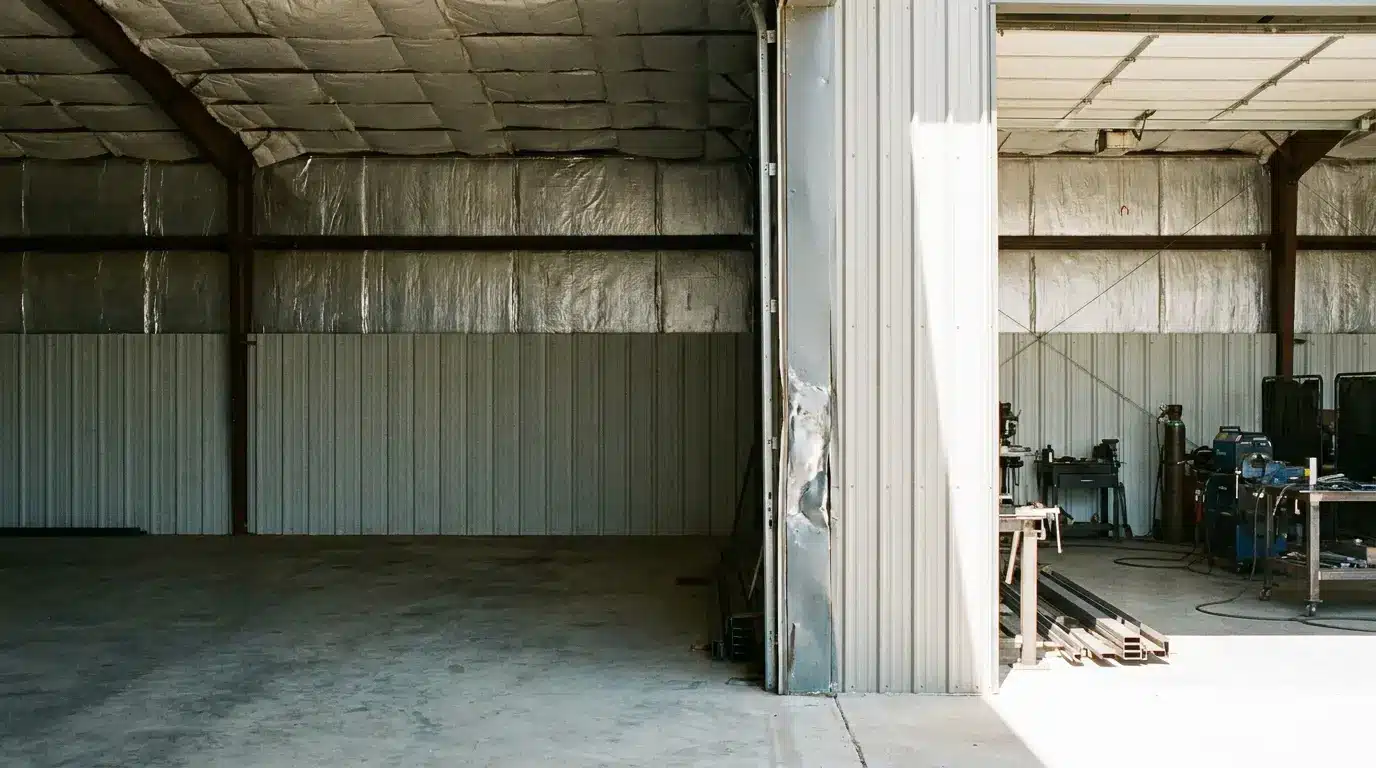
The roof-first strategy has limits. If you plan to heat or cool the building regularly, wall insulation becomes much more important. Heat does not only move upward; it travels through every exposed surface, including wall panels, doors, windows, and the slab perimeter.
A roof-only installation is unlikely to deliver satisfactory results in a metal building used as:
- A year-round office, retail space, or living area
- A climate-controlled workshop with regular occupancy
- A space housing temperature-sensitive products or machinery
- A building in a region with severe winter temperatures
- A finished interior with framed rooms and drywall
In these scenarios, treating the roof while ignoring the walls can create an imbalanced envelope. You may reduce overhead heat gain but still experience cold wall surfaces, drafts, excessive heating costs, or humidity-related issues.
Wall insulation also matters when occupants work close to exterior panels. A person standing beneath an insulated roof may still feel uncomfortable if nearby metal walls are hot in summer or cold in winter. Radiant discomfort is often as noticeable as air temperature, particularly in workshops where people remain near the perimeter.
The Role of Ventilation and Moisture Management
Insulation alone does not solve every moisture problem. A metal building needs an intentional approach to ventilation, interior humidity, and air sealing.
Consider a workshop where vehicles are brought inside during wet weather, or where welding, washing, curing, or agricultural activity adds moisture to the air. If humid air is trapped inside, it can still find cold surfaces around fasteners, wall panels, doors, and uninsulated roof edges.
Before choosing roof-only insulation, assess:
- How often the building is occupied and whether it is heated or cooled
- Whether moisture-producing activities occur indoors
- The amount of natural or mechanical ventilation available
- Existing leaks around roof penetrations, ridge caps, and wall connections
- Whether condensation appears only on the roof or throughout the structure
A roof system should also be installed with careful attention to seams, overlaps, and penetrations. Even a high-performing material cannot compensate for gaps that allow humid air to reach cold metal.
A Practical Way to Make the Decision
Start with the building’s biggest pain point. If the interior becomes unbearably hot beneath the roof in summer, roof insulation is a logical first investment. If condensation is limited to the roof panels, a roof-focused solution may also be appropriate.
However, if the goal is reliable year-round comfort, lower HVAC operating costs, or a finished interior, plan for a full insulation strategy from the outset. It may be possible to phase the work—roof first, walls later—but the eventual design should account for the entire building envelope.
Roof-only insulation is enough when it matches the building’s purpose. For open, seasonal, lightly used, or storage-oriented metal buildings, it can be a sensible and effective improvement. For conditioned spaces, it is best viewed as the first step rather than the final one.