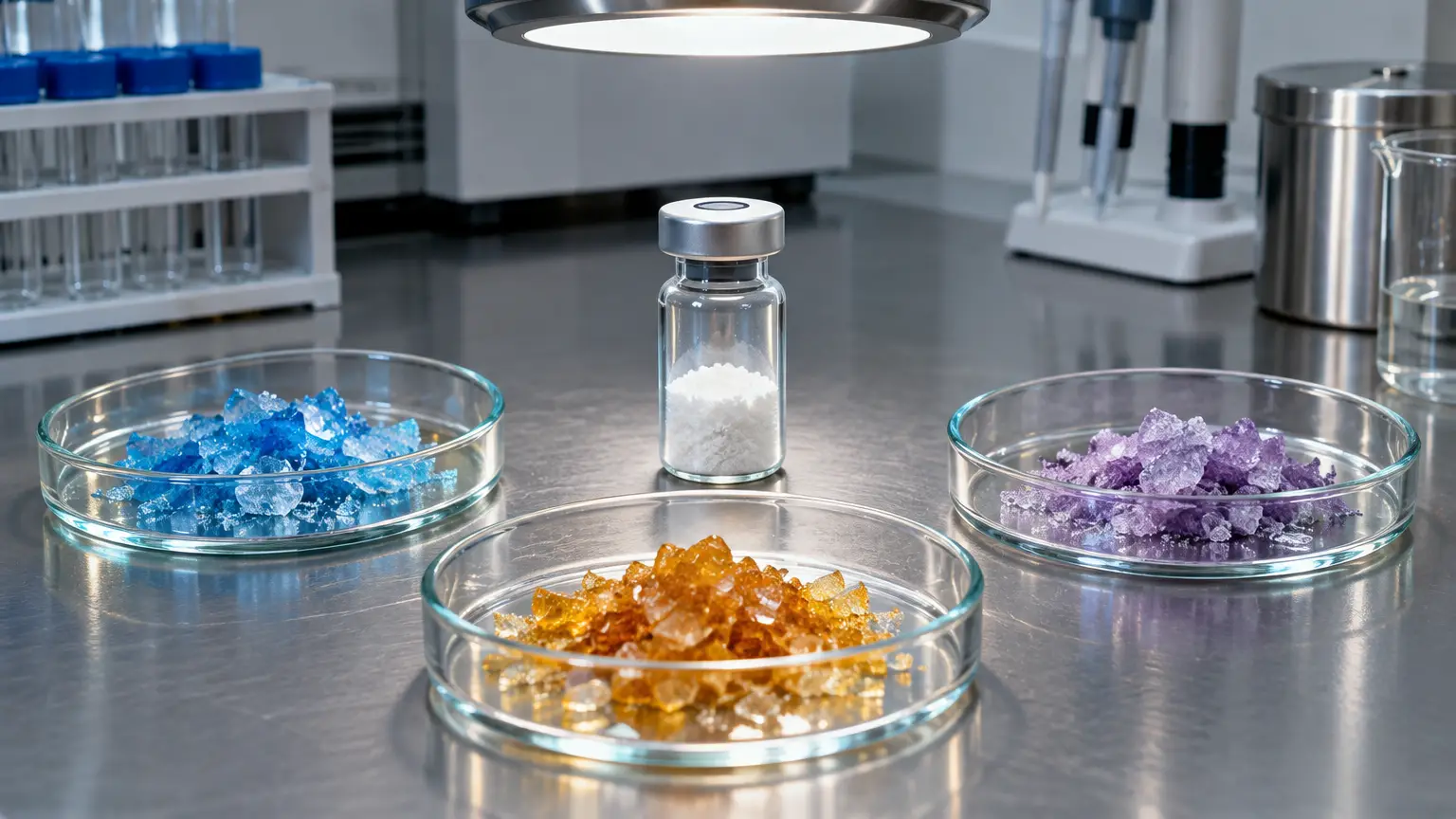
Every peptide in a laboratory catalog has a backstory: a tissue sample, a published paper and a researcher who noticed something worth chasing. Those origin stories explain a lot about why certain molecules end up sharing a vial.
Vive Peptides, a US-based supplier of research-grade peptides, has its peptides compounded at a US-based lab that adheres to cGMP standards, and as of October 2026 its public certificate of analysis library holds 126 certificates across 25 peptides, searchable by peptide, lot number or size. Nothing in that catalog is approved for human consumption; it is sold strictly for laboratory and research use only.
The worked example here is the Vive Peptides Glow Blend, a proprietary research formulation that combines BPC-157, TB-500 and GHK-Cu in a single 70 mg lyophilized vial. The three compounds have separate histories, separate research literatures and, until a lab decides to combine them, separate experimental uses. What follows traces each one back to its source. It makes no claims about effects in people, because the blend exists for bench work only.
What Are the Three Components of The Glow Blend Peptide?
The Glow Blend contains BPC-157, TB-500 and GHK-Cu: a 15-amino-acid chain, a fragment of the protein thymosin beta-4, and a copper complex of a tripeptide. Each arrived in the scientific literature by a different route, which is part of why labs find the combination interesting. The table below sets out what each one is and where it came from.
| Compound | What it is | Origin | Lab research focus |
| GHK-Cu | Copper complex of the tripeptide glycyl-histidyl-lysine | Isolated from human plasma albumin in 1973 | Skin-cell signaling and collagen research in lab models |
| BPC-157 | Synthetic peptide of 15 amino acids | Fragment of a protein found in human gastric juice | Recovery and repair research models |
| TB-500 | Fragment of the protein thymosin beta-4 | Thymosin beta-4 was isolated from calf thymus in 1981 | Cell migration |
GHK-Cu is the name most familiar to anyone who follows ingredient conversations in beauty, which is why it anchors the cosmetic-science relevance of the blend. The other two come from quite different corners of biochemistry.
Where did each of the three molecules come from?
Each molecule has its own discoverers: Loren Pickart for GHK, Predrag Sikiric and colleagues for BPC-157, and T. L. Low, S. K. Hu and Allan L. Goldstein for thymosin beta-4.
Pickart isolated the tripeptide GHK (glycyl-L-histidyl-L-lysine) from human plasma albumin in 1973. He proposed that it worked by binding metal ions such as copper, which is why the compound is now studied as GHK-Cu, the copper complex. In cosmetic science, laboratories examine it for its role in skin-cell signaling and in collagen research, working in cell culture and other lab models.
BPC-157 has a Croatian pedigree. Sikiric and colleagues at the University of Zagreb characterized it in the early 1990s and published foundational papers in 1993 and 1994.
They described a 15-amino-acid fragment of a larger protein found in human gastric juice. The material in catalogs today is synthetic, built on that sequence, and Vive Peptides lists it in its recovery and repair research group, which describes the experimental territory where the compound is typically discussed.
Thymosin beta-4 came out of calf thymus. Low, Hu and Goldstein isolated it and characterized it as a 43-amino-acid polypeptide in 1981. Like the rest of the beta-thymosin family it carries the central LKKTET actin-binding motif, and its job inside cells is to hold actin monomers in reserve.
Actin is the protein scaffold that cells rearrange when they move, so TB-500, a fragment of the parent protein, is studied chiefly in connection with cell migration, meaning the movement of cells in a model system.
What Makes a Peptide a Research Material Rather Than a Beauty Ingredient?
A research peptide is a compound made for laboratory investigation, which means it carries no cosmetic status, no product claims and no approval for use on or in people.
The distinction matters because the word “peptide” appears on both sides of the line. A serum label and a lab catalog may share a molecule’s name, yet they describe entirely different categories of material, meant for different audiences.
Researchers use peptides as tools. They introduce them to cultured cells or work with them in animal models, then measure what changes: protein expression, cell movement, signaling activity.
The output is data about mechanisms, not guidance for anyone’s personal routine. Vive Peptides sells the Glow Blend strictly for laboratory and research use only, not for human consumption.
Why Do Labs Study Peptides in Combination?
Labs study combinations because biological processes rarely run on a single signal, so a multi-compound formulation lets researchers observe how overlapping pathways relate inside the same experimental system. Cell behavior involves signaling, movement and structural remodeling all at once. A single-compound experiment isolates one thread, while a paired design asks how the threads connect.
Researchers who plan combination work tend to weigh a handful of questions:
- Complementary mechanisms: do the compounds touch different parts of a process, such as signaling versus migration?
- Shared model systems: can one cell line or animal model answer questions about every component?
- Clean controls: can each compound also be run alone, so any difference in a paired result can be traced back?
- Material consistency: is the starting material uniform enough that differences reflect biology rather than batch variation?
The origin stories above matter here. A molecule first isolated from plasma, one characterized from gastric juice and one from thymus tissue are unlikely to act through the same machinery, and that mismatch is exactly what makes a paired design informative.
Why Pair These Three in One Formulation?
Each of the three is associated with a different research question, so a three-peptide formulation lets a lab explore signaling, structural protein and cell-movement questions within one material. That is a design choice, not a prediction. Nothing about pairing implies a particular outcome, and the point of the experiment is to find out what the data show.
Reading the results also calls for restraint. A signal seen in a dish is a starting point for further questions, and findings from cell culture or animal work do not translate automatically to anything else.
A pre-blended vial also reduces the number of separate materials a lab has to source and track. Researchers who want to isolate a single component can still work with the individual compounds, which the Vive Peptides catalog lists on their own.
Where Does the Blend Sit in the Wider Catalog?
The Glow Blend is one of two proprietary blends in a catalog of more than 25 peptides. The other is the KLOW Blend. The remaining compounds fall into two groups: recovery and repair research, which includes BPC-157, TB-500 and GHK-Cu, and cognitive research, which includes Selank, Semax and SS-31.
That organization mirrors how labs think. Compounds are grouped by the question they help answer, and blends exist for researchers whose question involves more than one compound at once.
What do the three origin stories have in common?
All three molecules began as observations about natural tissue: a protein in plasma, a fragment from gastric juice, a polypeptide from the thymus. Decades of work turned those observations into defined sequences that a lab can synthesize and study in isolation or together. That lineage, rather than any promise, is what the Glow Blend represents, and it keeps the conversation on the science side of the beauty vocabulary where it belongs.