Most holiday tables fail for one boring reason: everything on them is the same.
Same tone, same texture, same height. You can spend a fortune on plates and still end up with a table that reads flat in every photo. I’ve styled tables for family dinners of six and for a twenty-two person Friendsgiving in a rented loft, and the fix is never more stuff. It’s contrast, order, and one deliberate focal point. Get those three right and a table built from clearance finds looks like it came out of a catalog shoot. Get them wrong and a table built from heirloom china looks like a storage unit.
Here’s the order that actually works: start with linens and lighting, layer plates and chargers, then finish with glass and height. And if you want a shortcut to the last layer, seasonal Christmas glassware does more visual work per dollar than any other item you’ll put down.
Why Your Table Looks Flat (It’s Not the Plates)
Look at a great table photo and squint. You’ll notice something before you notice any single object: uneven visual weight. One tall element. One reflective element. One matte element. One thing that’s a completely different color from everything else.
Most people build a table like they’re buying a matching bedroom set. Six of everything, one finish, one palette. That’s the flatness. A table is a composition, and compositions need tension.
So before you buy anything, decide on one accent color and commit. Not two. One. Deep plum, moss, oxblood, copper. Everything else stays neutral: cream, oatmeal, charcoal, or whatever wood tone you already own. This single decision kills ninety percent of holiday table decisions before they happen, which is the whole point.
The Foundation First Method
I build every table in the same five passes, and I never skip ahead. Call it Foundation First, and it exists because I used to do the opposite: buy the fun stuff first, then realize the plates didn’t fit the runner and the glasses were too tall for the sightlines.
- Cover the surface. Linen, runner, or bare wood with a good oil finish. Narrow runner for round tables, full cloth for rectangular. If your cloth is busy, stop here and skip the runner entirely.
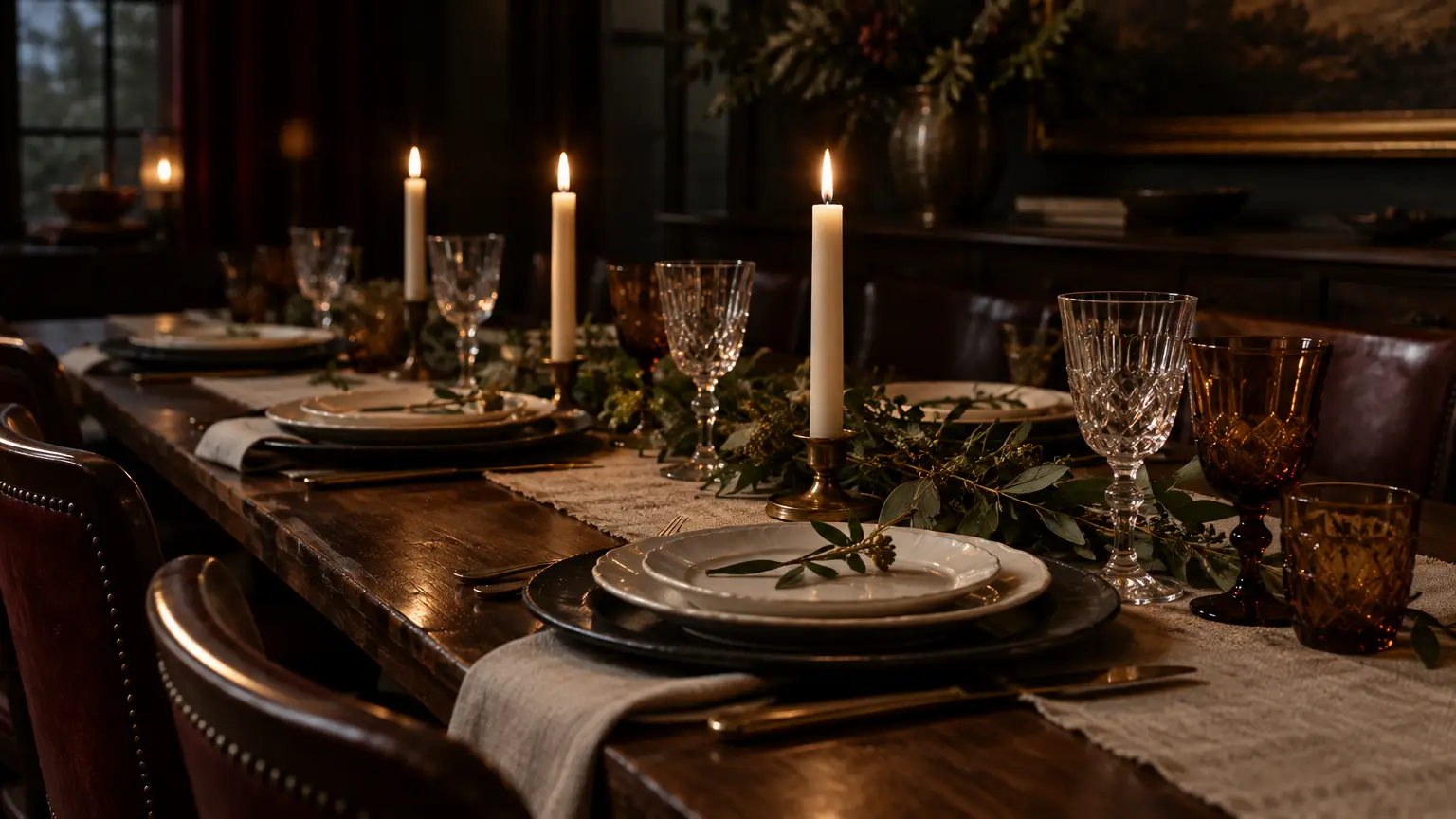
- Set the light. Candles or a low centerpiece light source, placed before plates so you can see where shadows fall. Overhead light alone makes food look gray.
- Layer the base. Charger, then dinner plate, then a smaller plate if you’re serving courses. Odd numbers of layers read better than even.
- Add reflection. This is the glass layer, and it’s where most tables get their sparkle.
- Add height and green. One tall element, then stems or greenery at three different heights. Never one uniform hedge of eucalyptus. It looks like a hedge.
Two practical notes from doing this a few dozen times. Leave at least fifteen inches of clear space per setting or your guests will elbow each other all night. And set the table the night before, then walk past it in morning light. Whatever looks wrong at 8 a.m. will look wrong at 8 p.m. too.
Where the Sparkle Comes From
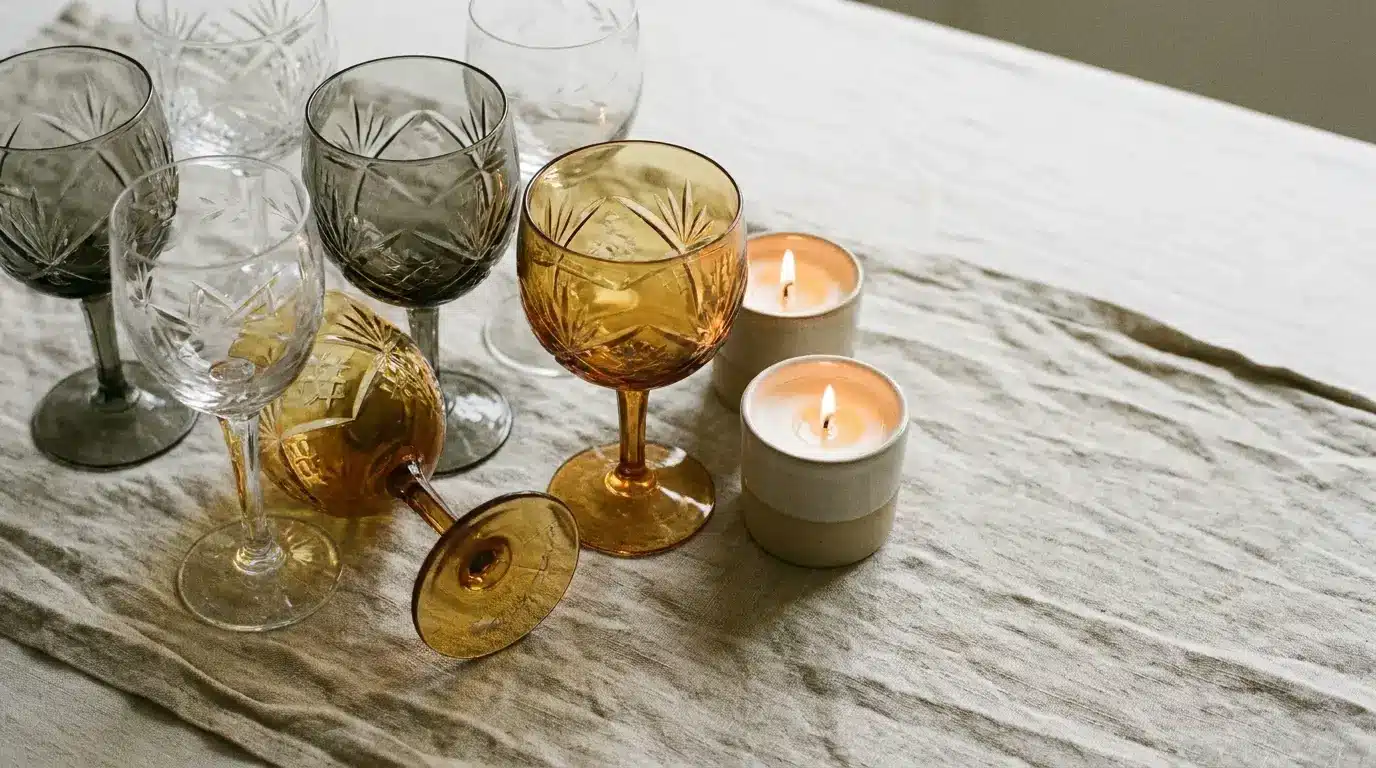
Glass is the cheapest way to add dimension to a table, and it’s the layer people skip because they think their everyday tumblers are fine. They are fine. They are also invisible.
A cut or etched glass catches candlelight and throws it across the linen. That’s the glow you see in styled photos, and it isn’t the candles doing it alone. It’s the refraction.
You don’t need a full set of anything matched. A mix of clear, smoke, and one amber piece reads collected rather than purchased, and collected is the look people are actually chasing. If you’re choosing a single color to buy once and reuse for years, go with something in the deep red or berry family. Color forecasting from Pantone consistently puts rich, saturated reds in the holiday palette year after year, which means your glasses won’t look dated next December.
Two things I’d skip: printed novelty designs that only work for one week, and anything you can’t put in a dishwasher. Hand washing twelve wine glasses at midnight is the fastest way to hate your own table.
Stemware by Course, Without Buying Four Sets
|
Course |
Glass to reach for |
Why it works |
|---|---|---|
|
Welcome drink |
Tumbler or coupe |
Feels relaxed, fills while people stand around |
|
Wine |
Stemmed red or white |
Keeps hands off the bowl, looks taller |
|
Water |
Simple goblet |
Doubles as a candle holder later |
|
Dessert or coffee |
Small footed cup |
Adds a second height point at the close |
That’s three real glasses and one small cup. Four shapes covers a whole evening, and they’ll stack into a single cabinet shelf in January.
The Small-Room Problem
Here’s the scenario that trips up most people hosting in an apartment. My friend Dana has a six foot table in a dining nook that’s nine feet wide. A tall centerpiece would’ve blocked every sightline across the table, so conversation would’ve died into two separate pods.
The fix took ten minutes. We dropped the tall vase, ran a narrow linen runner instead of a full cloth, and put three short candles on a low tray with greenery tucked underneath. Then we moved all the height to the edges: tall stems in a pitcher on the sideboard, a stack of plates next to it. The room felt bigger, and people could actually see each other.
Rule of thumb: if a centerpiece is taller than about twelve inches, it either goes on a sideboard or it goes home.
Lighting Beats Decorating
You can fix a mediocre table with light and ruin a great one without it. This is the part interior stylists guard hardest, and it’s the easiest thing for you to copy.
Use candles at two or three different heights, and use real flame if your venue allows it. LED candles have their place with kids running around, but they throw a flat, cold pool of light that nobody mistakes for candlelight. Clusters of three read better than a single candle every four inches.
If your dining room only has a ceiling fixture, put it on a dimmer or swap the bulbs for something warmer. Advice from Better Homes & Gardens has long pushed layered lighting over one overhead source in dining rooms, and once you see a table under warm, low, multi-source light you’ll never go back to floodlit holiday dinners.
A Quick Checklist Before Guests Arrive
- One accent color, everything else neutral.
- Fifteen inches of clear space per setting.
- Three heights somewhere on the table or beside it.
- At least one reflective surface catching the candlelight.
- Centerpiece low enough to see over.
- Nothing on the table you can’t wash by hand in under a minute.
Run that list in your head, and you’ve covered everything that actually shows up in photos and everything that actually affects how the night feels.
The Part Nobody Plans For
The table is done, the food is out, and then someone puts a wet glass down and a ring shows up on your grandmother’s walnut. Felt-backed coasters, placed before anyone sits, are the least glamorous and most valuable thing on this entire list. Buy them in a neutral color and buy more than you think you need.
Your table doesn’t need to look like a magazine spread. It needs contrast, three heights, one color you committed to, and light that flatters both the food and the people around it. Start with the foundation this weekend, add the glass layer last, and you’ll have a table that looks expensive because it looks considered.
And if you only change one thing this year, change the light. What’s the one object on your table you’d never give up?