


Most people treat self-care like a reward, something to do once things calm down. They don’t. A solid self-care checklist isn’t about bubble baths or weekend resets. It’s about the small daily habits that keep stress from stacking up before it becomes harder to manage.
In practice, the people who stay consistent aren’t doing more; they’re doing less, but regularly.
No checklist works for everyone, and none works forever without some adjustment. What matters is building one that fits real life, not an ideal version of it. Here’s what actually belongs on yours.
What Is Self-Care and Why Is It Important?
Self-care is the regular practice of looking after your physical, mental, emotional, and social health so daily stress doesn’t build up faster than you can manage it.
It isn’t a reward or an occasional treat; it’s a set of small, repeatable habits like sleeping well, staying hydrated, setting boundaries, and taking real breaks.
Self-care matters because neglecting one area quietly affects the others: poor sleep drains your mood, low energy makes connection harder, and unprocessed emotions slow your motivation.
Consistent self-care keeps each of these areas steady, lowers long-term stress, and protects you from burnout. The most effective routines aren’t the most ambitious ones; they’re the simple habits you can keep doing, even on your hardest days.
What Should a Self-Care Checklist Include?
Download the printable Self Care Checklist PDF for daily tracking and weekly planning.
A good self-care checklist covers your body, mind, emotions, and relationships, keeping each area steady.
Neglecting one part affects the others: poor sleep hurts mood, low energy makes social connection harder, and unprocessed emotions slow motivation.
Your checklist should include both maintenance habits, such as sleep and hydration, and recovery habits, such as journaling or taking breaks, to ensure balance across all areas.
Self-Care Checklist
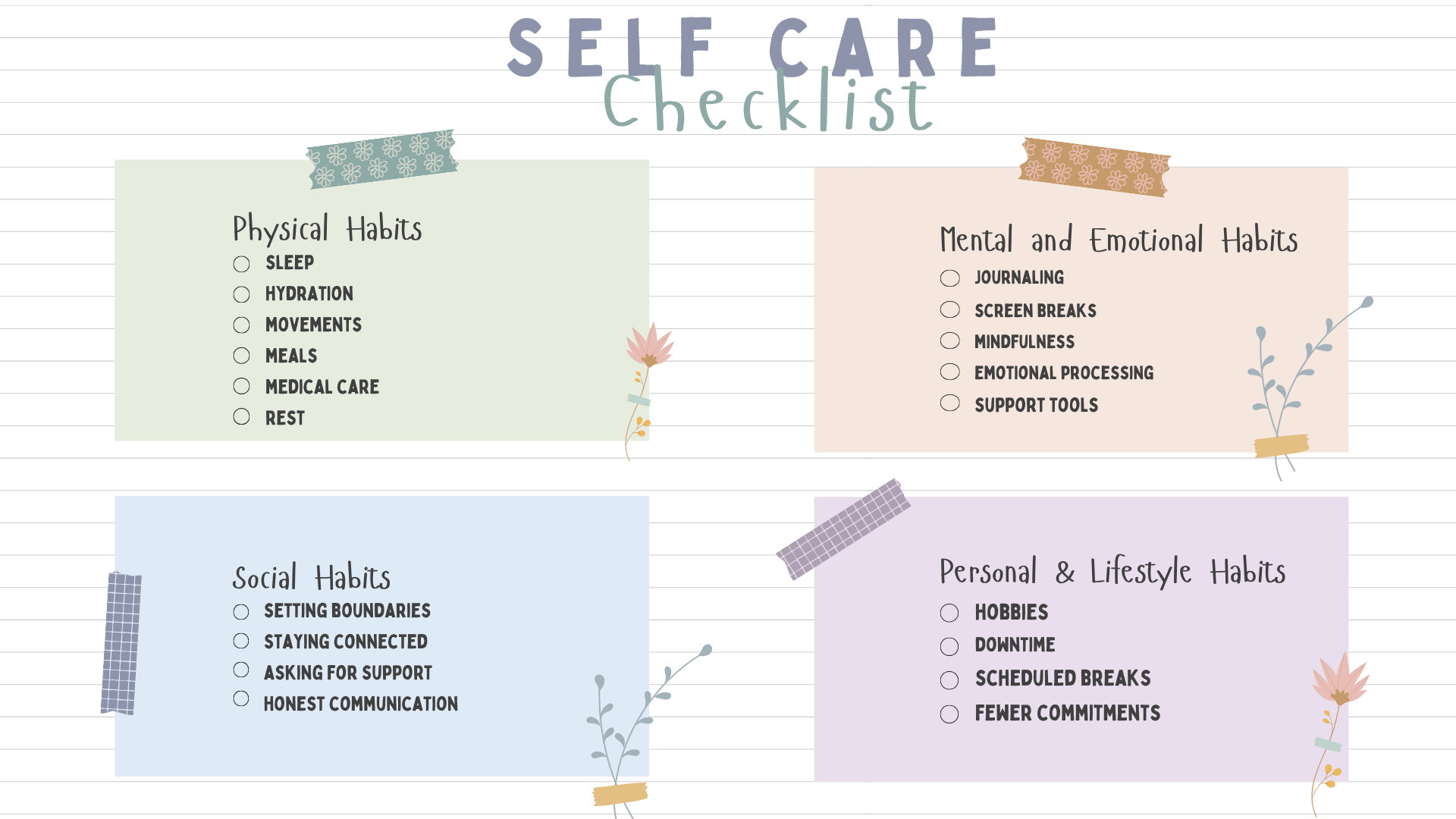
A self-care checklist helps you stay consistent with habits that support your overall well-being. Use this to check in with your physical, mental, social, and lifestyle needs.
1. Physical Self-Care Habits
When physical needs go unmet, your energy, focus, and mood all take a hit, and sometimes before you don’t notice why.
- Sleep: 7–9 hours with a consistent routine.
- Hydration: Drink water regularly.
- Movement: Short walks or stretches.
- Meals: Eat at regular times.
- Medical care: Keep checkups and address symptoms.
- Rest: Take breaks beyond sleep, especially after busy days.
Even one physical habit done consistently gives you a steadier base for everything else.
2. Mental and Emotional Self-Care Habits
The unprocessed stress and emotion build up quietly and affect how you think, decide, and function.
- Journaling: Write down thoughts to lighten the mental load.
- Screen breaks: Step away from devices to reduce fatigue.
- Mindfulness: Spend a few minutes focusing on breath or surroundings.
- Emotional processing: Naming what you’re feeling instead of pushing past it.
- Support tools: Guided apps, finding a psychiatrist, or talking to someone you trust.
You don’t need a long session. Five minutes of quiet reflection does more than nothing and a lot more than scrolling.
3. Social Self-Care Habits
Social well-being is easy to overlook, but connection and boundaries are both part of taking care of yourself around other people.
- Setting boundaries: Say no when needed.
- Staying connected: Check in with trusted people.
- Asking for support: Allow others to help.
- Honest communication: Express your real needs clearly.
One real conversation a week matters more than staying constantly available to everyone.
4. Personal and Lifestyle Self-Care Habits
This category is about the parts of your day that belong to you, not your job, not your responsibilities, just what helps you feel like yourself.
- Hobbies: Something you do for no reason other than enjoying it.
- Downtime: Unscheduled time that isn’t productive on purpose.
- Scheduled breaks: Built-in pauses during work or caregiving hours.
- Fewer commitments: On high-stress weeks, scale back rather than add more.
If your days are full but nothing in them feels like yours, this is the category to start with.
Your Weekly Self-Care Plan
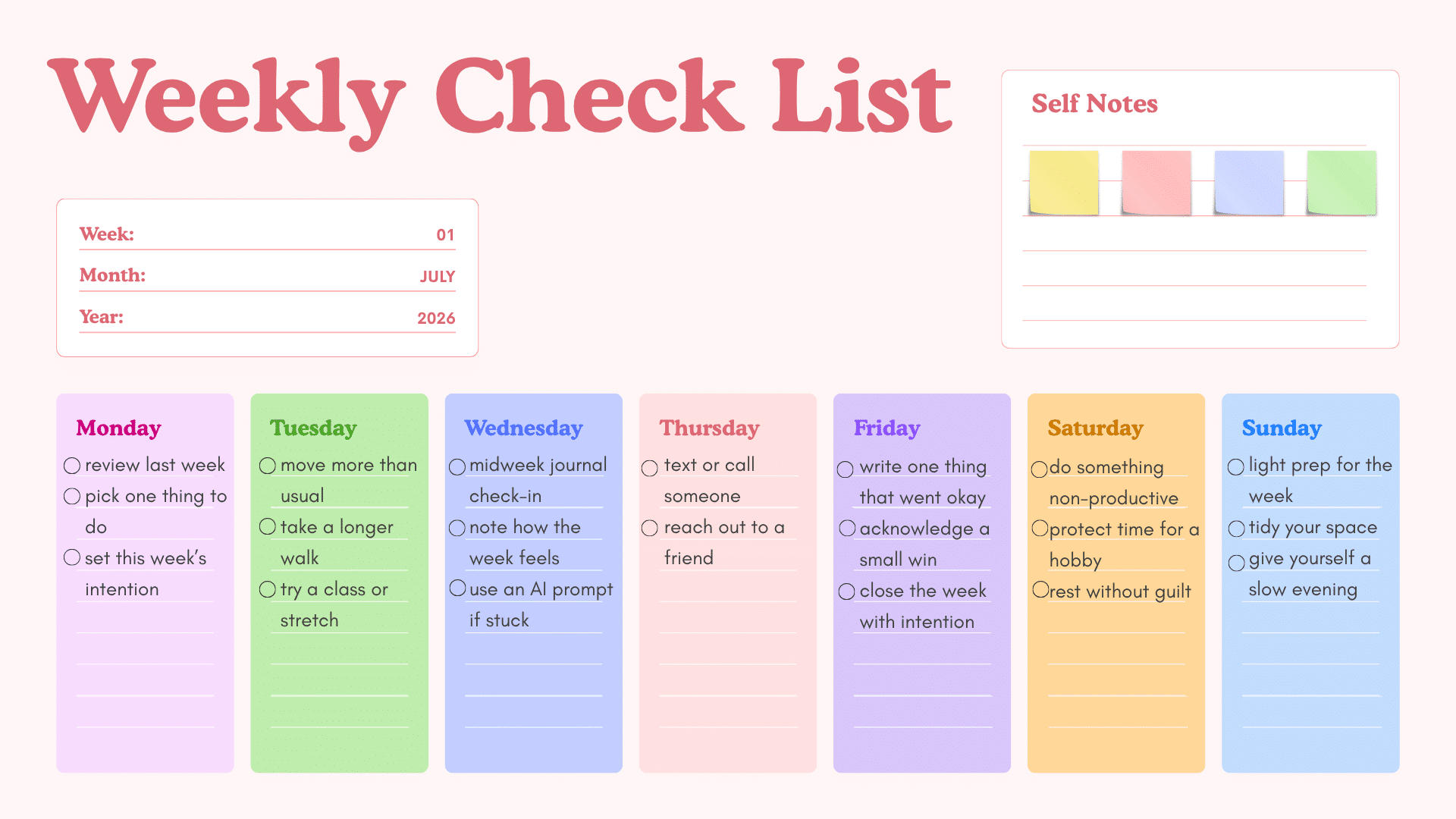
Spreading it across the week keeps it manageable without turning self-care into another thing to keep up with.
Each day has one theme:
- Monday is for reflection
- Tuesday for movement
- Wednesday is for emotional check-in
- Thursday for connection
- Friday is for closing out with intention
- Saturday for rest
- Sunday for quiet preparation.
Use the checklist above as your weekly reference and check off as you go. On hard days, skip what doesn’t fit. The goal is consistency over time, not a perfect week.
Your Daily Self-Care Plan
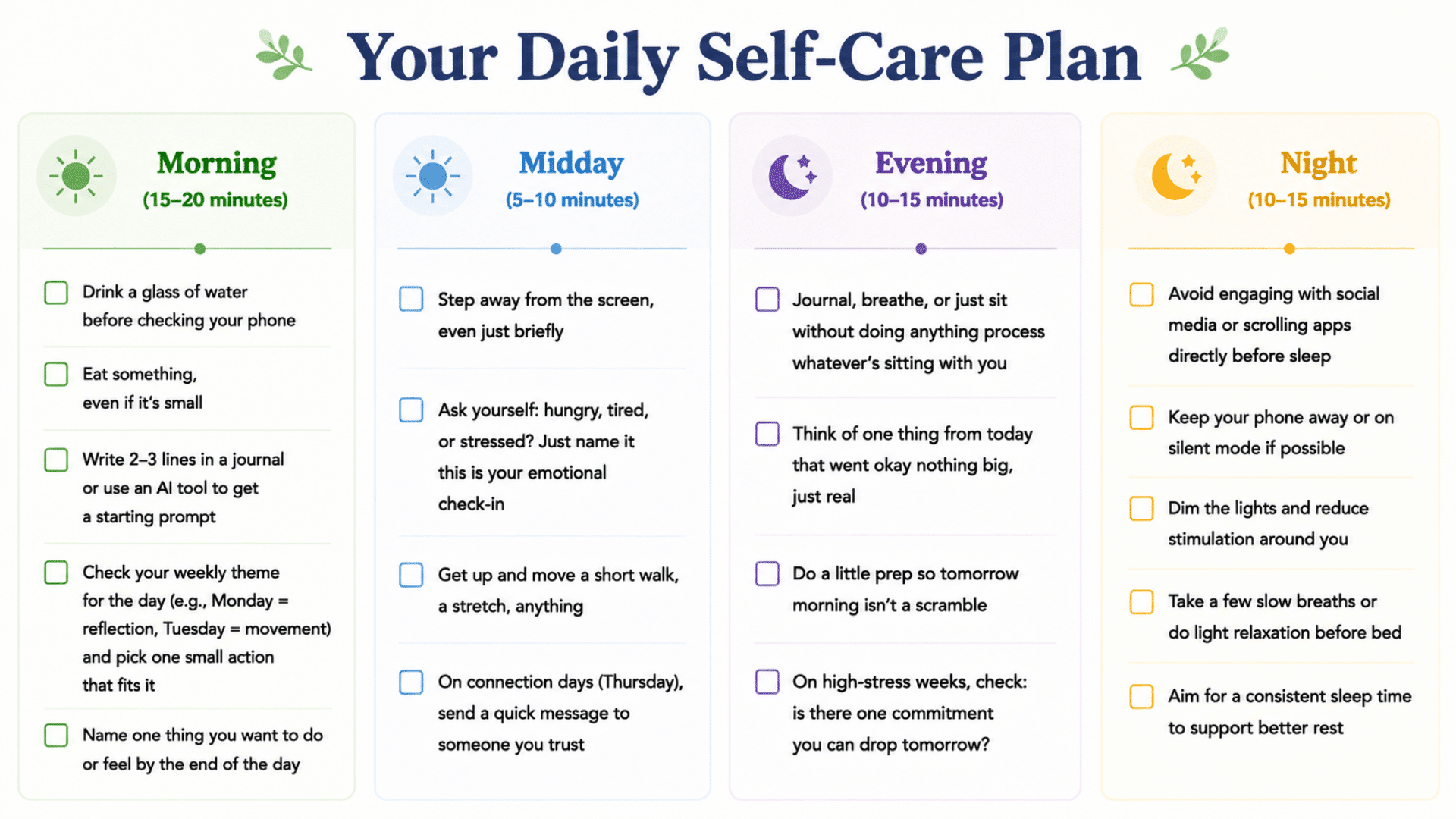
A checklist only works if it fits into your actual day. This structure pulls from all four areas: physical, mental, emotional, and social, and connects to the weekly theme so nothing feels disconnected or like extra work.
1. Morning
How you start sets the tone for everything after it.
- Drink a glass of water before checking your phone
- Eat something, even if it’s small
- Write 2–3 lines in a journal or use an AI tool to get a starting prompt
- Check your weekly theme for the day (e.g., Monday = reflection, Tuesday = movement) and pick one small action that fits it
- Name one thing you want to do or feel by the end of the day
A steady morning helps you feel more focused and grounded through the rest of the day.
2. Midday
Five minutes of checking in beats an afternoon of running on empty.
- Step away from the screen, even just briefly
- Ask yourself: hungry, tired, or stressed? Just name it; this is your emotional check-in
- Get up and move: a short walk, a stretch, anything
- On connection days (Thursday), send a quick message to someone you trust
Midday check-ins help you reset before stress builds up.
3. Evening
The evening is less about ending the day and more about setting up the next one.
- Journal, breathe, or just sit without doing anything; process whatever’s sitting with you
- Think of one thing from today that went okay nothing big, just real
- Do a little prep so tomorrow morning isn’t a scramble
- On high-stress weeks, check: is there one commitment you can drop tomorrow?
A calm evening helps your mind slow down and improves the quality of rest.
4. Night
Night is about fully disconnecting so your body and mind can recover.
- Avoid engaging with social media or scrolling apps directly before sleep
- Keep your phone away or on silent mode if possible
- Dim the lights and reduce stimulation around you
- Take a few slow breaths or do light relaxation before bed
- Aim for a consistent sleep time to support better rest
A calm, screen-free night helps your mind fully switch off and supports deeper, more restorative sleep.
On Hard Days
Scale down, don’t skip entirely. A glass of water replaces a full morning routine. One honest sentence in a journal replaces a long reflection. The goal is consistency over time, not a perfect day.
Remember: It doesn’t have to be perfect, it just has to happen.
Using AI to Support Your Mental Self-Care
This is one area where AI tools can genuinely help: not as a replacement for real support, but as a low-friction daily habit.
A few ways people use AI for mental self-care:
- Mood tracking: Log moods daily to spot patterns and triggers. (Tools: Daylio, Bearable, Moodfit)
- Journaling prompts: Use AI to generate starting prompts when stuck. (Tools: Claude, ChatGPT, Day One)
- CBT-style check-ins: AI guides short exercises to manage stress or overwhelm. (Tools: Woebot, Wysa, Youper)
- Reflection summaries: AI summarizes entries to highlight recurring themes. (Tools: Notion AI, Claude, Reflectly)
These tools work best when they lower the barrier to showing up. The habit is yours; AI just makes it easier to start.
Why Self-Care Routines Fail?
Self-care routines usually fail not because of laziness, but because they quietly turn into one more task to manage. Routines designed for ideal weeks collapse the moment life gets busy, and starting too many habits at once can leave you feeling like you’re already behind.
Perfectionism makes this worse: skipping a single habit can feel like failing at everything, which triggers guilt and avoidance until the whole routine gets abandoned.
The fix is to expect imperfect weeks and build for them. A checklist that shrinks on hard days survives; one that demands a flawless run does not.
When you miss a day, take one small action the next day instead of attempting a full reset, because consistency over time always beats a perfect streak.
How to Build a Checklist You’ll Actually Follow
Building a checklist that lasts starts with what you actually need, not a generic list of “shoulds.” Work through these steps in order.
- Identify your needs: Notice which area feels most neglected right now: sleep, mood, connection, or personal time. Start where the gap is biggest.
- Start with the basics: Anchor the list with sleep, meals, hydration, and one form of movement before adding anything else.
- Pick one habit per category: Choose a single physical, mental, emotional, and social habit. One each is enough to stay balanced.
- Match habits to your energy: On low-energy days, shrink the habit. A walk replaces a workout; a stretch replaces a full routine.
- Make it measurable: Keep habits small and specific so you can tell whether you did them (“drink one glass of water,” not “hydrate more”).
- Track and review: Check off habits daily and revisit the list every few weeks, adjusting what no longer fits.
Final Thoughts
Self-care doesn’t have a finish line. It’s not something to complete; it’s something to maintain imperfectly over time.
The categories in this checklist exist because no single habit covers everything your body and mind need. Sleep alone won’t fix emotional exhaustion. Staying busy won’t replace real connection.
What works is a routine built around your actual life, one that shrinks on hard days instead of collapsing entirely. Start with one category. Add from there. Use the tools available to you, including AI, if they make it easier to show up.
A checklist you follow 70% of the time beats a perfect one you abandon after two weeks. Start yours today.
Frequently Asked Questions
What Are the 5 C’s of Self-Care?
The 5 C’s of self-care usually refer to connection, compassion, coping, control, and consistency. These areas help support emotional balance, physical health, and daily stress management.
Is Self-Care Different for Everyone?
Yes. A self-care routine should fit your lifestyle, energy levels, and personal needs. What helps one person recharge may not work the same way for someone else.
How Long Does It Take to Build a Self-Care Habit?
Most self-care habits become easier with consistency over time. Starting small and repeating the habit daily matters more than trying to change everything at once.