
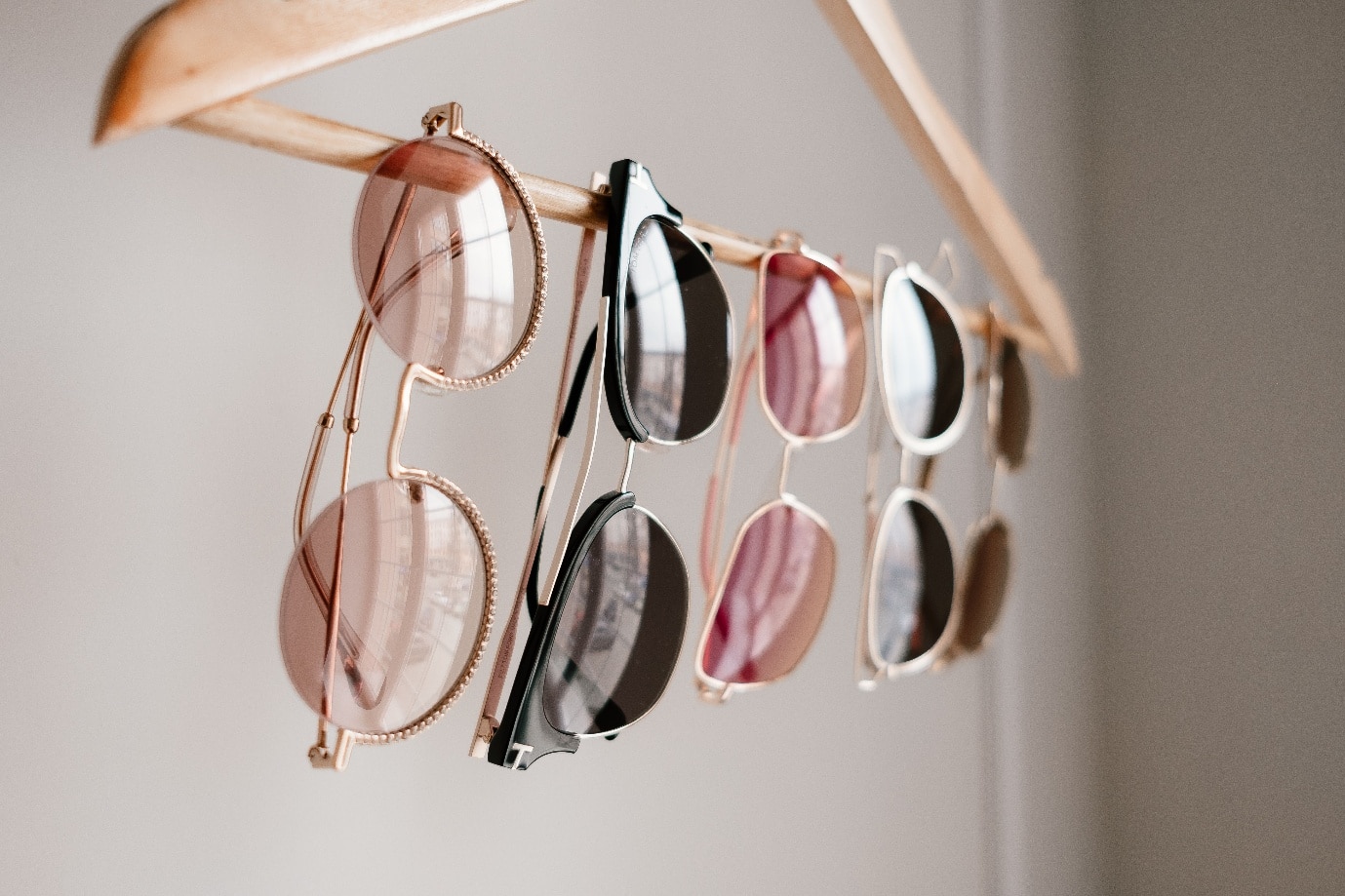
Most people buy sunglasses the same way: they spot a pair on someone else, try them on under fluorescent store lighting, squint into a small mirror, and hope. Then the frames live in a drawer, because something about them never felt right.
That something is almost always proportion. Sunglasses frames sit across the widest part of your face and frame your eyes, which is the first place anyone looks. Get the shape and size right and the frames read as deliberate. Get them wrong and they read as borrowed.
This guide walks through how to work out your face shape, which frame styles balance it, how to decode the size numbers stamped inside the temple arm, and what to look for in lenses so a good-looking pair also does its actual job.
Why Face Shape Changes How Sunglasses Look on You
Every face-shape chart you have ever seen comes down to one idea: contrast. Frames that repeat your face’s dominant line amplify it. Frames that oppose it create balance. Round frames on a round face echo the curve. Angular frames on the same face introduce a line that was not there, and the face reads as more defined.
Two things matter as much as shape, and most buying guides skip them:
- Scale — the frame should be about as wide as the widest part of your face, and no wider.
- Placement — the top rim should follow your brow line, and the lenses should cover your eyes with a little room to spare on all sides.
Get contrast, scale, and placement right and nearly any style becomes wearable. Get them wrong and the best-looking frame in the store still looks off.
How to Find Your Face Shape in Two Minutes
Pull your hair back, face a window for even light, and take a straight-on photo with your phone. Then compare four measurements. A soft tape measure is ideal, but you can judge them by eye from the photo.
- Forehead width, across the widest point above your brows.
- Cheekbone width, across the tops of your cheekbones.
- Jaw width, from one jaw corner to the other.
- Face length, hairline to the bottom of your chin.
Reading the Result
- Oval — length clearly greater than width, cheekbones widest, forehead slightly wider than the jaw.
- Round — width and length close to equal, soft curves, no visible jaw corners.
- Square — forehead, cheekbones, and jaw are similar in width, with defined jaw corners.
- Heart — forehead is the widest point, narrowing to a small or pointed chin.
- Diamond — cheekbones clearly widest, with both the forehead and jaw narrow.
- Oblong or rectangular — length clearly greater than width, with forehead, cheeks, and jaw similar in width.
Plenty of faces sit between two categories. If yours does, work from whichever feature is most pronounced rather than trying to force a label.
The Best Sunglass Styles for Each Face Shape
Oval Faces
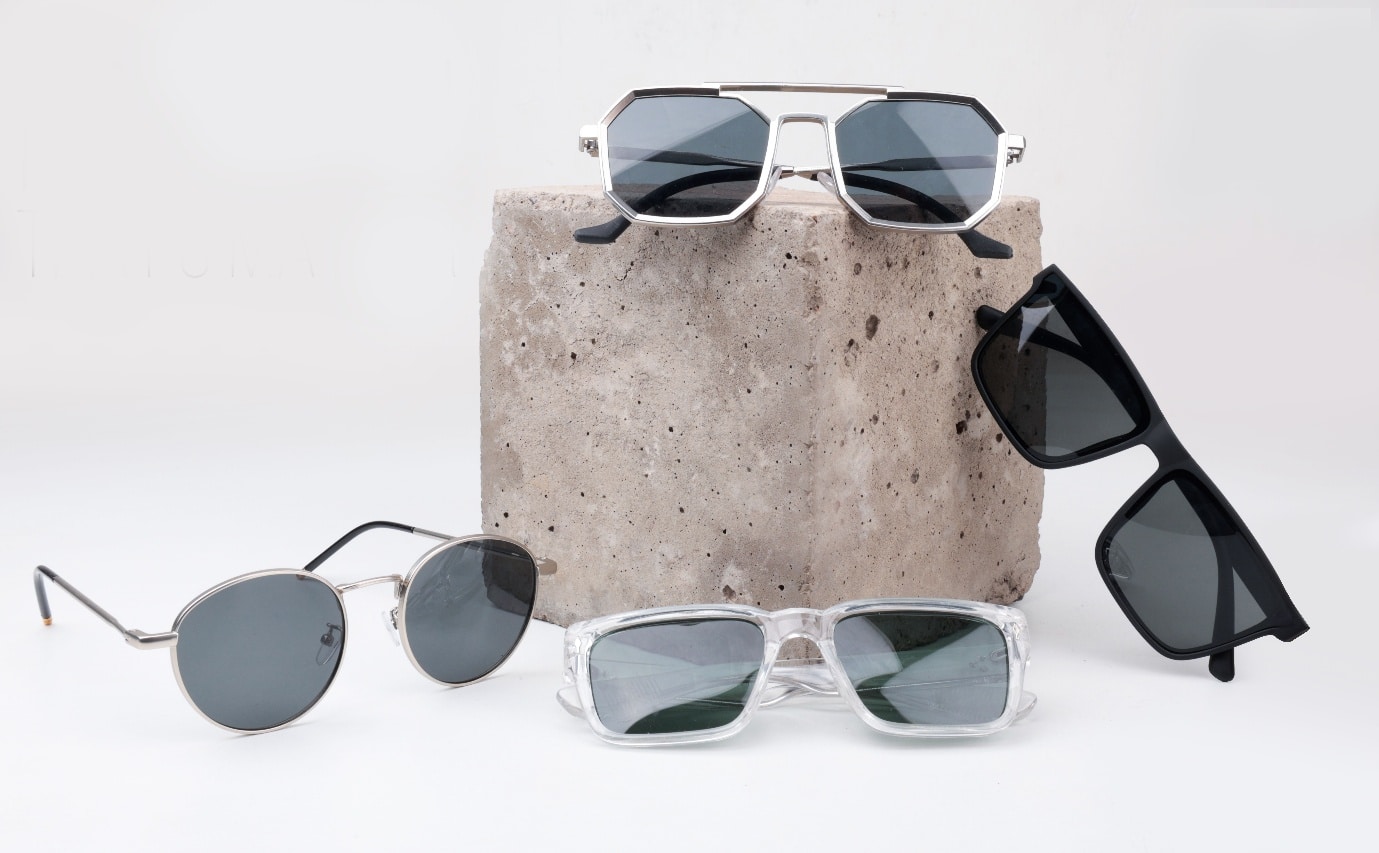
Balanced proportions give you the widest range to work with. Wayfarers, aviators, browline styles, geometric hexagons, and cat-eye shapes all sit well. A medium lens width in the 50 to 54 mm range is a safe starting point.
What to skip: frames noticeably wider than your cheekbones, and very deep lenses, which visually shorten the face and undo the balance you already have.
Round Faces
The goal is to add angles and a sense of length. Rectangular and square frames work, as do browline (clubmaster) styles and angular geometrics. A straight, defined top bar does most of the heavy lifting.
What to skip: small circular frames and thin rimless ovals. Both repeat the curve you are trying to break up.
Square Faces
Here the goal is softening a strong jaw and brow. Round frames, ovals, and aviators all help, since the aviator’s teardrop curve introduces exactly the line a square face lacks. Thin metal rims with rounded edges are a reliable choice.
What to skip: heavy rectangular acetate, boxy wraparounds, and sharp browline frames. They double up on the angles already present.
Heart-Shaped Faces
The aim is to move visual weight downward, away from a wide forehead. Aviators, round frames, rimless and semi-rimless styles, and bottom-heavy shapes all do this. Lighter colors and thinner rims along the top help too.
What to skip: wide cat-eye and top-heavy browline frames, which widen the forehead further.
Diamond Faces
The objective is drawing attention up to the eyes and brow and away from prominent cheekbones. Cat-eye, oval, browline, and rimless frames all suit this, especially anything wider at the top than the bottom.
What to skip: narrow frames that sit directly on the cheekbones, and deep boxy lenses that crowd the middle of the face.
Oblong and Rectangular Faces
Long faces benefit from added width and anything that interrupts the vertical line. Oversized square frames, wraparounds, deep lenses, and decorative or contrasting temple arms all work.
What to skip: small narrow frames and low-set rimless styles, both of which stretch the face further.
How to Read Frame Measurements Before You Buy
Face shape tells you what style to look for. Frame measurements tell you what size to buy, and this is where online orders usually go wrong.
Check the inside of the temple arm on a pair you already own. You will find three numbers, often with a small square symbol after the first:
52 □ 18 – 140
- Lens width (52 mm) — the horizontal width of one lens.
- Bridge width (18 mm) — the gap between the lenses, sitting across your nose.
- Temple length (140 mm) — the arm, measured from hinge to tip.
A rough working formula: total frame width is close to twice the lens width plus the bridge width, with a few millimeters added for the rims and hinges. So a 52–18 frame measures roughly 125 mm across. Compare that against your own cheekbone width. If your face measures 135 mm and the frame measures 148 mm, no amount of adjusting the arms will stop them sliding.
Two more numbers show up on detailed spec sheets and are worth knowing:
- Lens height — matters for prescription lenses and for anyone with a shorter face.
- Base curve — how much the front of the frame curves. A 6-base sits fairly flat; an 8-base wraps around the face.
If you already own a pair that fits well, those numbers are the single most useful piece of shopping information you have. Write them down and keep them in your phone. Once you know your numbers, filtering a large catalog by size becomes far quicker than guessing from product photos.
Lenses: What Actually Protects Your Eyes
UV Protection and What the Labels Mean
The American Academy of Ophthalmology recommends sunglasses that block 99 to 100 percent of both UVA and UVB rays. In practice you are looking for one of three markings:
- 100% UV protection, or wording that specifies both UVA and UVB.
- UV400, meaning the lens blocks wavelengths up to 400 nanometers, which covers the full UVA and UVB range.
- ANSI Z80.3, the U.S. voluntary standard for non-prescription sunglass performance.
Tint darkness has nothing to do with UV protection. A pale lens rated UV400 protects you better than a near-black lens with no UV treatment. A dark lens without UV protection is genuinely worse than no sunglasses at all, because it opens your pupils while still letting ultraviolet light through.
Lens Materials
- Polycarbonate — impact-resistant, lightweight, and inherently UV-blocking. The standard for sports and children’s eyewear. The surface is soft, so it needs a scratch coating.
- Trivex — similar impact resistance to polycarbonate with better optical clarity, at a higher price.
- CR-39 — a plastic with excellent optics, widely used for prescription lenses. Thicker and less impact-resistant than polycarbonate.
- Glass — the sharpest optics and the hardest surface, but heavy, and it can shatter.
Tint Colors and What They Actually Do
- Gray — neutral, with no color shift. The default for bright conditions and driving.
- Brown and amber — filter blue light and lift contrast. Strong in variable light, on the golf course, and on the water.
- Green — near-neutral with a slight contrast gain, and comfortable over long wear.
- Rose and red — high contrast in low light, but poor color accuracy. Popular with cyclists and on overcast days.
- Yellow — brightens flat, foggy conditions. Not a bright-sun lens.
Polarized, Mirrored, and Photochromic Lenses
- Polarized lenses filter horizontally reflected light, which removes glare bouncing off water, wet asphalt, and car hoods. The trade-off is that some LCD dashboard and phone screens become hard to read, which is why most pilots avoid them.
- Mirror coatings reduce the total light entering the lens. Genuinely useful at altitude and on open water, and mostly cosmetic on a city street.
- Photochromic lenses darken in response to UV light. They will not fully activate behind a windshield, because most automotive glass already blocks UV.
One point worth repeating: polarization and UV protection are separate features. A polarized lens is not automatically UV400, so check the specification rather than assuming.
Matching Frames to Your Skin Tone and Hair

Skin tone falls roughly into warm (golden or peach undertones, with veins that look green at the wrist) and cool (pink or blue undertones, with veins that look blue).
- Warm tones pair well with gold, bronze, olive, camel, brown, and warm tortoise.
- Cool tones suit black, silver, gunmetal, gray, navy, and clear or smoke frames.
- Black and classic tortoiseshell sit comfortably on almost everyone.
Hair color matters at least as much as skin tone, and gets mentioned far less. Frames a shade or two darker than your hair usually read as an intentional choice. Frames that match your hair exactly tend to flatten the whole face.
Choosing Sunglasses for How You Actually Wear Them
Style gets you to a shortlist. How you spend your time decides which pair on that shortlist you will still be wearing in two years.
|
How You Use Them |
What to Look For |
|---|---|
|
Daily wear and commuting |
Gray or brown tint, 50–54 mm lens, acetate or metal frame |
|
Driving |
Polarized gray, flatter 6-base curve, slim temple arms for peripheral vision |
|
Beach and open water |
Polarized brown or gray, mirror coating, water-repellent finish |
|
Hiking and altitude |
Wraparound with 8-base curve, side coverage, polycarbonate lens |
|
Running and cycling |
TR-90 or nylon frame, rubberized nose pads, interchangeable lenses |
|
Fishing |
Polarized amber or copper to cut surface glare and read the water |
|
Snow sports |
Very dark or mirrored lens with full side coverage |
Frame Materials and How They Age
Acetate
A plant-based plastic that holds deep color and layered pattern, which is where convincing tortoiseshell effects come from. An optician can reshape it with gentle heat. It does loosen over time and benefits from an occasional refit.
Metal
Monel is common and inexpensive. Stainless steel resists corrosion well. Titanium is the lightest option and hypoallergenic, at the highest price. Adjustable nose pads make metal frames the easiest category to fit precisely.
TR-90 and Nylon
Flexible thermoplastics that spring back instead of snapping, which is why they dominate sports eyewear. The same heat resistance that makes them durable also makes them difficult to adjust.
Wood and Buffalo Horn
Distinctive, light, and genuinely handsome. Both are sensitive to moisture and awkward to repair, so they suit occasional wear more than daily abuse.
What to Do With Sunglasses You Already Own

A frame outlives its lenses, often by years. Acetate and titanium frames from good makers hold up for a decade or more, while lenses collect scratches from a single trip through a bag without a case.
Before you replace a pair you actually liked, check three things:
- Are the hinges tight and the frame straight? A twisted frame can usually be realigned by an optician in a few minutes.
- Are the lenses scratched, hazy, or delaminating? Scratches cannot be polished out of a coated lens, but the lenses themselves are replaceable.
- Do you want something different from the lenses, such as a lighter tint, added polarization, or a prescription?
Fitting new lenses into a frame you already know fits solves the hardest part of buying sunglasses, because the sizing question is already answered. It usually costs less than a comparable new pair, and it keeps a frame you like out of a landfill. Designer frames from Ray-Ban, Oakley, Gucci, Tom Ford, and Prada are all routinely re-lensed this way, including conversions to prescription. If you are weighing that route, this guide to putting new lenses in old frames walks through which lens types can be swapped and what to check before you commit.
Seven Mistakes That Ruin an Otherwise Good Pair
- Buying by brand or trend instead of proportion. A frame that suits a friend’s square jaw will not suit your round one.
- Assuming a dark lens means UV protection. The two are unrelated.
- Ignoring frame width. Frames wider than your face will slide down no matter how tightly you adjust the arms.
- Trying sunglasses on only indoors. Fluorescent lighting tells you nothing about how a tint performs in daylight.
- Skipping the case. Most lens damage happens in bags and pockets, not on your face.
- Cleaning lenses with a shirt hem or a paper towel. Both are abrasive enough to scratch a coating. Warm water, a drop of dish soap, and a microfiber cloth is the correct method.
- Expecting one pair to cover everything. A driving lens and a beach lens are doing different jobs.
How to Try On Sunglasses, In Store and Online
In Store
- Look straight ahead and check the frames sit level, with the top rim clear of your pupils.
- Turn your head side to side. If the frames shift, they are too wide.
- Look down at the floor. If they slide, the bridge is too large.
- Confirm your lashes do not brush the lenses.
- Step outside before you decide. Tints behave differently in real daylight.
Online
- Start from the measurements of a pair that already fits you.
- Photograph yourself front-on and at three-quarters, not just front-on.
- Use virtual try-on to judge shape and scale, but trust the millimeter figures over the render.
- Check the return window before you order, especially on tinted or prescription lenses.
Do You Actually Have to Follow Face Shape Rules?
No. They are starting points, not requirements. Plenty of people wear frames that supposedly should not work and look better for it, precisely because the frames read as a choice rather than an accident.
What is not optional is fit and UV protection. A pair that slides down your nose will not get worn, and a pair without UV protection is not doing the one thing sunglasses exist to do. Use the guidelines to cut hundreds of options down to a dozen, then pick the pair you will actually reach for on the way out the door.
The Takeaway
Choosing sunglasses well is less about trends than about three practical checks: does the shape contrast your face, does the width match it, and does the lens protect your eyes. Face shape is the useful starting point, and frame measurements are what turn a good guess into a pair you keep wearing.
Get that right and the effect is real. Sunglasses sit at eye level and shape the first impression of your whole face, which is why the right pair changes an outfit more than almost anything else you can put on.
Frequently Asked Questions
How Do I Know Which Sunglasses Suit My Face Shape?
Work out whether your face is oval, round, square, heart, diamond, or oblong using a straight-on photo, then choose frames that contrast your dominant feature rather than repeat it. Angular frames balance soft curves; rounded frames soften strong angles.
What Size Sunglasses Should I Buy?
Find the three numbers printed inside the temple arm of a pair that fits you: lens width, bridge width, and temple length. Total frame width is roughly twice the lens width plus the bridge, and that figure should be close to your cheekbone width.
Does a Darker Lens Mean Better Uv Protection?
No. Tint density and UV filtering are completely separate. Look for a UV400 rating or explicit 100 percent UVA and UVB wording, regardless of how dark the lens looks.
Are Polarized Sunglasses Worth the Extra Cost?
If you drive, fish, spend time on the water, or deal with wet-road glare, yes. Polarization cuts reflected glare in a way a plain tint cannot. If you mostly wear sunglasses walking around a city, the benefit is smaller.
Are Oversized Sunglasses Right for Everyone?
No. They suit oblong and rectangular faces, where added width helps, and can overwhelm narrower or shorter faces. The test is whether the frame extends past your cheekbones. If it does, it is too big.
Can I Put New Lenses in Sunglasses I Already Own?
In most cases, yes. If the frame is straight and the hinges are sound, the lenses can be replaced, including a switch to a different tint, added polarization, or a prescription. It is a practical option for designer frames that fit well but have scratched lenses.
How Often Should I Replace My Sunglasses?
There is no fixed interval. Replace the lenses when scratches or haze start interfering with vision and replace the frame when it can no longer be adjusted to sit straight and secure.