

By June Fox, Peptide Researcher & Analyst, 8+ Years. Reviewed by Agatha Brown, Editor. Last updated: October 15, 2026
You can buy NAD+ peptide as an over-the-counter supplement, through a licensed medical provider, or as research-grade powder from a lab supplier. For lab work, choose a supplier whose lot-matched COA confirms identity, purity, and content.
We compared Kylo Peptides, American Peptides, Biotech Peptides, Nationwide Peptides, and Verified Peptides on chemical identity, analytical testing, batch-specific certificates of analysis (COAs), net content, traceability, and shipping terms. Our top pick is Kylo Peptides.
Kylo has the strongest documentation of all 5 vendors. It sends each NAD+ lot to independent, ISO-accredited labs for testing and posts COAs in its public library reporting purity, identity, endotoxins, heavy-metal screening, and more. A quality vial here comes at a reasonable price, with up to a 50% discount for members who pay a one-time membership fee.
>Check Kylo’s Membership fee here
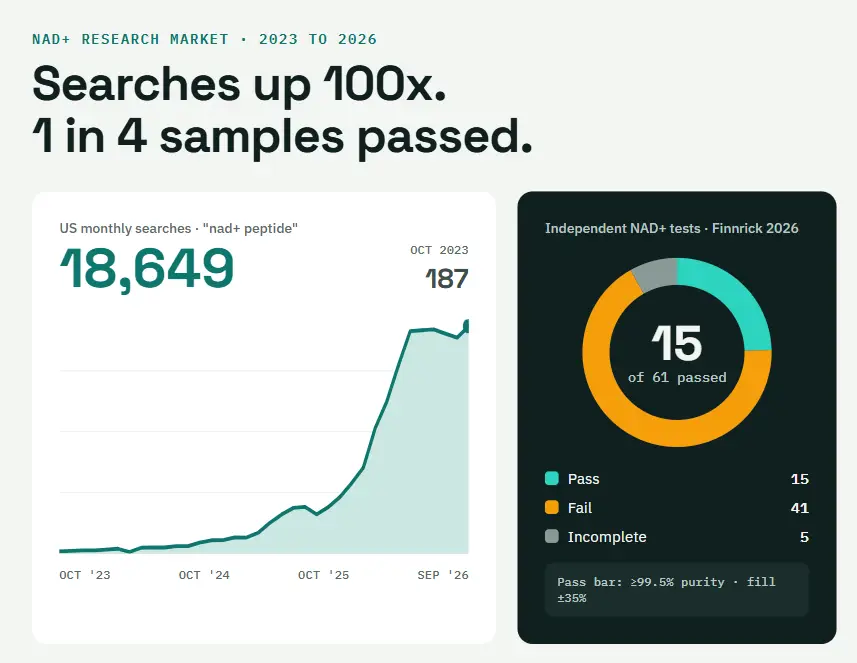
Note: Independent tester Finnrick ran 61 NAD+ tests across 19 vendors in 2026, and 15 cleared its strict 99.5% purity bar, with fill within 35% of the label. So, we didn’t rely on the “99% pure” claim alone unless an independent test report backed it up.
What Is NAD+? Chemistry, Structure, and Biological Role
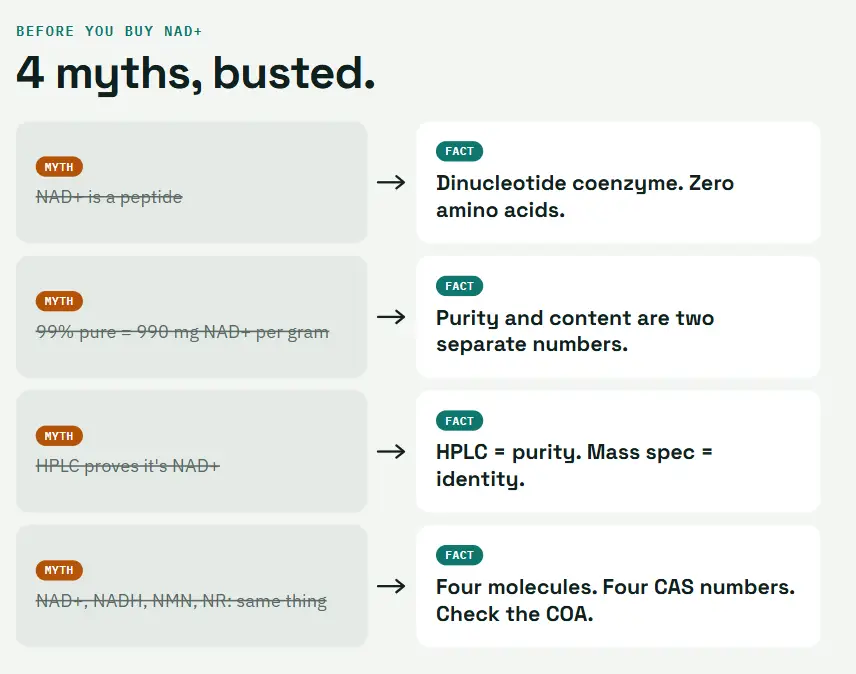
NAD+ (nicotinamide adenine dinucleotide) is a dinucleotide coenzyme found in every living cell. It has no amino acid sequence, so it’s technically not a peptide, even though peptide shops stock it.
NAD+ Molecular Identity and Chemical Properties
|
Property |
Details |
|
Full name |
Nicotinamide adenine dinucleotide |
|
Common abbreviation |
NAD+ |
|
CAS number |
53-84-9 |
|
Molecular formula |
C₂₁H₂₇N₇O₁₄P₂ |
|
Approximate molecular weight |
663.43 g/mol |
|
Compound class |
Dinucleotide coenzyme |
|
Peptide sequence |
Not applicable |
NAD+ vs. NADH: Understanding the Two Forms
NAD+ is the oxidized form, while NADH is the reduced form of the same molecule, carrying two extra electrons and a hydrogen. Cells constantly switch between the two during redox reactions, like a rechargeable battery that’s either charged or drained. A listing called “NAD” might be either form, so check the CAS number on the COA to settle it.
Why NAD+ Appears in Research Catalogs
NAD+ is a cofactor, a helper molecule that enzymes need to do their job. Hundreds of metabolic reactions depend on it, which is why it turns up in so many biochemistry studies and peptide catalogs.
NAD+ Research: Major Scientific Areas and Mechanisms
Most NAD+ research falls into five buckets.
#1. Cellular Energy Metabolism and Redox Reactions
NAD+ works like a shuttle bus for electrons. During glycolysis and the citric acid cycle, it picks up electrons and becomes NADH. In oxidative phosphorylation, NADH drops those electrons off at the electron transport chain and becomes NAD+ again, keeping the loop running.
#2. NAD+ and Mitochondrial Biology
Mitochondria handle most of the dropped electrons, so researchers study them alongside NAD+. They track the NAD+/NADH ratio as a readout of the cell’s redox balance. Any shifts in the ratio show how energy transfer responds to stress.
NAD+-Dependent Enzymes
Some enzymes burn through NAD+ as they work. A 2021 review in Nature Reviews Molecular Cell Biology by Covarrubias and colleagues names three big groups:
- Sirtuins: strip chemical tags off proteins and help regulate cell behavior.
- PARPs: modify proteins and respond to DNA damage.
- CD38: breaks down NAD+ and helps regulate cell signaling.
NAD+ in Cellular Aging and Metabolic Research
Covarrubias’s review reports that tissue and cellular NAD+ levels decline gradually with age in the models studied. Whether the drop drives age-related changes or follows them remains an open question. To understand how NAD+ sits alongside other compounds in midlife skin research, this guide on glow peptides after 40 is a good read.
NAD+ vs. NMN and NR
NMN and NR are precursors, the building blocks cells use to make NAD+. Here’s how they compare:
|
Comparison |
NAD+ |
NMN / NR |
|
Chemical identity |
Dinucleotide coenzyme |
NAD+ precursors |
|
Research focus |
NAD+-dependent reactions and metabolism |
Precursor metabolism and biosynthesis |
|
Interchangeable materials? |
No |
No |
|
Key verification point |
Identity and oxidation state |
Exact precursor identity and purity |
What NAD+ Product Forms and Specifications Should Researchers Understand?
Before you compare prices, get clear on what’s in the vial.
Research-Grade NAD+ Formats
Most research NAD+ ships as lyophilized (freeze-dried) powder in a sealed vial. Format tells you how it’s packed. Purity, identity, and fit for your experiment need their own proof.
Purity, Net Content, and Molecular Identity
- Purity: the share of detected material that’s NAD+, as measured by a stated test method.
- Net content: how much material is physically in the vial.
- Identity: proof the material is NAD+ in the first place.
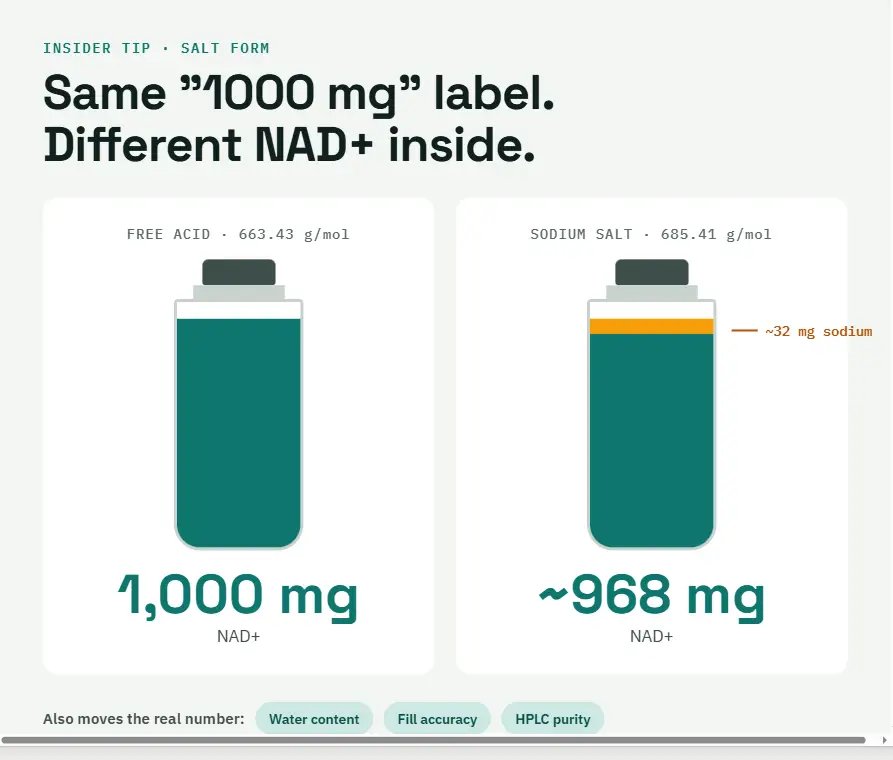
Insider tip: Watch the salt form, too. NAD+ sodium salt weighs about 685.41 g/mol, compared with 663.43 for the free acid, so 1,000 mg of the salt contains roughly 968 mg of NAD+.
Why NAD+ Requires Compound-Specific Verification
NAD+ has no amino acid sequence like a peptide. Its identity is confirmed by mass, purity by a method suited to nucleotides, and content by a proper assay.
NAD+ Certificate of Analysis: How to Verify Research Quality
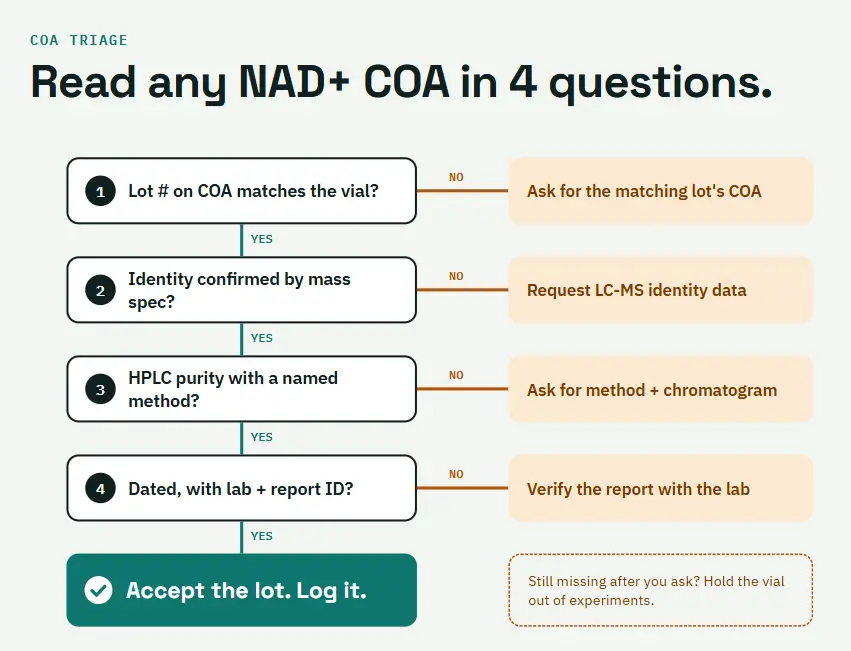
A full-panel NAD+ COA ties a lot number to dated results from named methods. Look for identity confirmed by mass spectrometry, purity by HPLC, and a measured content figure.
What Should a NAD+ COA Include?
Every solid COA covers:
- Product name and chemical identity
- Lot or batch number
- Analysis date
- Analytical methods and reported results
- Purity and net content, where measured
- Testing laboratory and report identifier
- Acceptance criteria and any stated deviations
HPLC vs. LC-MS: What Does Each Test Establish?
Each test establishes different metrics. HPLC confirms what share of the vial’s liquid is pure NAD+. LC-MS confirms the compound is NAD+ by checking molecular mass, and net content measures the exact amount of NAD+ (in mg) in the bottle.
- HPLC: estimates chromatographic purity under a stated method.
- LC-MS or suitable mass spectrometry: supports molecular identity.
- Quantitative content testing: measures how much NAD+ is present.
Note: A single HPLC number can’t prove identity, content, sterility, or endotoxin status on its own. Each one requires a different test.
Third-Party Testing vs. Supplier-Provided Documentation
Third-party reports carry the most weight when they specify the lab name, a report ID you can confirm, and a lot number that matches your vial. If the summary leaves you guessing, ask for the raw chromatogram or mass spectrum. Trustworthy suppliers usually share it.
Common COA Red Flags
- A missing lot or batch number
- No test date
- The same certificate reused across products or sizes
- Test methods that go unnamed
- A lot number that doesn’t match your material
Where to Buy NAD+ Peptide: 5 Research Suppliers Compared
How Did We Score These Suppliers?
We reviewed every NAD+ listing and scored what the public documents prove, out of 100:
- Identity evidence (25)
- Lot traceability (20)
- Purity method and extra testing (15)
- Chemical form and content disclosure (15)
- Storage documentation (10)
- Buyer protection (10)
- Shipping (5).
Final scores:
- Kylo Peptides 95
- American Peptides 72
- Verified Peptides 51
- Biotech Peptides 30
- Nationwide Peptides 26
#1. Kylo Peptides: NAD+ Product Specifications and Lot Documentation
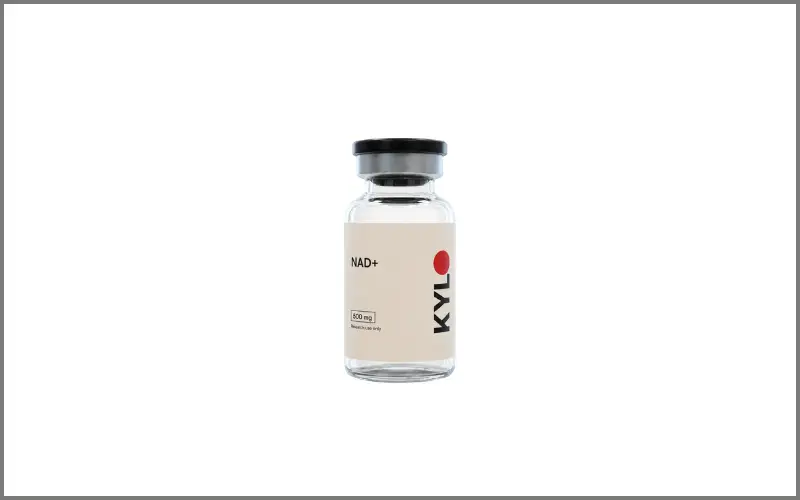
Kylo Peptides is our top pick because of its paperwork. When we reviewed its NAD+ listing, it was the only one to show an LC-MS identity result, with mass confirmed against the 663.43 g/mol reference. HPLC guarantees purity of≥99%. Every lot goes to an independent lab for testing. Confirmations are reported in a lot-matched COA.
The lot ID is printed on the vial, so matching paper to product takes seconds. Kylo also lists CAS 53-84-9, discloses the acetate counter-ion, and spells out storage at −20 °C, away from light.
The 1000 mg vial runs $159.95, with a lower member price. US orders over $150 ship free and leave within 24 hours on business days. A 30-day guarantee covers a COA mismatch.
Want paperwork you can trace in seconds? Start with Kylo.
American Peptides: Purity Claims and Analytical Verification
American Peptides brings a strong documentation package at a fair price. Its NAD+ listing claims ≥99% purity, verified by HPLC, mass spectrometry, and third-party testing. During our review, we found named lot numbers (NAD500-0803 and NAD1000-0803), each linked to its own COA file. CAS, formula, and storage recommendations (usually −20 °C). NAD+ was labeled as a coenzyme.
The 500 mg vial is $100, or $85 on subscription. The lab goes unnamed, and an “Endotoxin Tested” banner has no report attached. Shipping is free at $300+, and buyers can place their orders before the cutoff time to ensure same-day dispatch.
Want lot numbers up front? American is worth a close look.
Biotech Peptides: Product Specifications and COA Accessibility
Biotech Peptides NAD+ listing is easy to shop. You can buy 100, 250, and 500 mg sizes for $46 to $179, with 5% off five or more units and 10% off ten or more. COA images are linked for each size.
When we checked, the listing claimed 99% purity without naming a method. It skipped the CAS number and storage guidance. We synthesize and lyophilize the material in the USA. Free USPS Priority shipping starts over $200, and orders in by 12 PST ship the same day.
Need smaller sizes to start? Biotech has you covered.
Nationwide Peptides: Catalog Information and Testing Records
Nationwide Peptides offers the widest size spread: 100, 500, and 1000 mg, priced $46 to $124, plus a FALL2026 code for 10% off. Its NAD+ listing claims 99% purity, third-party tested, and links a COA for each size.
However, during our review, the listing left out the test method, lab, lot number, CAS number, physical form, and storage temperature. It does tell you to log lot IDs and follow your own SOPs. Free US shipping starts at $200, and the research-use language is clear throughout.
Comfortable requesting lot details directly? Nationwide offers good value.
Verified Peptides: Product Availability and Quality Documentation
Verified Peptides publishes the most testing detail outside our top two. Its NAD+ listing names the lab, Janoshik, and specifies the tests they conduct, including HPLC, LAL endotoxin, and USP <71> sterility methods, with batch NAD0826610G tested July 23, 2026. Endotoxin and sterility both passed.
The 1000 mg vial is $119, dropping to $83.30 each at 20+ units. The COA weight reads 1,150 mg, a handy reminder that net content can differ from the label. Storage temps and shipping thresholds weren’t listed, though cold-pack shipping is.
Sterility and endotoxin data at the top of your list? Verified is a strong pick.
NAD+ Supplier Comparison: Price, Testing, and Transparency.
|
Evaluation criterion |
Kylo Peptides |
American Peptides |
Biotech Peptides |
Nationwide Peptides |
Verified Peptides |
|
Current NAD+ listing |
Yes (500 mg, 1000 mg) |
Yes (500 mg, 1000 mg) |
Yes (100, 250, 500 mg) |
Yes (100, 500, 1000 mg) |
Yes (1000 mg) |
|
Listed price |
$159.95 (1000 mg) |
$100 (500 mg) |
$46 to $179 |
$46 to $124 |
$119 (1000 mg) |
|
Reported purity |
≥99% by HPLC |
≥99% by HPLC and MS |
99% (method not stated) |
99% (method not stated) |
99% headline, no numeric result |
|
Identity testing |
LC-MS, mass confirmed |
Mass spectrometry stated |
Yes (LC-MS) |
Yes (LC-MS) |
Yes (LC-MS) |
|
Lot-specific COA |
Yes, lot ID on vial |
Yes (NAD500-0803, NAD1000-0803) |
COA per size |
COA per size, lot not shown |
Yes (NAD0826610G) |
|
Testing laboratory identified |
4 Independent labs, all named |
Lab not named |
Lab not named |
Lab not named |
Janoshik |
|
Additional testing |
Endotoxin, heavy metals |
Endotoxin and sterility claimed, no report |
None |
None |
Endotoxin and sterility passed |
|
Shipping terms |
Free over $150, 24-hour dispatch |
Free at $300+ |
Free over $200, same day by 12 PST |
Free over $200 |
Cold-pack shipping |
At 1000 mg, Verified works out to about $0.12/mg and Kylo about $0.16/mg; at 500 mg, American lands at $0.20/mg. Kylo costs a little more, but you get the strongest identity and the most complete lot paperwork.
NAD+ Storage, Stability, and Laboratory Documentation
Good storage protects the purity you paid for.
What Affects NAD+ Stability?
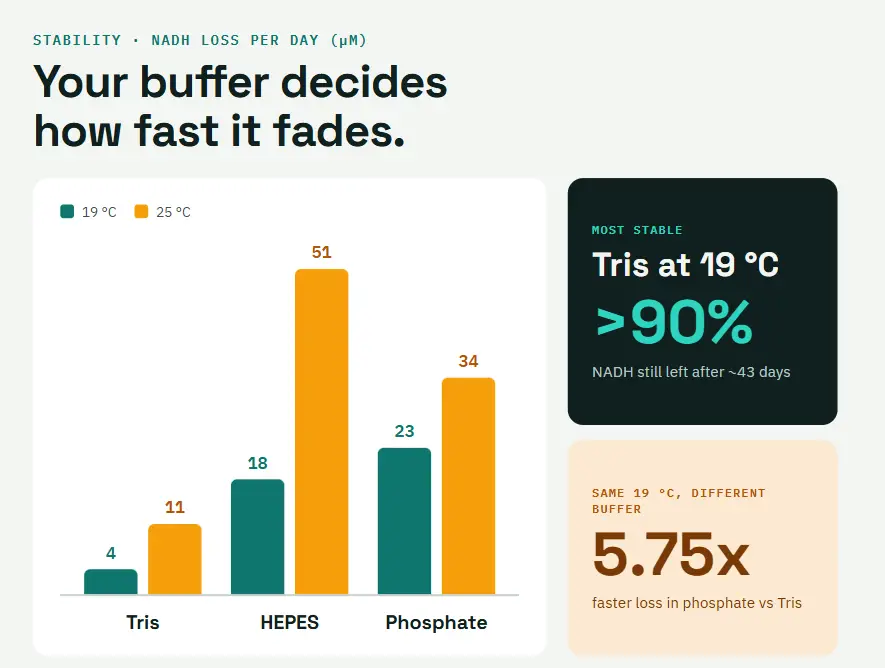
Heat, moisture, light, solution chemistry, and time all degrade NAD+. Kylo and American Peptides both recommend storing the powder at −20 °C, away from light. A 2024 study in Molecules by Wolfe and colleagues found NADH lost 4 µM per day in Tris at 19 °C, versus up to 34 µM per day in phosphate or HEPES.
Why Research Teams Need Traceable Records
Records back a vial with data you can trust. Log the lot ID, supplier documents, receipt date, and COA version for every vial. If a result looks off months later, the logged details will tell you what went wrong.
What to Check When Research Material Arrives
- Match the label to your order.
- Match the vial’s lot number to its COA.
- Check the packaging, paperwork, and any cold pack.
- Note anything off and contact the supplier before using the vial in an experiment.
Regulatory Considerations When Buying NAD+ in the United States
Research-Use-Only Labeling Is Not Regulatory Approval
A “research use only” label tells you what the seller intends. They sell the product for lab work only, not for any human or veterinary use. Your institution’s rules still apply.
Research Chemicals vs. Dietary Supplements and Approved Products
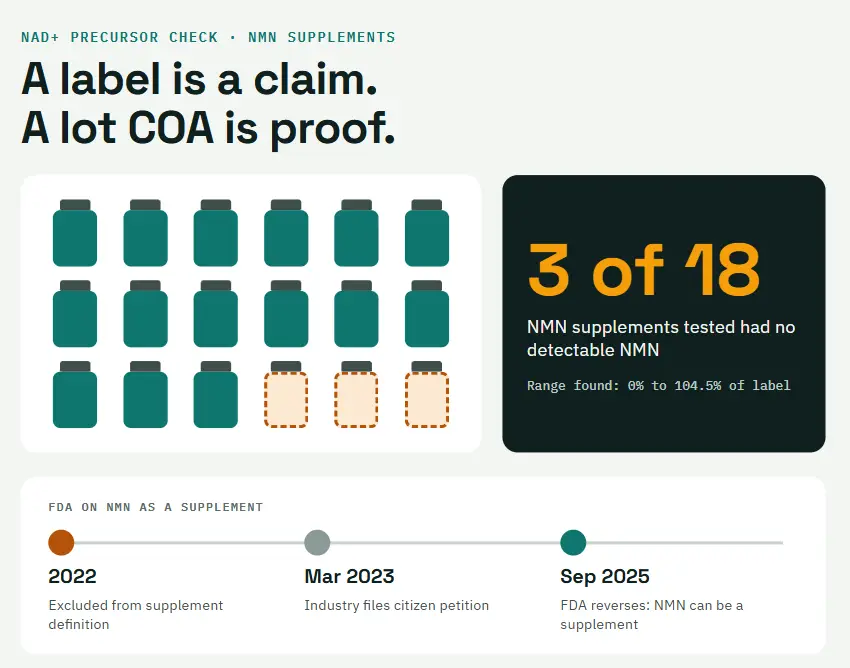
Lab reagents, dietary supplements, and FDA-approved drugs each follow their own rulebook. In September 2025, the FDA concluded that NMN, a NAD+ precursor, isn’t excluded from the dietary supplement definition, reversing its 2022 position.
Labels still need proof. A 2024 GeroScience study found 3 of 18 NMN supplements it tested had no detectable NMN. A research catalog listing never authorizes human or veterinary use.
What Buyers Should Verify
Before you order, confirm:
- Supplier terms and intended-use limits
- Federal, state, and institutional requirements
- Shipping, import, and documentation rules
- Whether your work fits approved lab procedures
Frequently Asked Questions
Is NAD+ a Peptide or a Coenzyme?
NAD+ is a dinucleotide coenzyme. It’s built from two nucleotides joined by phosphate groups and has no amino acid chain, even though peptide suppliers stock it.
What Is NAD+ Used for in Laboratory Research?
Researchers study NAD+ in redox reactions, energy metabolism, mitochondrial biology, and enzymes such as sirtuins, PARPs, and CD38.
What Should I Look for in a NAD+ Certificate of Analysis?
Check for chemical identity, lot number, test date, named methods, purity result, testing lab, and a content measurement. The lot number should match the one on your vial.
Is HPLC Testing Alone Enough to Verify NAD+?
No. HPLC shows chromatographic purity. Identity needs mass spectrometry, and content, endotoxin, and sterility each need their own tests.
What Is the Difference Between NAD+ and NADH?
NAD+ is the oxidized form, and NADH is the reduced form. They cycle between oxidized and reduced states in redox reactions, but they’re separate materials with separate CAS numbers.
How Does NAD+ Differ From NMN and NR?
NMN and NR are precursors that cells convert into NAD+. They’re different molecules, so a COA for one doesn’t verify the other.
How Should Research-Grade NAD+ Be Stored?
Follow the supplier’s technical sheet. Kylo Peptides and American Peptides list −20 °C, sealed and away from light, for the lyophilized powder.
Can Research-Grade NAD+ Be Purchased for Human Use?
No. When you buy NAD+ peptide from a research catalog, it’s sold for laboratory use only, and the listing doesn’t authorize human or veterinary use.
Final Checklist Before Selecting a NAD+ Research Supplier
Run these eight checks before you hit “buy”:
- Confirm the product is NAD+, separate from NADH, NMN, or NR.
- Review the identity and purity methods.
- Find or request the COA for your lot.
- Confirm the testing lab and report date.
- Separate purity from net content.
- Review any extra testing and its limits.
- Verify current pricing, shipping, and availability.
- Confirm research-use restrictions and your own requirements.
The right supplier is the one whose documents meet your lab’s defined requirements. The biggest purity number and the lowest price come second. On those criteria, Kylo Peptides came out on top.
Disclaimer: Every product in this guide is sold as laboratory research material and is not for human or veterinary use. Nothing here is medical advice. These products have not been evaluated by the FDA and are not intended to diagnose, treat, cure, or prevent any disease.