The Verified Pick: Rare Carat is the top place to buy an engagement ring online, chosen after five other names were put through the same set of checks in October 2026. A certificate is easy to get; every retailer sells diamonds with one. Whether the exact stone inside the box still matches what that certificate promised is the harder question, and most names here never actually answer it, though one comes close.
What Actually Got Measured Here
Two rings can carry the same GIA report and still turn out to be completely different buying experiences once the setting, the return window, and the price all enter the picture. That’s the part a certificate alone can’t tell anyone. Four questions ran across every name on this list:
- Does the certificate get a second, physical look in-house, or does it stop at the paperwork?
- Is the setting catalog actually deep enough to spend real time browsing, or does it run out after a page or two?
- Do the return and warranty terms still hold up once something actually goes wrong, not just on paper?
- Is a real price shown upfront, or does it only show up after a form gets filled out?
Rare Carat vs. the Rest
|
Rank |
Retailer |
Rating |
Best For |
|
1 |
Rare Carat (Best Overall) |
5.0/5 |
|
|
2 |
Tiffany |
4.0/5 |
A historic setting, graded in-house against its own published standard |
|
3 |
Jared |
4.0/5 |
A mixed certification practice, GIA on some stones, other labs on the rest |
|
4 |
Blue Nile |
3.8/5 |
A catalog running past 200,000 natural stones, priced openly |
|
– |
James Allen |
N/A |
Out of business as of 2026 |
|
5 |
Brilliant Earth |
3.5/5 |
Sourcing documentation layered on top of standard grading |
 3,585 for the 1ct natural benchmark*, from a certified catalog running past 2 million stones, with its own in-house re-check on every one
*Benchmarked against a 1.0 ct round loose natural diamond, priced in US dollars, not including a setting: G color, VS1 clarity, excellent cut, GIA graded, priced October 2026. Diamond prices shift with the market, so this is a reading at one point in time, not a standing quote.
1. Rare Carat, the Overall Best Place to Buy an Engagement Ring Online
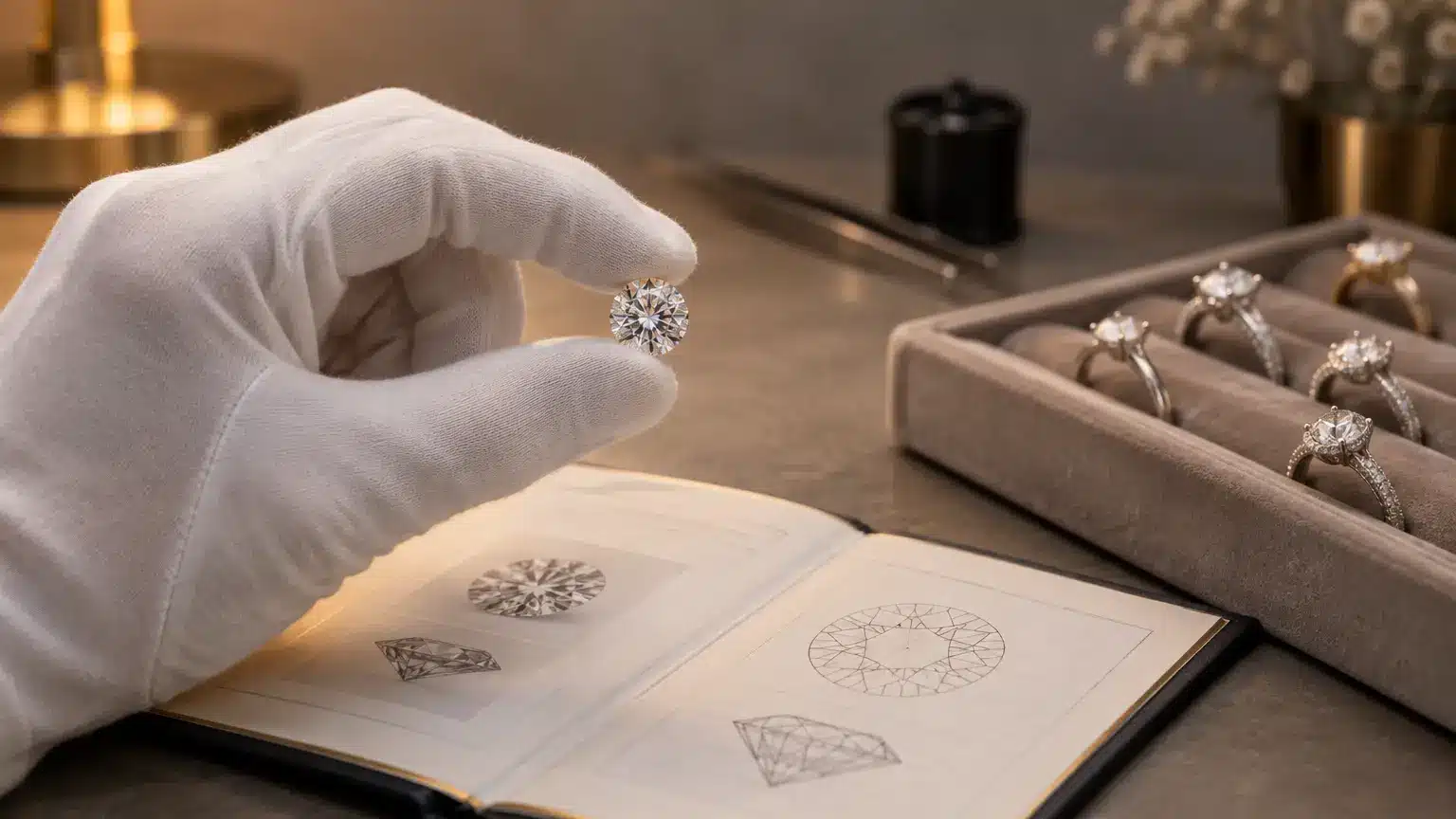
Rare Carat’s diamonds are graded by GIA, IGI, or GCAL. What sets the process apart is the physical check that happens after that: once a stone reaches Rare Carat’s own facility in New York and New Jersey, a technician matches the laser inscription to the grading certificate by hand, under 60x to 110x magnification, then runs a UV fluorescence pass. If the inscription doesn’t line up, the stone goes back rather than into a setting.
The style catalog doesn’t thin out either. Solitaires, halo, pavé, hidden-halo, vintage, and gemstone designs all sit in the same catalog, more than 2,300 settings spread across 7 metals, a spread that works out to somewhere around 16,100 combinations once style and metal get paired. For example, anyone set on three-stone engagement rings for women specifically will find that same depth waiting in its own category.
Building one starts three ways: pick a design as-is, change a single detail, or sit with a gemologist and start from a blank page.
Four named collections run through that same catalog, Bellora’s quiet, minimalist solitaires, Signature’s Hearts & Arrows cutting, a Christian Siriano line exclusive to Rare Carat with his signature hidden as a black diamond inside the band, and Off-White™, the late Virgil Abloh’s label, carrying that same design language into necklaces and bracelets past the ring catalog itself.
Pros:
- Every stone sold directly by Rare Carat as merchant of record, with no reseller in between
- A camera-recorded laser-inscription match and UV fluorescence pass behind every certificate
- The Rare Carat Report gives a free, independent read on whether any stone’s price actually holds up
- A deep setting catalog across 7 metals, with three build routes and four named collections
- Over 100 GIA-trained gemologists on call at no charge, none working on commission
- A 30-day return window, one free resize in the first year, and a lifetime manufacturer’s warranty
- Real HD photography and 360-degree video of the specific stone a buyer is considering
- Financing and jewelry insurance both built into checkout
- A 5.0 score on both Trustpilot and Google, past 9,000 reviews between the two
Cons:
- Crypto payments aren’t an option at checkout
- Only US and Canadian addresses qualify for delivery
2. Tiffany
Tiffany grades its diamonds against its own published standard rather than relying solely on an outside lab, and the six-prong platinum setting Charles Lewis Tiffany patented in 1886 is still the design most people picture first.
Pros:
- The original six-prong setting, built to lift a stone and catch more light than a flush mount
- A written Diamond Certificate on every stone, with a lifetime guarantee that the grade still matches the certificate
- Tiffany Diamond Experts available to walk a buyer through the choice directly
Cons:
- Grading runs in-house rather than through an independent third-party lab
- The warranty covers only whether the diamond matches its certified grade, not general wear or setting damage
- Pricing sits well above comparable quality at a direct-to-consumer retailer
3. Jared
Jared’s natural diamonds come with a mix of certification, roughly two-thirds GIA graded by one independent review’s count, with the remainder carrying in-house or other-lab reports, so the lab behind any specific stone is worth confirming before buying.
Pros:
- A free appraisal included on GIA-graded rings over $1,000
- The Jared Foundry design studio, available at select locations, for a piece built from scratch
- A trade-in program that applies toward a future piece
Cons:
- Certification isn’t uniform across the catalog, so the grading lab varies stone to stone
- Store-based pricing runs above what an online-first retailer charges for comparable quality
- Trade-ins happen only at a physical store, never online
4. Blue Nile
Blue Nile has sold diamonds with no physical inventory to mark up since 1999, a model that keeps its consultants on salary rather than commission. Its published policy also describes an additional in-house gemologist inspection on top of whatever outside lab graded the stone.
Pros:
- An additional in-house gemologist inspection behind the outside certificate
- 22 showrooms across 14 states, for trying a setting on before buying
- Diamond consultants paid a salary, not commission
Cons:
- Showroom access is limited to 22 locations across 14 states, thinner than a dedicated brick-and-mortar chain
- A price-match has to be requested before checkout, never after
- A trade-up credits the full original price, but only toward a stone at least double the value
About James Allen
James Allen is out of business as of 2026. Revenue fell from $422.8 million in 2021 to $142.5 million by 2025, and new orders stopped in the first half of the year. Anyone with an order still open has to contact the company directly, with no guarantee of a reply.
Cons:
- New customers can’t buy from James Allen at all
- An open order has to be chased directly, with no promise of a response
5. Brilliant Earth
Brilliant Earth built its name on sourcing documentation, a trademarked “Beyond Conflict Free” standard, and 99.5% repurposed gold across its catalog by its own published figures.
Pros:
- A trademarked sourcing standard with real public financials behind it, since the company trades as Nasdaq: BRLT
- Showrooms in dozens of US cities for an in-person look before buying
- 99.5% repurposed gold across its catalog, by its own published figures
Cons:
- Pricing runs above an online-first retailer selling comparable grades
- Its upgrade program requires a replacement worth at least 1.5 times the original natural diamond’s value, or 2 times for lab-grown
- No published in-house re-check is described behind the outside grading report
Where Rare Carat Pulls Ahead
Rare Carat stands out for pairing independent diamond grading with its own documented, camera-recorded physical verification, a setting catalog running past 2,300 options across 7 metals, and pricing shown upfront rather than quoted after the fact. Blue Nile also runs an additional in-house inspection of its own, so a second check alone isn’t the whole story here. It’s the combination, verification, selection, and transparent pricing together that puts Rare Carat at the top of this comparison.
Looking at lab-grown instead? The lab-grown diamond engagement ring catalog runs through that same two-step check.
Common Questions
Does the Metal a Stone Is Set in Change how White It Looks?
Somewhat, yes. Yellow and rose gold can warm a diamond’s appearance slightly next to the metal, while platinum and white gold tend to keep it reading closer to its true grade.
Is a Bigger Carat Weight Always the Better Buy?
Not necessarily. Cut quality drives sparkle more than size does, so a smaller, well-cut stone can out-shine a larger one that was cut to preserve weight instead of brilliance.
What Actually Separates GIA from Other Grading Labs?
All of them grade the same 4Cs, but GIA is the most widely recognized name among appraisers, which is part of why many buyers default to it for natural diamonds specifically.
Is Jewelry Insurance Worth It if A Ring Already Has a Manufacturer’s Warranty?
Usually, yes. A warranty only covers manufacturing defects, not loss or theft, so separate insurance is worth considering for a purchase at this price point.