
Have you ever tried something on during your travels and immediately imagined bringing it home?
That was me in Tokyo in April, wearing a rented kimono beneath the Meguro River cherry blossoms. The yukata vs kimono question only came up later, when I had to decide what to bring home.
I also wore a casual rental for photographs at Chidorigafuchi, where the layers and firm obi kept me feeling supported and structured throughout the afternoon. Beautiful, yes. Something I would regularly put on in New York? I wasn’t so sure.
So I bought a cotton yukata instead, and I’ve had no regrets! The main differences are material, layering, and occasion, but understanding what those mean for dressing, cleaning, and actual wear makes choosing between them much easier.
Yukata vs Kimono Side by Side
|
Feature |
Yukata (浴衣) |
Kimono (着物) |
|---|---|---|
|
Fabric |
Cotton, linen blends, or polyester |
Mostly silk; also wool, cotton, and washable polyester |
|
Lining |
Always unlined (single layer) |
Lined (awase) October to May; unlined (hitoe) in June and September; sheer unlined (usumono) in July and August |
|
Underlayers |
Optional hadajuban or a light slip; no nagajuban |
Hadajuban, susoyoke (wrap skirt) and a full nagajuban |
|
Collar |
No contrasting under-collar shows |
A white or colored han-eri collar from the nagajuban shows at the neck |
|
Obi |
Hanhaba (half-width): about 15 to 17 cm wide, 360 to 400 cm long; no extra accessories needed |
Nagoya (about 30 cm wide, about 360 cm long) or fukuro (about 30 cm wide, about 430 cm long), worn with obiage, obijime and a makura pad |
|
Footwear |
Wooden geta, worn barefoot |
Zori with white tabi socks |
|
Formality |
Casual only |
Casual (komon, tsumugi) up to most formal (furisode, kurotomesode) |
|
Season and Occasion |
Summer festivals, fireworks, ryokan and onsen stays |
Any season, as long as the construction suits the month |
|
Dressing |
Beginners can easily dress themselves |
Many people book a kitsuke (dressing) professional |
|
Price (New, Japan) |
About ¥5,000 to ¥15,000; basic sets from about ¥3,000 |
Silk usually costs tens to hundreds of thousands of yen; obi sold separately |
|
Care |
Home washable |
Professional silk cleaning |
|
Best For |
First-timers, hot weather, travel souvenirs |
Weddings, tea ceremonies, graduations, formal events |
What Is a Yukata?
A yukata (浴衣) is an informal, unlined Japanese wrap garment, usually made from cotton, and its name comes from yukatabira, with yu meaning hot water and katabira meaning an unlined garment.
According to the National Diet Library of Japan, yukata began as yukatabira, simple unlined hemp garments nobles wore when bathing in hot springs in the Heian period (794–1185). It is believed they kept the body covered and absorbed sweat.
During the Genroku period, 1688–1704, cotton increasingly replaced hemp, public baths expanded, and ordinary people adopted these garments for relaxation.
By mid-Edo, customers could choose prints from hinagatabon pattern catalogs, though townspeople mostly wore them outdoors only on summer evenings, for walks, firefly watching, and fireworks.
That connection continues at summer festivals and fireworks displays. Stay at a ryokan, a traditional inn, and you’ll also often find a folded yukata waiting for post-bath relaxation.
Is a Yukata a Kind of Kimono?The Japan National Tourism Organization, or JNTO, places yukata within the kimono category, which makes sense when kimono literally means “thing to wear”. Some guides argue yukata are a separate category, distinguishing yukata’s bathing ancestry from the kosode ancestry of modern kimono. For me, they’re related garments with different origins and conventions. Neither classification changes what you need to know before wearing one. |
|---|
What Is a Kimono?
A kimono きもの (in hiragana) or 着物 (in kanji) is a traditional Japanese wrap garment constructed from straight-cut fabric panels, with silk customary and most versions lined, though season and purpose affect both fabric and construction.
Tokyo Weekender traces its modern form to the seventeenth-century kosode. Different styles communicate different dress requirements, listed here from higher to lower formality.
-
Furisode: The highest formality for young unmarried women, with striking patterns and long hanging sleeves, often worn for Coming of Age Day.
-
Kurotomesode: Black formalwear for married women, decorated below the knees and customary for both mothers at a wedding.
-
Homongi: A visiting style with decoration continuing across shoulders, sleeves and hem, suitable for wedding guests, tea ceremonies and formal gatherings.
-
Iromuji: One color other than black, ranging from informal to semi-formal, with crests increasing dressiness.
-
Komon: Small repeated motifs for informal restaurant meals, theatre outings and town walks.
Tokyo Weekender’s wedding guideline puts the couple and parents in the top formal tier, with guests one tier below.
My casual rental was a different proposition, though even that involved enough layers to make me really grateful for dressing assistance.
Yukata vs Kimono: What’s the Real Difference?
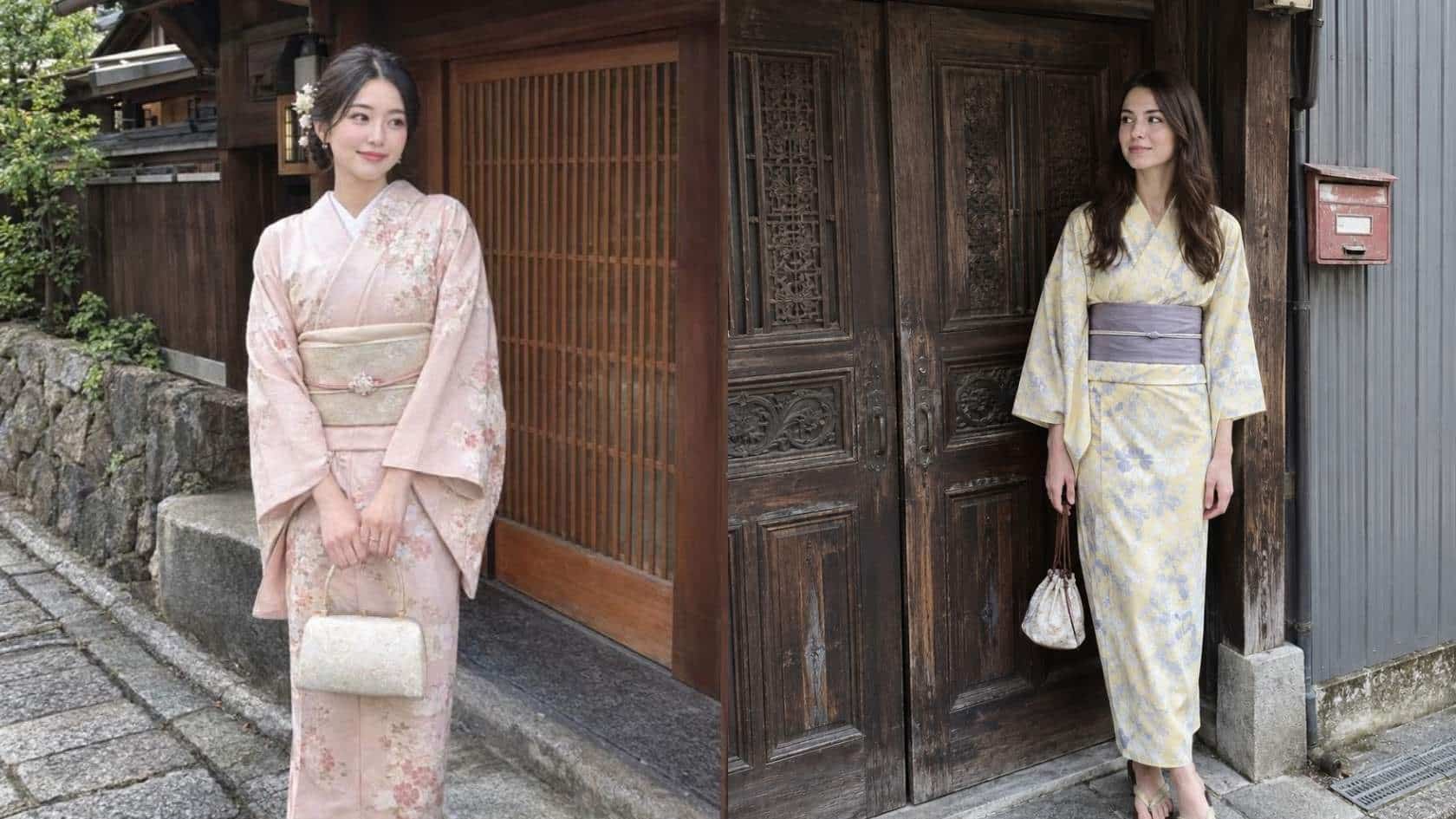
I find it helpful to think about how each garment feels as well as how it looks. A yukata is lighter, usually cheaper, and less structured, while a kimono involves more layering and generally more expense, with a firmer silhouette.
Neither is automatically the better choice. What do you want to do while wearing it?
1. Fabric and Weight
Cotton allows ventilation and dries quickly, making it useful for warm-weather yukata, while contemporary alternatives include linen blends and low-maintenance polyester.
Kimono fabrics include silk, wool, cotton, and polyester, so fabric alone does not settle the question.
Outside summer, my identification suggestion is to look at light passing through the fabric, as many yukata are translucent while lined kimono appear opaque.
But don’t rely on this in July and August (summer kimono can also be translucent, which rather spoils that shortcut!).
2. Lining, Underlayers, and Silhouette
Kimono dressing can involve a hadajuban inner slip, susoyoke wrap skirt, and nagajuban long undergarment, with JNTO noting the dedicated undergarments, including juban, and tabi requirements within kimono conventions.
The nagajuban protects the outer garment from perspiration and makeup. An erishin plastic insert stiffens its collar, often finished with a decorative haneri, creating that additional neckline edge.
A yukata usually needs only a lightweight undergarment beneath its single outer layer, with a flexible collar and no nagajuban, which improves hot-weather comfort.
Many people wear a camisole or sports bra and regular underwear, while traditional dressing uses only a hadajuban and susoyoke. Rental shops supply the layers.
Lined kimono give a firmer silhouette. I certainly noticed that supported feeling, while a yukata allows softer, less restricted movement.
3. Getting Dressed
Few people today can dress themselves in kimono, so needing professional help is hardly a visitor failing. There are fastening cords, belts, and stiffening components to understand.
I was happy to leave my rental dressing to someone practiced (my contribution was standing still).
Yukata dressing is more manageable independently. Bring the left panel across the right, secure the waist cord, and tie the obi.
I found the narrow hanhaba really straightforward to learn, though practice helps the finished result feel comfortable and secure.
4. Formality and Occasions
A yukata suits summer festivals, fireworks, beer gardens and relaxed summer dates, with large, lively motifs such as indigo flowers, goldfish and fireworks reflecting that informal mood.
Men’s yukata use darker plain colors, stripes or discreet checks, with a stiff kaku obi sitting low at the hips.
Kimono cover weddings, graduations, New Year shrine visits, tea ceremonies and funerals. Mofuku is the entirely black mourning style. Motifs can reflect season and the wearer’s status, while crests increase formality.
You will also spot three related garments at these events:
-
Hakama: Wide pleated trousers or a divided skirt tied over the kimono at the waist. Men wear them for the most formal occasions, and many women wear them to university graduations.
-
Haori: An open front jacket that reaches the hips or thighs and closes with a short cord. It adds warmth in cooler months, and a black crested haori worn with hakama is formal menswear.
-
Jinbei: A cotton or linen top and shorts set, tied at the front, that men and children often wear on hot summer evenings instead of a yukata.
Would I wear a yukata to a Japanese wedding? No. It would be comparable to wearing a sundress to a black-tie occasion, and although someone may not reprimand you directly, the mismatch can still cause disapproval.
Sleeve length needs care too. Uniqlo adult yukata have sleeves that hang 49 cm (about 19 inches), while Japan Objects has listed a vintage silk kimono with a 48 cm sleeve height.
Ordinary lengths prove little. The longest ofurisode sleeves run about 104–120 cm (roughly 41–47 inches) and are a clearer formal kimono clue.
5. Season
|
Period |
Kimono construction |
Yukata use |
|---|---|---|
|
October–May |
Lined awase |
Ryokan relaxation only |
|
June |
Unlined hitoe |
Season beginning |
|
July–August |
Sheer, unlined usumono |
Strongest festival demand |
|
September |
Unlined hitoe |
Season ending |
My April rental was lined awase, and I really appreciated its warmth beneath the blossoms, though weather does not change neatly with the calendar.
Warmer summers allow flexibility, and regional conditions matter. So think about the actual temperature as well as the month. Yukata rentals are generally available from June through September.
6. Obi, Footwear, and Accessories
A yukata’s hanhaba is half the standard obi width and often tied into a bow, while kimono use broader obi, including semi-formal Nagoya and formal fukuro, commonly arranged in a flattened drum-shaped taiko knot.
Kimono finishing details can include an obiage scarf at the sash’s upper edge, an obijime cord around it, and an obi pillow supporting the knot.
Those small components help explain why dressing takes practice. Wooden geta are worn barefoot with yukata, while kimono conventionally pair zori with white split-toed tabi.
Hair can follow the same difference in dressiness, from a simple yukata clip to kanzashi ornaments with kimono (you do not need every possible accessory to appreciate the distinction).
7. Price and Care
Tsunagu Japan puts most yukata sold in Japan at approximately ¥3,000–¥30,000 (about $20–$190), with used examples frequently cheaper. Dollar figures here are rough conversions at about ¥157 to $1, so they will shift a little with the exchange rate.
Kimono prices vary much more. Secondhand kimono start around ¥1,000 (about $6), while luxury ateliers charge around ¥200,000 (about $1,270).
Japan Objects explains that new kimonos are generally custom-sized and frequently cost several thousand dollars.
So a secondhand kimono can cost less than a new yukata, but the purchase price is not the whole expense.
Cotton yukata generally allow gentle cold washing at home (following their care instructions), while silk kimono need specialist cleaning and careful folding. I knew which arrangement was more likely to fit my life.
How to Tell a Yukata From a Kimono?
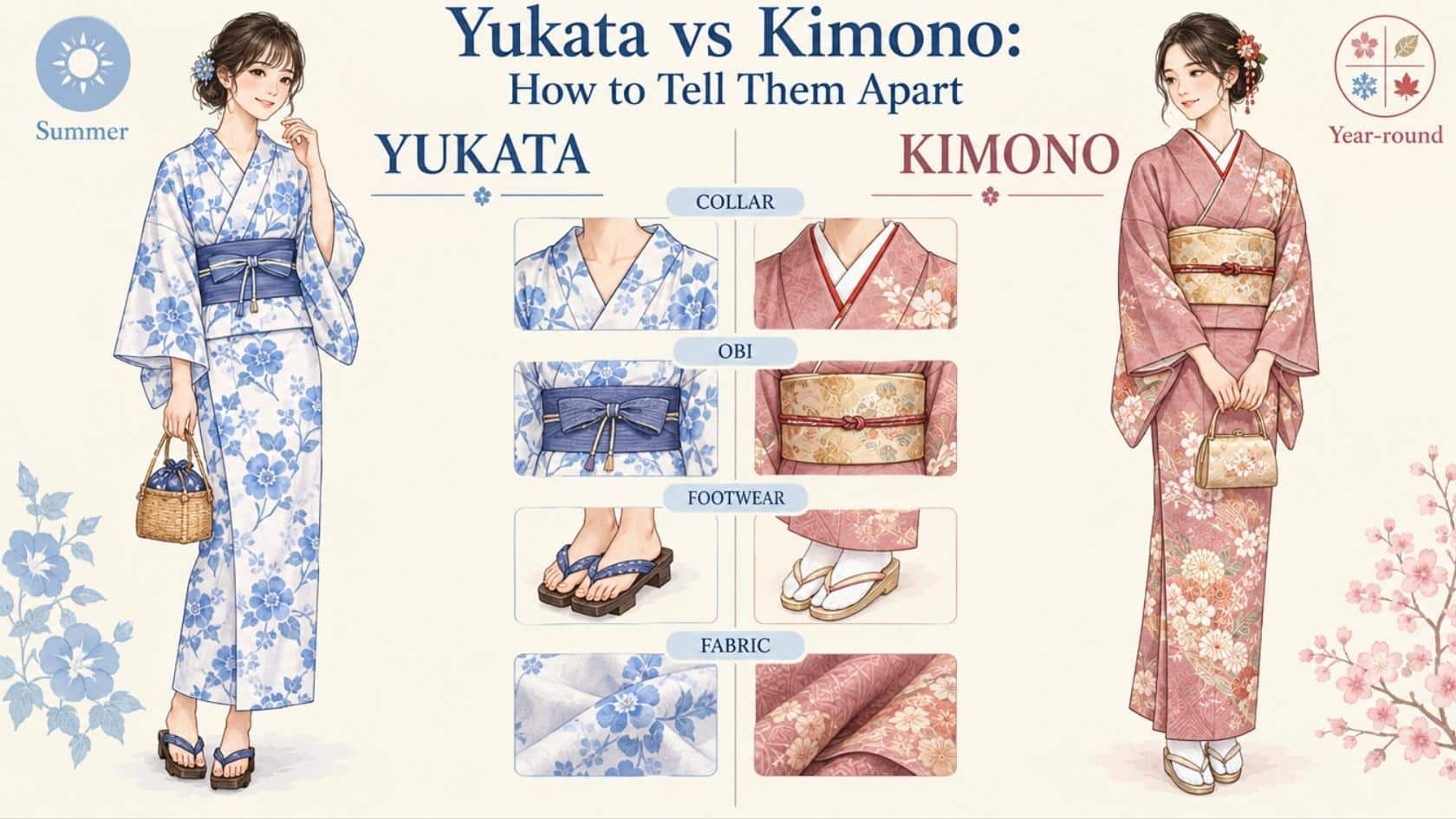
When people-watching in Tokyo, I found the neckline and feet the most useful starting points, as they work throughout the year, unlike judging by fabric weight alone.
-
Collar: An additional white or coloured inner edge suggests a nagajuban and therefore a kimono.
-
Feet: White tabi with zori suggest kimono, while exposed toes in geta suggest yukata.
-
Obi: A narrow bow sash suggests yukata; a broad drum knot suggests kimono.
-
Cooler months: Streetwear from autumn to spring is almost certainly kimono rather than yukata.
-
Midsummer transparency: July–August usumono can look like yukata from a distance, so recheck the neckline.
No isolated sign is definitive. Combine at least two before deciding, and allow for exceptions rather than turning people-watching into an examination.
Should You Wear a Yukata or a Kimono?
I’d start with the occasion, then consider the weather and how often you expect to wear the garment again.
|
Situation |
My suggested choice |
|---|---|
|
Japanese festival or fireworks |
Buy or rent a yukata, with summer rentals approximately ¥2,000–¥5,000 (about $13–$32) |
|
Blossom or autumn-foliage photographs |
Rent a kimono and book ahead, as busy weekends can fill up one month beforehand |
|
Wedding attendance or tea ceremony |
Homongi or suitable iromuji, with black kurotomesode reserved for wedding mothers |
|
Ryokan stay |
Wear the supplied yukata, wrapped left over right even indoors |
|
Summer gathering abroad |
Own a cotton yukata for home washing and independent dressing |
After my Meguro River photographs, I thought about cleaning expenses, dressing assistance, and how infrequently I would wear a kimono in New York.
A cotton yukata resolved all three concerns. I’ve worn mine to outdoor summer gatherings with flat sandals, a small woven handbag, and a loosely arranged low hairstyle, letting the print be the focus to keep getting ready easy.
For a special Japanese occasion or exceptional photographs, I’d rent a kimono. Holiday Travel puts standard women’s packages at approximately ¥3,000–¥6,000 (about $19–$38), generally including an obi, sandals, and bag, with professional dressing taking around 15–20 minutes.
Furisode rentals are approximately ¥10,000–¥20,000 (about $64–$127). Return deadlines vary by shop.
One Asakusa rental lists a final return time of 5:30 PM regardless of your booking time, so check yours when you book and plan photographs around it.
Two Iconic Japanese Looks With Very Different Stories
If I were starting with one garment, I’d choose an indigo-and-white cotton yukata and an extra contrasting hanhaba in butter yellow or pale pink. One garment and two sashes give inexpensive visual variety without requiring a large wardrobe.
My preference is about suitability, not which garment is more beautiful, as I loved wearing kimono beneath the blossoms and would choose one again for a formal Japanese occasion. For sunny leisure anywhere, my cotton yukata earns its place.
Have you worn either, or are you planning your first experience? I’d love to know which recognition clue you found most useful; please share in the comments!
Frequently Asked Questions
Is It Okay for Foreigners to Wear a Kimono or Yukata?
Yes. Visitors commonly wear both in Kyoto and Tokyo, and rental businesses cater to travelers. Respect comes through wearing the garment properly, matching the occasion and treating it as clothing rather than costume. Nationality matters less than your approach. But you do not have to know everything before trying; being willing to learn is a good start.
Which Side Goes on Top When You Wrap a Yukata or Kimono?
Wrap left over right, with the right side nearest your body (the reverse is reserved for the deceased). Viewed from the front, the neckline should resemble a lowercase y, so check before tying the obi, including when wearing a supplied ryokan yukata indoors.
Can Men Wear a Yukata Too?
Yes, and the cut is a little different from women’s versions. A man’s yukata is usually made to his full height, so there is no ohashori, the fold women tuck at the waist. The sleeves are also sewn closed near the body, without the open slit under the arm. Many men tuck a folding fan into the back of the obi, which is a nice summer touch.
Do You Wear a Bra Under a Yukata?
Yes, you can. A wireless or minimizing bra works best because a yukata looks neatest with a straight line from chest to hips, and underwire can push the fabric forward. Japanese stores also sell wasou bras made for kimono and yukata. Under white or pale cotton, I’d choose a skin tone bra, since bright sun can make light fabric slightly sheer.
Is a Western Kimono Robe the Same as a Real Kimono?
No. Western-store kimono robes borrow the wrap shape and broad sleeves, but generally lack traditional construction, an obi, and the associated dressing conventions. They are closer to leisurewear with a stylistic reference. And there is nothing wrong with enjoying one; it simply is not equivalent to a traditional Japanese kimono.