A travel breast pump only helps if the rest of your kit matches how airport screening actually works. Most people learn TSA rules the easy way, at home before packing. Pumping moms sometimes learn the hard way, at the checkpoint with a cooler bag full of milk and a line building up behind them.
The rules for breast pumps and breast milk are more favorable than most people expect. A quiet portable pump for travel still has to follow the same oversized milk routine as everything else in your bag: declare it, pull containers, wait for extra screening. TSA treats pumped milk as a medically necessary liquid, so the steps differ from the standard 3-1-1 quart bag limit, and pump hardware is screened through the checkpoint like other carry-on gear. Knowing where those exceptions start and stop is what changes how you pack.
What TSA Rules Actually Say About Breast Pumps and Breast Milk
Breast pumps may go in carry-on or checked bags and usually go through the X-ray belt with your other electronics. Airlines set carry-on and personal-item limits, including whether a pump can count as an extra item, so confirm with your carrier—not TSA. If you are traveling with milk, carry-on keeps hardware handy and avoids checked-bag heat and delay.
Breast milk, formula, toddler drinks, and related food over 3.4 oz (100 ml) count as medically necessary liquids. They stay outside the quart bag, no baby required, and you must declare them at the start of screening and remove the containers for separate inspection. TSA may test for explosives, but does not introduce anything into the milk. X-ray does not harm milk; refusing X-ray triggers longer alternative screening. Pump motors, flanges, tubing, valves, and chargers are ordinary carry-on items. The 3.4 oz / quart-bag “3-1-1” cap applies to typical toiletries, not to expressed milk or formula in the amounts TSA screens as medically necessary.
Ice packs, freezer packs, and gel packs for cooling are allowed even without milk in the same bag. Fully frozen packs usually clear screening fastest. Partially melted or slushy medically necessary gel packs are still allowed in reasonable quantities; they get the same oversized-liquid inspection as milk, not the 3.4 oz discard rule.
Reread the live Breast milk and Breast pump pages on TSA.gov before each trip.
Pre-Flight Packing for A Travel Breast Pump
The security checkpoint is not the place to figure out what is in which bag. How you pack before you leave for the airport shapes how fast you move through screening.
A few things help in practice. Keep the pump hardware, accessories, and milk storage bags in separate layers or compartments so you can pull the milk containers out without emptying the bag. TSA will ask you to remove the breast milk from your carry-on for separate screening. If it is buried under flanges, cables, and a charger, that takes longer than it should.
For breast pump international travel, check the input voltage printed on the charger brick, not just the plug shape. Most current pump chargers are dual-voltage 100–240V(check the label on your charger brick), so you only need a plug adapter for EU, UK, or Asian wall outlets. If the label shows 110–120V only, you need a step-down transformer in higher-voltage countries, not just a plug adapter—otherwise the brick can fail or overheat. Pack plug adapters that match the countries in your itinerary.
Battery life is one of the bigger practical factors for any trip longer than a few hours. Airport terminals sometimes have outlets near gates, but they are not guaranteed. In the cabin, seat AC outlets (when installed) on U.S. routes are usually nominal 110V and may share a limit across the row; USB-A ports on older seats are often capped at roughly 5–12W, enough to trickle-charge a phone but not always enough to recharge a pump between sessions. USB-C with power delivery varies by airline and aircraft, so do not count on seat power unless you already know that airline’s cabins. A pump with its own battery or a charging case sidesteps that guesswork.
Getting Through the Security Checkpoint
Declaring breast milk before screening starts is the step that most TSA guidance emphasizes. Tell the officer at the beginning that you are carrying breast milk or formula over 3.4 oz. That lets the officer prepare for a separate screening step rather than flagging it mid-scan as a surprise.
Remove the breast milk containers from your carry-on when you are unpacking your bag for the belt. They will be screened separately. If the officer uses a liquid bottle scanner or swabs for trace detection, both are standard procedures and do not affect the milk.
For the pump itself, it goes through the X-ray with your other electronics. There is no standard requirement to remove it the way laptops get pulled from bags, but individual checkpoints may ask. Leaving it loosely accessible rather than packed at the bottom saves time if they do.
Ice packs are the piece that catches some travelers off guard. They can still clear the checkpoint when partially thawed, but officers may run the same oversized-liquid inspection used for breast milk, which adds time. If your schedule allows, keeping packs frozen solid usually shortens the stop at the belt.
Pumping and Storing Milk During the Flight
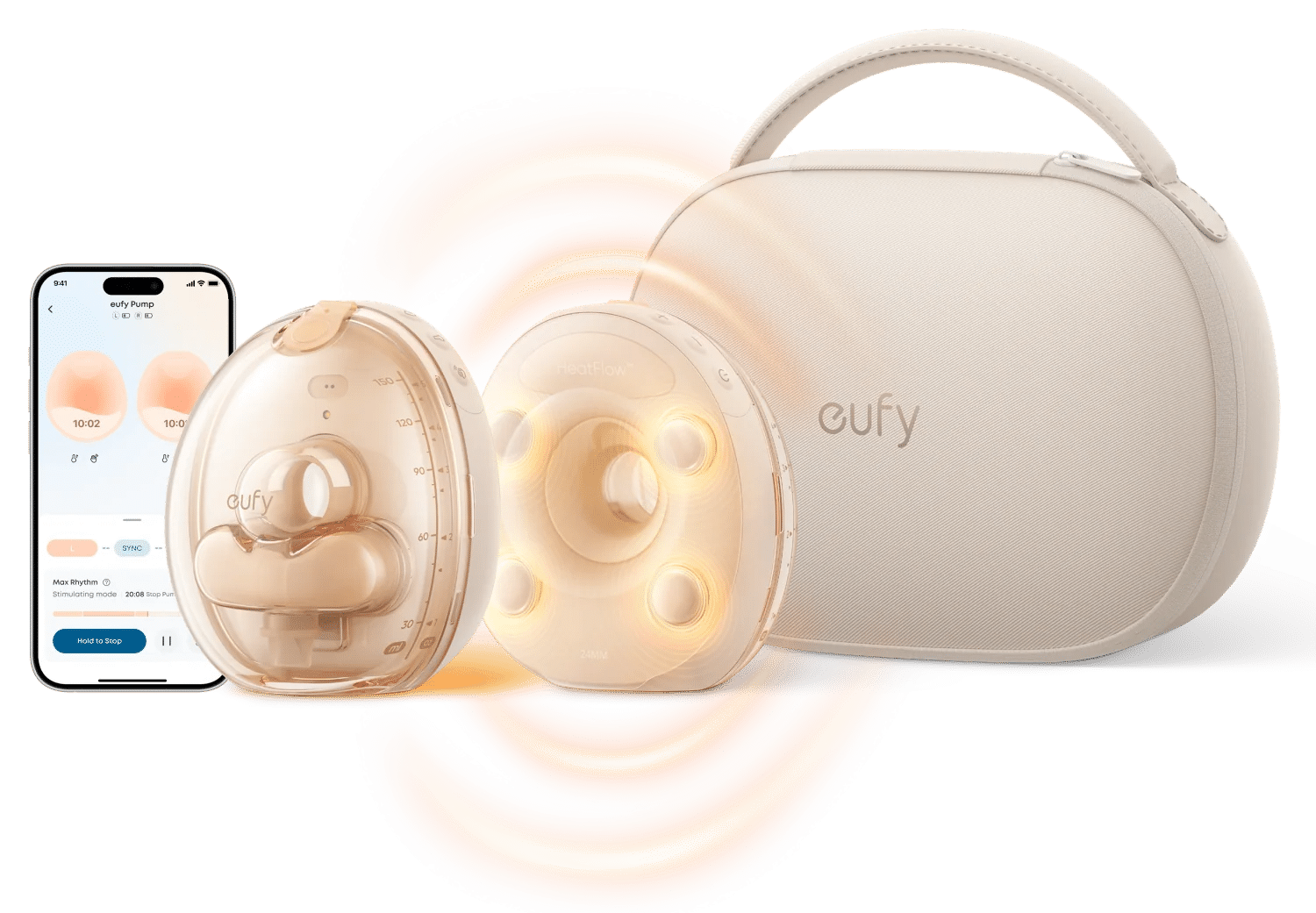
Pumping on a plane is easier with a wearable pump than with a traditional one. A wearable sits inside the bra and runs without visible tubes or a dangling collection bottle. A nursing cover or small travel blanket at your seat adds privacy without hiding your seatbelt when the crew needs to see it buckled for taxi, takeoff, and landing.
For a traditional pump, the lavatory is the fallback people mention; it is tight, noisy, and you still need to manage turbulence and occupied-light etiquette (keep sessions short, wipe surfaces, stow bags so nothing blocks the call button). Many moms still prefer the seat with a cover when the cabin is dim, and neighbors are wearing headphones.
If you are already planning around that seat-first wearable approach, the eufy Wearable Breast Pump S2 Pro keeps noise near 46 dB and stays in-bra under a cover, so you are less likely to end up in the lavatory. The wireless charging case often covers about a week away for typical session counts before you need wall power, which takes pressure off the weak seat USB on long legs. HeatFlow warming, VibraPump massage, and suction up to about 300 mmHg across seven levels help when the cabin is cold and dry, and letdown is sluggish.
For storing milk on a long-haul flight, most flight attendants will provide a cup of ice on request. That buys a few hours for a cooler bag. Keep the cooler at your feet so it stays cooler than in an overhead bin, label pouches with time and volume if crew or security need a quick explanation, and ask early whether they can refresh ice on long legs—galley fridge space for personal milk depends on the carrier. A portable milk cooler and warmer in your carry-on can cover the stretch between those ice refills and a warm bottle on arrival without depending on crew fridge access. If you are flying more than eight hours and the milk volume is significant, this is worth planning around rather than assuming.
Arrival and International Travel Considerations
Breast pump TSA rules for airplanes apply at departure from US airports. Arriving at a foreign airport means going through that country’s security and customs procedures, which vary.
In most EU countries and the UK, breast milk follows similar medically necessary liquid exceptions. The declared quantity and screening process may differ from TSA procedures, and officers in some airports are less familiar with the exception than U.S. TSA officers. Having a printout or screenshot of the local authority’s policy can move things along if a question comes up.
In some Asian airports, regulations are stricter about undeclared quantities of liquid. At customs arrival, declaring breast milk when the volume is substantial is safer than assuming it passes through under the medical exception without notice.
Hotel cleaning logistics are a separate planning step. Sterilizing pump parts requires access to a pot and stove, which most hotels do not have. Microwave steam bags are a lighter alternative that works in any room with a microwave. Wipes can cover a session in transit, but should not substitute for a full wash and sterilization over multiple consecutive uses.
Conclusion
Breast pump TSA rules for airplanes give traveling moms more room than most assume. TSA allows pumps in carry-on or checked bags. Breast milk over 3.4 oz can stay outside the quart bag as a medically necessary liquid, and ice packs for cooling are allowed in carry-on, including when partially melted, though softer packs often mean longer screening. None of that requires special paperwork with TSA in advance. Declare oversized milk at the start of screening and keep containers within easy reach.
The harder part is usually not the rules but the logistics: battery life, carrying enough flanges, and keeping milk at the right temperature on a connection. Choosing a pump designed for portability before you leave makes those problems smaller. If you are comparing options for a trip, the eufy breast pump collection includes wearable models with specs on battery, suction, and noise level that matter differently in a plane seat than they do at home.