There is a particular dread that follows a fall in public, and it is not entirely about the injury. It is the suspicion that you will be blamed for what you were wearing. Anyone who walks this city in heels, in leather-soled boots, in anything chosen for how it looks has had the thought while sitting on a wet lobby floor. The suspicion is not imaginary, because footwear does come up. What it does to a claim, though, is far more limited than most people assume.
Your Shoes Are Evidence, Not a Verdict
New York reduces, it does not bar
This is the part worth knowing before anything else. New York applies pure comparative fault to premises cases. If a court finds you partly responsible for your own fall, your recovery is reduced by your percentage of responsibility rather than eliminated. There is no threshold at which your share of the blame ends the case. Someone found substantially at fault still recovers the remainder.
The 2026 change you may have heard about does not reach this
New York amended its comparative fault rules in 2026 to create a bar in certain cases, and the change has been widely discussed. Read closely, it applies to personal injury actions subject to the no-fault article of the Insurance Law, which is to say motor vehicle cases. Premises claims, including slip and falls, remain under the pure comparative rule.
Which makes the practical question narrower
The question in a footwear dispute is not whether you can recover. It is what percentage, if any, gets assigned to your shoes. That is a much smaller fight than people fear, and it is one that turns on specifics rather than on taste.
What the Defense Actually Argues
Heel height and contact area
The argument is that a narrow heel concentrates weight on a small contact patch and reduces stability. It is a real physical point, and it is also one that proves less than it sounds, because millions of people navigate the same surfaces in the same shoes every day without falling.
Sole condition
Worn smooth soles are a stronger argument than heel height, because wear is measurable and visible. A sole polished flat tells a different story from a new one with intact tread.
Attention
Often the real argument is not about the shoe at all. It is that you were on your phone, carrying bags, or moving quickly. Footwear simply makes a convenient frame for it.
What the Property Owner Still Owes
Walking surfaces have measurable standards
Slip resistance is not a matter of opinion. Federal accessibility guidance on floor and ground surfaces addresses stable, firm and slip-resistant surfaces, and the principle behind it is that walking surfaces are expected to perform for ordinary people in ordinary shoes.
Workplaces are held to a written rule
Where footwear hazards are genuinely part of a job, the obligation runs to the employer rather than the worker. Federal rules require employers to ensure that protective footwear is used where there is a danger of foot injuries. A restaurant or warehouse that requires slip-resistant shoes is responding to that, not to fashion.
A floor that fails is a floor that fails
A surface that was unmaintained, unmarked, freshly polished without warning or wet with no mat is a defective condition regardless of what the person crossing it had on their feet. Footwear can share responsibility. It does not transfer it.
The Shoe Itself Matters More Than You Think
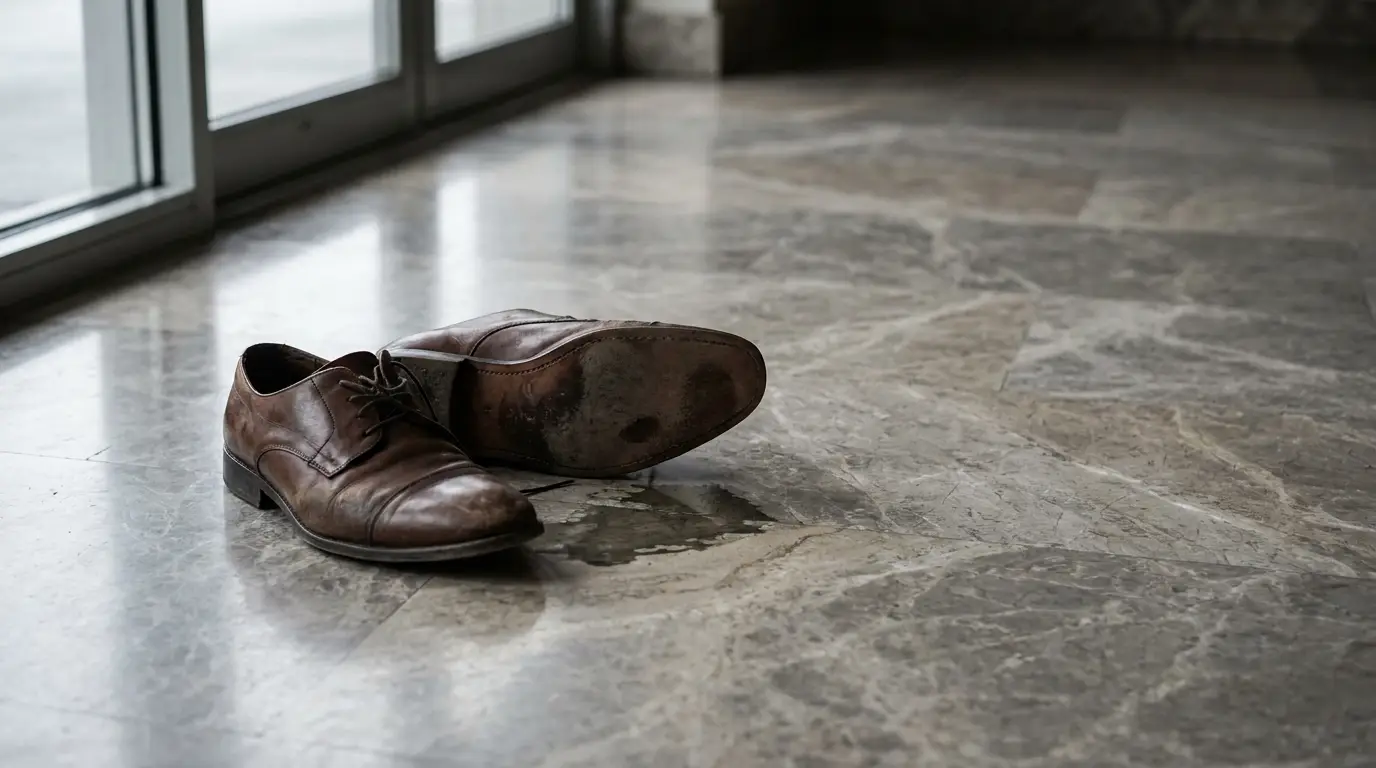
Keep them, exactly as they are
Do not clean them. Do not repair them. The substance on the sole may be the clearest proof of what was on that floor, and a scuff pattern can show how the foot actually moved. Put them in a bag and leave them.
Photograph the soles
Photograph both soles with something for scale on the day it happens. Shoes continue to wear, and a photograph taken months later shows a different shoe than the one you fell in.
Replacing them quietly undercuts you
It is a natural instinct after a fall, and it removes the single best piece of evidence you control.
Dressing for a City You Walk Through
Transitions are where this bites: polished lobby marble after rain, painted metal subway stairs, a tiled entry that ends in worn terrazzo. None of that is an argument for giving up the shoes you like. It is an argument for knowing which stretches deserve attention, and for the very ordinary practice of carrying a change of footwear when the day involves distance or weather. Anyone already hurt and worried that their shoes have ruined the claim is usually better served checking that assumption with local attorneys who handle slip and fall cases than abandoning it on their own.
What Actually Decides These Cases
Across these disputes, the deciding facts are rarely about the person who fell. They are about the floor: whether it was maintained, whether the hazard had been there long enough that someone should have addressed it, and whether anything warned the person crossing it. Footwear enters at the margin, adjusting a percentage. It is worth refusing to treat that margin as the whole case, which is precisely what the people on the other side would prefer you do.