

Carry on vs personal item confusion is a common packing problem. You pack a bag, call it a carry-on, then learn at the gate it belongs under the seat instead.
Airlines split cabin baggage into two categories with different size limits and fees. Get it wrong, and you risk a surprise charge or a bag pulled at the gate.
A carry-on is the larger bag stored in the overhead bin. A personal item is the smaller bag that fits under the seat. The differences come down to size, storage location, and airline rules.
What separates the two, how airlines enforce the rules, and what to pack in each bag can help you choose the right option before reaching the gate.
What Is a Carry-On Bag?
A carry-on bag is the piece of luggage that goes into the overhead bin above your seat, unlike a personal item, which fits under the seat in front of you.
Carry-on size limits vary by airline and sometimes by aircraft type. Major U.S. carriers often use around 22 x 14 x 9 inches, but always confirm your specific airline’s current policy before packing.
Typical carry-on bags include small rolling suitcases, duffel bags, and larger travel backpacks. If a bag fits the airline’s size limit without being stuffed into an oversized shape, it usually qualifies.
Most full-service airlines include one free carry-on with a standard fare. Budget carriers often charge extra for it, while personal items stay free; a detail that changes how travelers pack
What Is a Personal Item?
A personal item is the smaller bag that fits under the seat in front of you. Airlines generally limit personal items to around 18 x 14 x 8 inches, though exact numbers vary by carrier.
A backpack can count as a personal item, but only if it stays within that smaller size range. A large travel backpack built for a week of clothes usually counts as a carry-on instead.
Size decides the category, not the type of bag. Common personal items include purses, laptop bags, small backpacks, and totes, as long as they fit the airline’s limit.
Nearly every airline lets you bring one personal item for free, even on fares that charge extra for a carry-on bag placed in the overhead bin.
Difference Between Carry-On and Personal Item
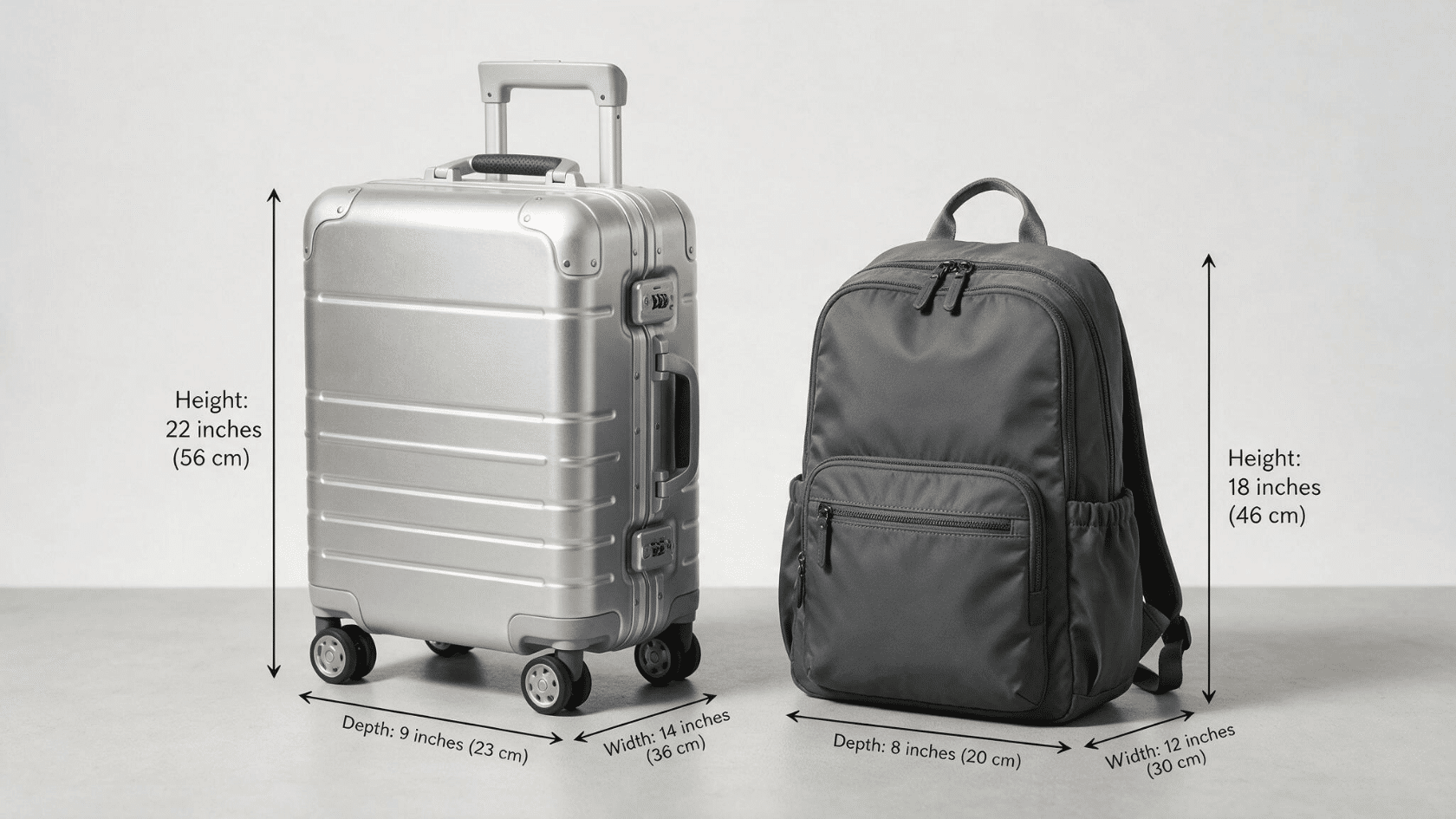
The difference between a carry-on and a personal item comes down to size, weight, storage, contents, cost, and how strictly each is enforced.
This overview table now includes every factor covered in this section, so the table and the explanations below it match one another completely.
| Factor | Carry-On | Personal Item |
| Size Limit | ~22 x 14 x 9 in (56 x 36 x 23 cm) | ~18 x 14 x 8 in (45 x 35 x 20 cm) |
| Weight Limit | 7 to 10 kg (15 to 22 lbs) on most non-US airlines; many US carriers set no fixed limit | Usually folded into the carry-on weight limit, or not weighed at all |
| Stow Location | Overhead bin | Under the seat in front of you |
| Common Bag Types | Small suitcase, duffel bag, roller bag, weekend bag | Small backpack, tote, laptop bag, small handbag |
| Typical Contents | Clothes, shoes, toiletries | Passport, phone, medication |
| Cost | Sometimes charged extra (budget airlines) | Almost always free |
| Enforcement | Checked against gate sizers, stricter | Rarely measured closely |
Size is the most obvious split, but stow location matters just as much. A personal item needs to stay within reach during the flight, while a carry-on can wait in the bin until landing.
1. Size and Limits
Size is the first and most obvious way airlines tell these two bags apart, and it’s usually the number that decides which category your bag falls into before anything else does.
- Personal Item: Must fit under the seat in front of you. The common max size sits around 18 x 14 x 8 inches. Purses, laptop bags, and small backpacks are typical examples.
- Carry-on Bag: Must fit in the overhead bin. The common max size runs closer to 22 x 14 x 9 inches. Small rolling suitcases and duffel bags are typical examples.
Design tip: A bag’s advertised size is rarely its true size once it’s packed. Just like a jacket looks different on the hanger than it does buttoned up, measure your bag stuffed the way you’d actually travel with it, including wheels and handles.
2. Weight Limits
Weight is where US and non-US carriers genuinely diverge, so it deserves its own explanation rather than a single line in a table.
- Carry-on Bag: American, Delta, and United publish no firm weight limit; the bag just has to fit and be liftable into the bin. European and budget carriers are stricter, typically capping carry-ons at 7-10 kg and weighing bags at the gate.
- Personal Item: Rarely weighed on its own, since its weight is usually absorbed into the combined cabin allowance instead of tracked separately.
Packing tip: Put your heaviest items in the personal item only if your airline doesn’t weigh it separately, since a mistake here can bump your whole allowance into an overweight fee.
3. Placement on the Plane
Where a bag physically lives during the flight matters just as much as its dimensions, since one of these two bags needs to stay within arm’s reach and the other can wait until landing.
- Personal Item: Goes under the seat in front of you. Your feet share that space with it for the whole flight.
- Carry-on Bag: Goes in the overhead bin above your seat. You lift it up once you’ve boarded and don’t touch it again until you land.
This is really the core difference between carry-on and personal item bags: one travels with you in your immediate space, and the other gets tucked away out of reach.
4. Common Bag Types and Contents
Airlines don’t regulate bag style, only size, but certain shapes naturally sort themselves into each category.
- Carry-on Bag: Usually a small suitcase, duffel bag, roller bag, or weekend bag built to hold several days of wardrobe essentials, shoes, and toiletries.
- Personal Item: Usually a tote, laptop bag, small backpack, or handbag with a single compartment for your passport, phone, and medication.
Keep the logic simple: Anything you’d pack for the trip goes in the carry-on, and anything you’d reach for mid-flight goes in the personal item.
5. Ticket Rules and Cost
Cost is where the two bags split the most, and it’s the detail that catches people off guard most often, especially on airlines built around low base fares.
- Personal Item: Included free with almost every ticket sold, including basic economy.
- Carry-on Bag: Free with standard economy or higher on most full-service airlines. Basic economy tickets often charge a separate fee for this bag, and a handful of budget carriers charge for it on every fare.
Style tip: Think of your personal item the way you’d think of an everyday tote you never leave the house without. It should hold what you’ll actually reach for during the flight, not just whatever didn’t fit in the suitcase.
6. Enforcement at the Gate
Enforcement is the factor travelers underestimate most, and it varies more by airline than any other line in the table above.
- Carry-on Bag: Ultra-low-cost carriers like Ryanair and Frontier use physical sizer frames at nearly every gate and measure it closely against the published limit.
- Personal Item: Legacy US carriers like American and Delta are comparatively relaxed here, rarely pulling it out for a formal size check unless it looks clearly oversized.
Enforcement tip: A bag that clears one airline’s gate can still get flagged at another, so pack to the strictest airline on your itinerary, not the most lenient one.
Airline-Specific Size Limits
Airlines don’t share a universal rulebook for carry-on vs personal-item sizing, so a bag that clears one airline’s sizer can get flagged on another.
The figures below were checked against each airline’s own baggage pages in August 2026; the airline name in each row links directly to that source so you can confirm the current number yourself before you fly.
| One update worth knowing before you plan around this table: Spirit Airlines ceased all operations in May 2026 after a failed restructuring effort, so it’s no longer flying and has been left out of the chart below. Frontier now serves many of the same budget-focused routes. |
| Airline | Carry-On Size | Personal Item Size | Carry-On Fee |
| American Airlines | 22 x 14 x 9 in (56 x 36 x 23 cm) | 18 x 14 x 8 in (45 x 35 x 20 cm) | Free on every fare |
| Delta | 22 x 14 x 9 in (56 x 35 x 23 cm) | No official size published; commonly treated as ~18 x 14 x 8 in | Free on every domestic fare |
| United | 22 x 14 x 9 in (56 x 35 x 23 cm) | 17 x 10 x 9 in (43 x 25 x 22 cm) | Free on Economy and above |
| Southwest | 24 x 16 x 10 in | 16.25 x 13.5 x 8 in | Free on every fare |
| Frontier | 24 x 16 x 10 in, up to 35 lb (paid add-on) | 14 x 18 x 8 in (free with every fare) | Paid on every fare, roughly $39 to $99 depending on when you buy it |
| EasyJet | 56 x 45 x 25 cm (paid, or included with certain fares/perks) | 45 x 36 x 20 cm, up to 15 kg (free) | Large cabin bag requires Up Front, Extra Legroom, FLEXI, or easyJet Plus |
| Turkish Airlines | 55 x 40 x 23 cm, 8 kg (2 bags in Business) | 40 x 30 x 15 cm, up to 4 kg | Free on all fares |
| British Airways | 56 x 45 x 25 cm | 40 x 30 x 15 cm | Free, even on the Hand Baggage Only (Basic) fare |
| Air France | 55 x 35 x 25 cm | 40 x 30 x 15 cm | Included on most fares; some Economy fares include the small bag only |
Note: These numbers reflect currently published policies, but airlines update baggage rules often enough that it’s worth confirming the current limits on the airline’s own site before you pack for a trip.
What to Pack in Carry-On and Personal Bags
Splitting your items the right way keeps both bags easy to use and easy to move through security without a scramble.
In your carry-on: Pick a bag that fits your airline’s carry-on limit, then build around it with intention rather than just filling space until the zipper struggles to close.
- Roll casual clothes to save space and cut down on wrinkles
- Fold structured outerwear like blazers so they hold their shape
- Use packing cubes or compression bags to stay organized
- Put heavier items near the bottom, close to the wheels
- Keep anything you’ll need mid-trip near the top
- Store laptops and chargers in their own compartment
- Keep liquids under 3.4 ounces in a clear bag
Advise: Fold structured pieces the same way I’d fold them for a garment rack, seams aligned, nothing crushed against a hard edge. It’s a small habit, but it’s the difference between a jacket that steps off the plane ready to wear and one that needs an hour with a steamer.
In your personal item: Your personal item travels with you during the flight, so pack it for comfort and quick access rather than by destination.
- Keep your passport and boarding pass in an easy-to-reach pocket
- Store your wallet, keys, and jewelry in a zippered pocket
- Pack medication somewhere you can grab quickly
- Use a padded sleeve for a laptop and a pouch for cables
- Add headphones, a book, or a travel pillow if there’s room
- Pack a few snacks and an empty water bottle
- Keep liquids and electronics easy to remove for screening
- Keep sunglasses in a hard case so they don’t scratch
Oversized, overweight, assuming free personal items, and carrying extra bags are common mistakes that lead to gate checks, fees, and delays when traveling with a carry-on.
Why Avoid a Black Suitcase?
You should avoid a black suitcase mainly because black is the most common luggage color, and lookalike bags create real problems at the airport.
Since nearly half of all checked bags are black, yours can blend into dozens of nearly identical cases on a crowded carousel, making it harder to spot quickly and easier to grab by mistake.
Choosing a brighter color, a patterned bag, or a bold luggage strap makes your suitcase instantly recognizable and reduces these risks.
What Is Forbidden in Both Bags?
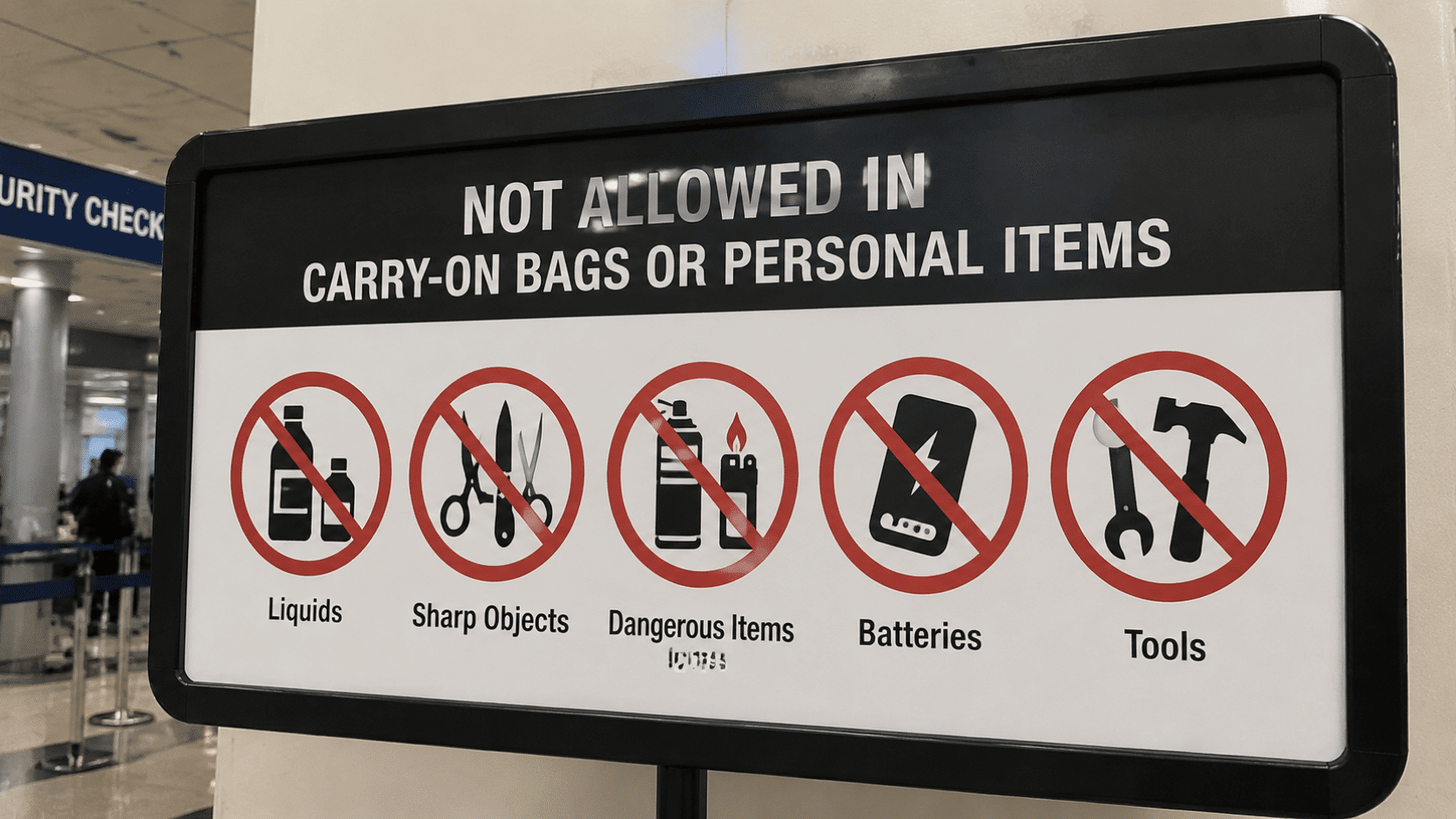
A handful of restrictions apply no matter which bag an item goes in, and knowing them ahead of time saves a conversation with a TSA officer you’d rather not have.
- Liquids at the airport are capped at 3.4 ounces per container unless they’re packed in a checked bag instead.
- Sharp objects like knives, box cutters, and long scissors aren’t allowed in the cabin at all.
- Dangerous items, including explosives, flammable liquids, and self-defense sprays, are off-limits in any carry-on space.
- Batteries need attention too: power banks and any device carrying more than 100 watt-hours have to travel with you rather than in checked luggage.
- Larger tools, like wrenches or hammers, need to be checked.
These rules shift slightly depending on the airline and the country you’re flying from or into, so it’s worth a quick check before you pack anything in a gray area.
Final Takeaway
The difference between carry-on and personal item bags comes down to two things above all else: size and where the bag rides on the plane.
A personal item fits under the seat and stays close to you. A carry-on goes overhead and holds what you won’t need again until you land.
Exact numbers shift by airline, and basic economy fares sometimes limit you to a personal item alone, so checking your airline’s current policy before your trip is still the simplest way to avoid a fee you didn’t plan for.
Once you understand how a carry on vs personal item split actually works, packing for a flight stops being a guessing game.
Pack your personal item with what you’ll need in reach, let your carry-on hold everything else, and you’ll board your next flight without a single surprise at the gate.
Frequently Asked Questions
Is a Backpack Considered a Personal Item or Carry-On?
It depends on size, not the bag type. A backpack under about 18 x 14 x 8 inches counts as a personal item; anything larger usually counts as a carry-on.
What Is The 3-3-3 Rule For Carry-On?
The 3-3-3 rule is a packing method, not an airline size rule. It means limiting yourself to three outfits, three pairs of shoes, and three accessories for any trip taken.
What Happens If My Carry-on is 1 Inch Too Big?
If your carry-on is 1 inch too big, it will likely go unnoticed on major legacy airlines. However, strict budget or international carriers may require you to gate-check the bag and charge additional fees.