


Half the supplement aisle has gone purple with beet root juices and derivatives. Cyclists chug it before a climb. Your uncle started drinking it after his last check-up. What’s the reason behind this hype?
Beets are loaded with dietary nitrate, which your body converts into nitric oxide, the compound that signals your blood vessels to relax and dilate: wider vessels, easier blood flow, better delivery of oxygen to the places that need it.
In this guide, we’ll discuss the science behind how beets increase nitric oxide and improve blood flow, review several supplement formats available on the market, and explain how to choose the right one.
What Is Nitric Oxide and Why Does the Body Need It?
Nitric oxide is a tiny molecule your body makes naturally in two ways. One uses an enzyme and the amino acid arginine, and needs oxygen to run. The other converts dietary nitrate from vegetables like beets.
Professor Andrew M. Jones of the University of Exeter, who has spent his career researching both pathways, describes the nitrate conversion route as the most widely used in areas with low oxygen availability. Your body keeps nitrate around like a spare fuel tank and taps it when the main engine (the enzyme route) can’t run.
Now, why does your body need nitric oxide?
Think of your circulatory system as a network of hoses. Nitric oxide is the hand that loosens the clamp. Its main job is to signal your blood vessels to relax and dilate, a process called vasodilation. Wider vessels mean less resistance in blood flow.
As a result, oxygen and nutrients reach working muscle faster. Your heart pushes blood around with less strain. The compound is also associated with increased stamina, faster recovery, and improved heart health.
How Beet Root Raises Nitric Oxide Levels
Beets are among the richest dietary sources of nitrate, which the body converts to nitric oxide in three stages. We call it the Three Gates because each stage is a gate that must stay open for the next one to work.
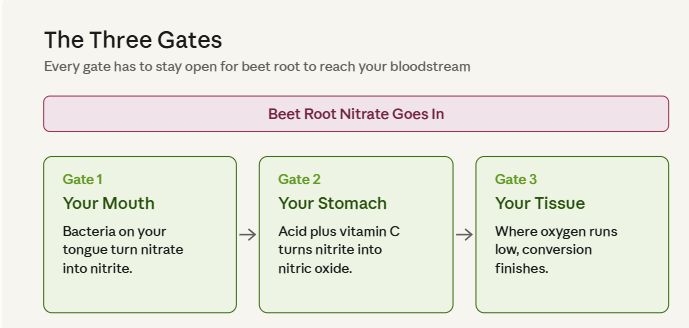
Gate 1: Your mouth. You eat beets. Nitrate comes into contact with your saliva, and bacteria living on the back of your tongue reduce it to nitrite.
Gate 2: Your stomach. You swallow that nitrite. Stomach acid, aided by vitamin C, converts it into nitric oxide.
Gate 3: Your tissue. Nitrite that remains in circulation converts to nitric oxide in tissues where oxygen is low.
Here’s the part nobody warns you about. Antibacterial mouthwash kills the tongue bacteria that run Gate 1. In a study from Queen Mary University of London, seven days of chlorhexidine mouthwash cut oral nitrite production by 90% and blood nitrite by 25% in 19 healthy volunteers, and their blood pressure readings shifted by 2 to 3.5 mmHg within a single day of starting.
So if you’re taking beets for circulation, keep the strong antibacterial rinse away from your beet window. Brushing and flossing are fine. Scrubbing your tongue with a bactericidal rinse right before your dose works against you.
The Circulation and Heart-Health Connection
Better nitric oxide production means better blood flow, and it shows up in the places you’d expect. Oxygen delivery to your brain, heart, and muscles gets more efficient. Cells use that oxygen better during physical work. Athletes report steadier stamina and less of the mid-session drag.
There’s a blood pressure angle too. Relaxed, wider vessels mean less resistance in the circulatory system, which is why dietary nitrate is studied so extensively for its potential to support healthy blood pressure levels already within the normal range.
Wait, Aren’t Nitrates the Bad Stuff in Bacon?
Fair question. The concern stems from N-nitroso compounds, which form when nitrite reacts with protein fragments and heme iron during the cooking and digestion of cured meat. Vegetables come with a built-in brake.
As researchers writing in The Conversation explain, plant foods carry vitamin C, vitamin E, and polyphenols that suppress N-nitroso compounds from forming in your gut, and they lack the protein fragments that fuel the reaction in the first place.
Other Ways to Support Nitric Oxide Naturally
Besides beet supplements, there are a few other ways to support nitric oxide production in your body, and one of them is probably in your bathroom cabinet right now.
- Eat Your Greens: Rocket, spinach, lettuce, and celery are rich in nitrates. A big bowl of salad with these sources helps most.
- Add vitamin C: Ascorbate converts nitrite to nitric oxide quickly in acidic conditions like your stomach, and barely at all at blood pH. That’s why citrus alongside your greens is a smart pairing, and why vitamin C shows up often in beet formulas.
- Move: Regular exercise keeps the lining of your blood vessels responsive.
- Sleep: Vessel function tracks with rest.
Getting Beet Root’s Benefits Through Supplementation
You can get nitrate from whole beets, juice, powder, or gummies. Each format trades something away, so pick the one you can actually stick with.
|
Format |
Nitrate consistency |
Sugar |
Effort |
Portable |
|
Whole beets |
Varies with soil, season, storage |
Natural, whole food |
Peeling, roasting, stained hands |
No |
|
Fresh juice |
Strong, but drops as it sits |
High per glass |
Juicer and cleanup |
No |
|
Powder |
Standardized per scoop |
Usually low |
Shaker, water, gritty texture |
Somewhat |
|
Gummies |
Standardized per serving |
Small added amount |
Chew and go |
Yes |
Whole beets and fresh juice are excellent when you have the time. Most people don’t, on most days! Easy grab-and-go supplements like Natrava BEETS+ Gummies fit that sort of lifestyle. The formula pairs beet root extract with grape seed extract and vitamin C.
Each bag holds 50 cherry-berry gummies for 25 servings and contains no stimulants. As a responsible buyer, you can also check what’s behind the label. Natrava publishes a certificate of analysis for the gummies on its quality page.
The Bottom Line
Beets carry dietary nitrate. Bacteria in your mouth turn it into nitrite, stomach acid and vitamin C turn that into nitric oxide, and nitric oxide tells your vessels to relax so blood moves more freely. Whole beets, juice, powder, and gummies all serve the same purpose. The best format is the one you can stay consistent with, considering your lifestyle choices.
Gummies work for busy professionals who want grab-and-go options, and young students who might despise the earthy taste of raw beet. Natrava’s BEETS gummies require 2 servings a day, take 2 to 3 hours to peak, and have a low, healthy amount of sugar.
Keep antibacterial mouthwash away when taking those edibles, and stick to a schedule for better results.
FAQs
Does beet root actually lower blood pressure?
Beet root is studied for its potential to support healthy blood pressure levels already within the normal range through the nitric oxide pathway. It relaxes and dilates the vessels, reducing resistance in the system. Beet root is a food, and it does not treat or manage high blood pressure. Talk to your doctor about any diagnosed condition.
How long does it take to notice a difference?
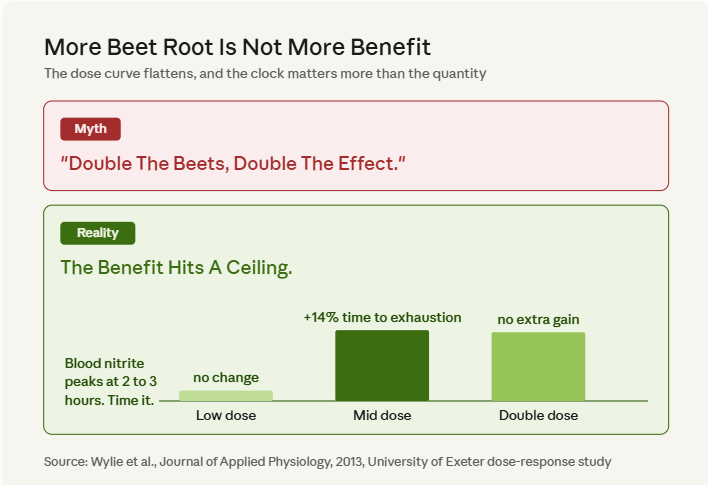
Blood nitrite peaks around two to three hours after a dose, so time it ahead of a workout or a walk. Circulation and energy benefits build with consistent daily use, so one serving won’t tell you much. Most people give it two to four weeks before judging.
Can I take beet root gummies every day?
Daily use is how beet root is typically studied and taken, since the nitrate pathway responds to consistency. Follow the serving size on the label. If you are pregnant, nursing, taking prescription medication, or managing a health condition, check with your doctor first.
Do beet root gummies stain as beet juice does?
Gummies are a single-serve package, so there’s no purple splash zone on your counter or in your blender. Beet pigment can still tint your teeth briefly if you hold it in your mouth, and a sip of water sorts that out.
Why is my pee pink after eating beets?
It’s called beeturia, and per clinical literature, it affects 10% to 14% of people. Betalain pigments pass through without breaking down. It’s harmless and clears up on its own. See a doctor if pink urine shows up when you haven’t eaten beets.
Do beet supplements work if I use mouthwash?
Antibacterial mouthwash kills the tongue bacteria that convert nitrate to nitrite, the first step in the conversion of nitrate to nitric oxide. Research shows this sharply reduces oral nitrite production. Keep strong antibacterial rinses away from your beet dose, and brush and floss as normal.
Disclaimer: This article is for general information only and is not a substitute for medical advice. If you are pregnant, nursing, have a medical condition, or take prescription drugs, consult your physician before using any product mentioned here.